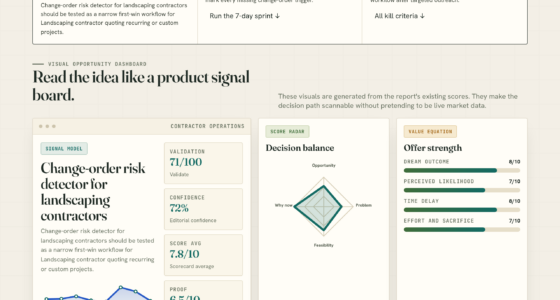
📊 Full opportunity report: Preparing A Logistics Environment For Effective Citizens’ Assembly Management on IdeaNavigator AI — validation score, market gap, and execution plan.

Get the latest gadgets delivered free — and shop member deals
- Fast, free delivery on millions of items
- Access to Prime Big Deal Days deals on October 6–7
- Prime Video, Amazon Music and more included
TL;DR
A civic-dialogue nonprofit is testing a new logistics workspace designed to streamline the planning and management of citizens’ assemblies. The tool aims to replace manual processes, enabling nonprofits to scale deliberative democracy programs more effectively.
A civic-dialogue nonprofit is currently testing a new logistics workspace designed to automate key aspects of citizens’ assembly management, including participant recruitment, demographic balancing, facilitator scheduling, and reporting. This development addresses a critical need as increasing numbers of local governments and funders commission deliberative forums, but nonprofits lack scalable tools to manage these events efficiently.
The proposed logistics workspace is a minimal viable product (MVP) that guides coordinators through a workflow from participant roster creation to scheduling and final reporting. It aims to streamline processes that are currently handled manually via spreadsheets and email, which hampers scalability. The nonprofit plans to validate the tool by recruiting five coordinators planning upcoming forums, then comparing their manual workflows with the new platform to assess usability and willingness to pay for the service.
This initiative is driven by the rising demand for citizens’ assemblies and deliberative panels, often funded by local governments or philanthropic organizations. However, small nonprofits delivering these programs face operational challenges due to their reliance on ad hoc systems, limiting their capacity to expand or handle larger cohorts efficiently. The new platform could fill a significant market gap, providing a subscription-based solution tailored to civic engagement programs.
Potential Impact on Civic Engagement Scaling
If successful, the logistics workspace could significantly improve the operational capacity of nonprofits running citizens’ assemblies, enabling them to manage larger and more complex programs without proportional increases in administrative workload. This could lead to broader adoption of deliberative democracy practices at the local level, fostering more inclusive and representative decision-making processes. Additionally, the platform’s scalability might attract more funders and governments to support citizens’ assemblies, knowing there are effective tools to manage logistics at scale.
project management software for civic engagement
As an affiliate, we earn on qualifying purchases.
As an affiliate, we earn on qualifying purchases.
Growing Demand for Scalable Citizens’ Assembly Tools
Over the past few years, there has been a marked increase in the number of citizens’ assemblies and deliberative panels organized by local governments and civic organizations worldwide. This trend is driven by a desire to enhance democratic legitimacy and foster more inclusive participation. However, the operational side remains largely manual for small nonprofits, which often rely on spreadsheets and email chains. The need for purpose-built logistics tools has become urgent to enable these organizations to scale their efforts effectively, especially as funding opportunities expand.
Initial efforts have focused on developing digital platforms for participant recruitment and engagement, but comprehensive event management workflows are still lacking. The current pilot by the nonprofit aims to address this gap by creating a guided, easy-to-use workspace tailored specifically for citizens’ assembly logistics, with validation expected in the coming months.
“Streamlining logistics is essential for nonprofits to scale deliberative democracy programs without overburdening their staff.”
— an anonymous researcher
participant recruitment platform for community events
As an affiliate, we earn on qualifying purchases.
As an affiliate, we earn on qualifying purchases.
Unclear Aspects of Platform Adoption and Effectiveness
It is not yet confirmed how well the platform will perform in real-world settings or whether coordinators will find it sufficiently intuitive to replace manual workflows entirely. The willingness of nonprofits to subscribe and pay for the tool remains to be tested through the upcoming pilot, and long-term scalability and integration with existing systems are still under consideration.
As an affiliate, we earn on qualifying purchases.
Next Steps in Validation and Market Testing
The nonprofit plans to run pilot tests with five coordinators, collect feedback on usability and workflow improvements, and measure their willingness to pay for continued use. Results from this pilot will determine whether the platform can be further developed into a full product and scaled to broader markets. Additional features and integrations may be considered based on early user input, with potential for wider rollout within the next year.
event reporting software for nonprofits
As an affiliate, we earn on qualifying purchases.
As an affiliate, we earn on qualifying purchases.
Key Questions
What specific problems does the logistics workspace aim to solve?
The workspace aims to automate participant recruitment, demographic balancing, facilitator scheduling, and reporting processes currently managed manually through spreadsheets and email, improving efficiency and scalability.
How will the platform be tested for effectiveness?
The nonprofit will recruit five coordinators planning upcoming forums, compare their manual workflows with the platform, and assess usability, time savings, and willingness to pay based on their feedback.
Who will pay for the logistics platform?
The platform will operate on a subscription model billed to the organizing nonprofit per program, aiming to serve civic engagement and deliberative democracy programs.
What are the potential benefits of this platform for deliberative democracy?
If successful, it could enable nonprofits to manage larger and more complex citizens’ assemblies more efficiently, fostering broader civic participation and supporting the scaling of deliberative practices.
When will the pilot results be available?
Results are expected within the next few months as the nonprofit completes its initial testing phase and gathers feedback from participating coordinators.
Source: IdeaNavigator AI
Halloween Picks
halloween
As an affiliate, we earn on qualifying purchases.