
📊 Full opportunity report: Community volunteer action tracker for local boards on IdeaNavigator AI — validation score, market gap, and execution plan.

Get the latest gadgets delivered free — and shop member deals
- Fast, free delivery on millions of items
- Access to Prime Big Deal Days deals on October 6–7
- Prime Video, Amazon Music and more included
TL;DR
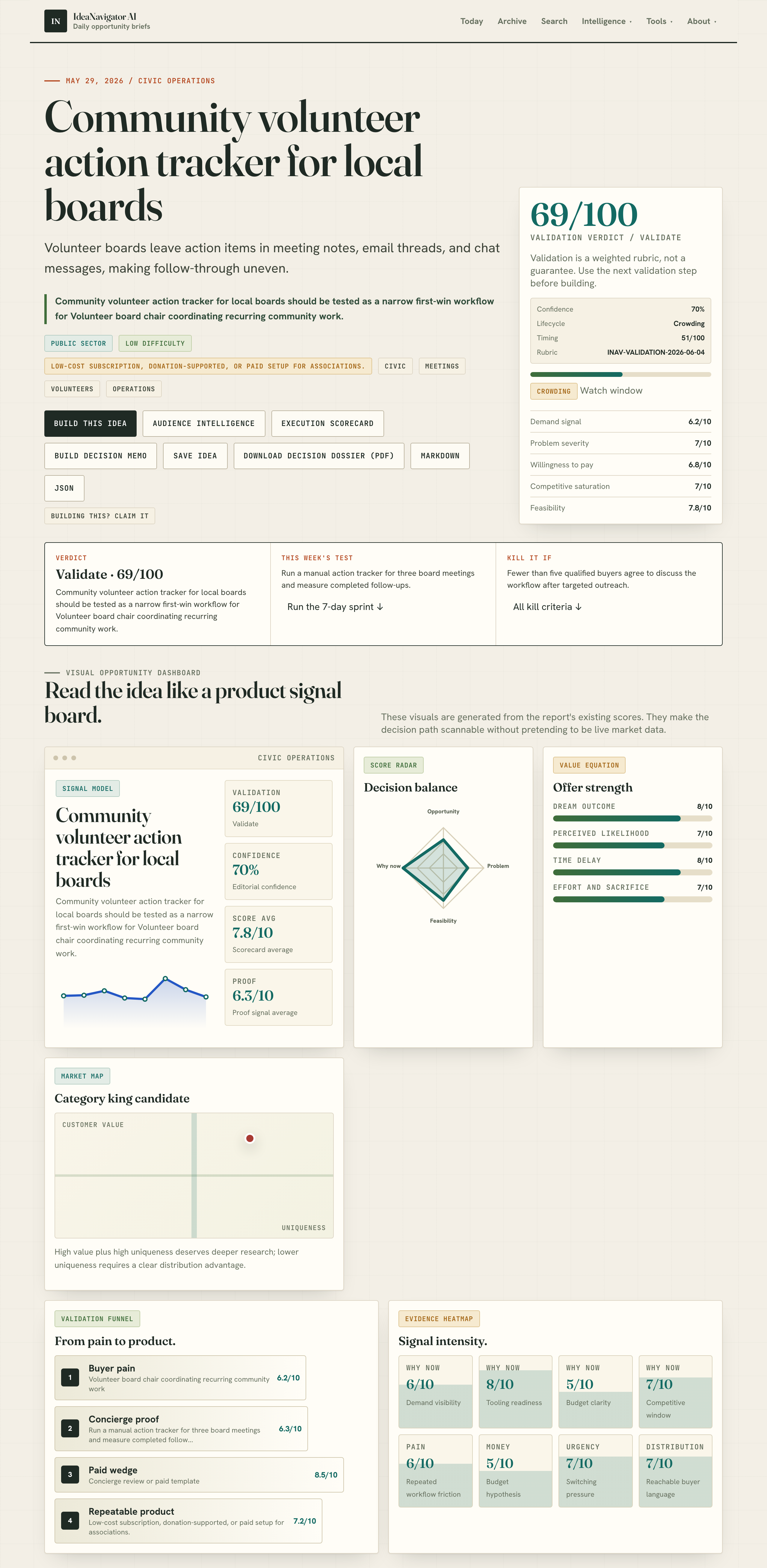
A prototype volunteer action tracker for local civic boards is in early testing. It aims to streamline follow-up tasks and improve community project coordination. Validation will occur over three meetings to assess effectiveness.
A new community volunteer action tracker for local boards is set to be tested as a workflow tool to improve follow-up on community projects, according to plans outlined by IdeaNavigator AI. This initiative aims to address common coordination challenges faced by small civic groups relying on volunteers, making follow-through more consistent and efficient.
The proposed tool is a meeting-action tracker that will automatically extract decisions made during meetings, assign responsibilities, track due dates, and send weekly reminders to volunteers and board members. It is intended for volunteer board chairs who coordinate recurring community work, often leaving action items scattered across meeting notes, emails, and chat messages.
The project is in the testing phase, with plans to run the tracker through three consecutive board meetings. The goal is to measure how well the system facilitates follow-up and whether it leads to higher completion rates of assigned tasks. The initiative is designed as a low-cost solution, potentially supported by subscriptions, donations, or paid setup services for civic associations.
Developers believe that this tool could serve as a first step toward more structured civic operation workflows, especially for groups with limited budgets and professional staff.
Potential Impact on Civic Group Coordination
This initiative could significantly improve how small civic groups manage community projects by providing a simple, automated way to track responsibilities and deadlines. Better follow-through may lead to more effective community engagement and project completion, addressing a common pain point for volunteer boards.
By offering a low-cost, easy-to-implement solution, the tracker could become a standard tool for volunteer organizations, especially as civic groups seek more professional coordination without increasing budgets. The success of this initial testing could influence broader adoption and further development of civic operational tools.
meeting action tracker for volunteer boards
As an affiliate, we earn on qualifying purchases.
As an affiliate, we earn on qualifying purchases.
Background on Volunteer Coordination Challenges
Volunteer boards and civic groups often rely on informal communication methods, such as meeting notes, emails, and chat threads, to coordinate community efforts. This scattered approach frequently results in incomplete follow-up, missed deadlines, and reduced accountability. Small civic organizations are increasingly seeking affordable, straightforward tools to improve operational efficiency without the resources for complex project management software.
The idea of a dedicated action tracker emerged as a potential solution, with initial plans to test a minimal viable product (MVP) that automates extraction of decisions and responsibilities from meetings. This approach aims to simplify task management and enhance follow-up, addressing a recognized need within the civic operations market.
“The challenge for volunteer boards is ensuring follow-up without the resources for complex systems.”
— an anonymous researcher
community project management software
As an affiliate, we earn on qualifying purchases.
As an affiliate, we earn on qualifying purchases.
Uncertain Outcomes of Initial Testing Phase
It is not yet clear how effective the tracker will be in real-world settings, as testing is only planned over three meetings. The actual impact on follow-up completion rates and overall workflow improvements remains to be validated. Additionally, user adoption and integration challenges are still unknown at this stage.
task management tool for civic groups
As an affiliate, we earn on qualifying purchases.
As an affiliate, we earn on qualifying purchases.
Next Steps for Validation and Potential Expansion
The immediate next step is to conduct the planned testing over three consecutive board meetings, measuring task completion and follow-up effectiveness. Based on these results, developers will decide whether to refine the tool and consider broader deployment among civic groups. Further, feedback from early users will shape future features and scalability options.
volunteer responsibility assignment app
As an affiliate, we earn on qualifying purchases.
As an affiliate, we earn on qualifying purchases.
Key Questions
What is the main purpose of the volunteer action tracker?
The tracker aims to automate the extraction of decisions from meetings, assign responsibilities, track deadlines, and send reminders to improve follow-up on community projects managed by volunteer boards.
Who is this tool designed for?
It is intended for volunteer board chairs and small civic groups coordinating recurring community work, especially those with limited budgets and resources.
How will the effectiveness of the tracker be evaluated?
By running it through three consecutive meetings and measuring the rate of follow-up task completion compared to previous informal methods.
When will broader deployment or adoption occur?
Potentially after successful validation in the initial testing phase, with further development based on user feedback.
What are the potential challenges in implementing this tool?
Some challenges include user adoption, integration with existing communication methods, and ensuring the system accurately extracts decisions from meeting notes.
Source: IdeaNavigator AI
Halloween Picks
halloween
As an affiliate, we earn on qualifying purchases.