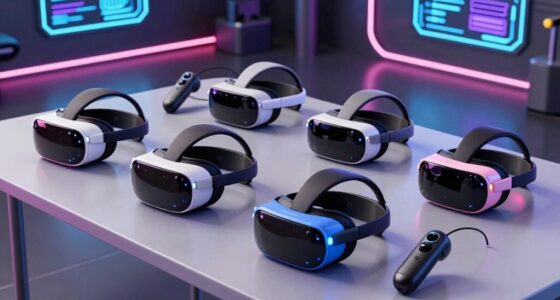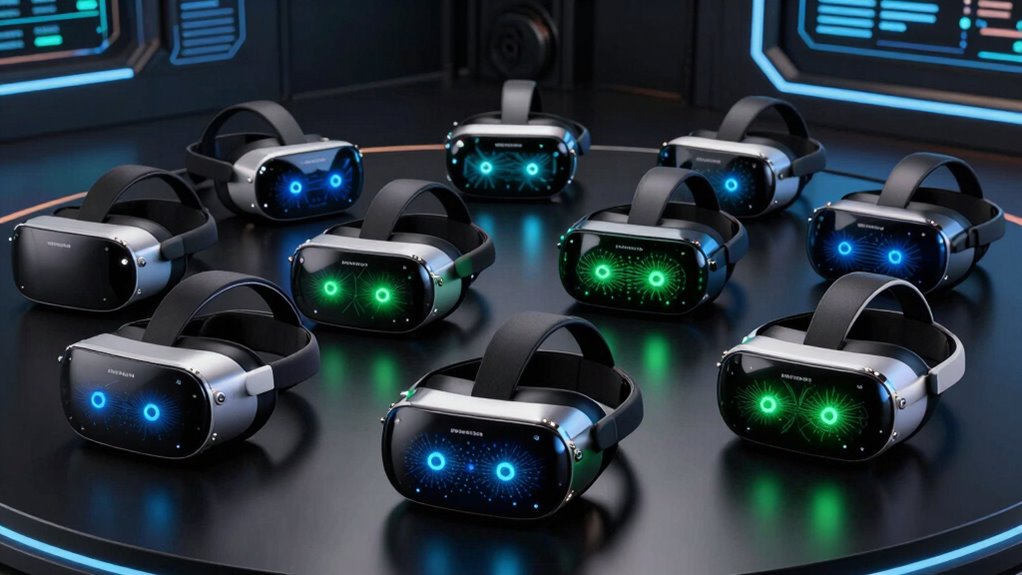
When searching for VR headsets with the best tracking, accuracy and responsiveness are key. The HTC Vive Pro Eye stands out for its precise eye tracking suitable for professional use, while the Meta Quest Pro offers impressive inside-out tracking for convenience and versatility. However, tradeoffs often involve balancing tracking fidelity against ease of setup and comfort. Continue reading to explore the detailed comparisons and find the best fit for your needs.

Get the latest gadgets delivered free with Prime
- Fast, free delivery on millions of items
- Prime Video, Amazon Music and more included
- Member-only deals all year
Complete the kit

Key Takeaways
- The HTC Vive Pro Eye leads in eye-tracking accuracy, making it ideal for professional VR applications.
- Pimax headsets excel in wide FOV and advanced hand tracking, providing immersive experiences for enthusiasts.
- Inside-out tracking has become more reliable across devices like Meta Quest Pro, reducing setup complexity.
- Wired headsets generally offer better tracking stability but may sacrifice convenience for mobility.
- Price often correlates with tracking sophistication; premium models deliver higher precision at a cost.
| HTC Vive Pro Eye Virtual Reality System |  | Best Overall for Precision Eye Tracking and High-Fidelity Visuals | Eye Tracking: Precise and consistent | Visual Fidelity: Top-tier graphics, textures, and text | Comfort: Designed for a wide range of head sizes and vision types | VIEW ON AMAZON | See Our Full Breakdown |
| HTC Vive Focus Vision Wired Bundle — XR Headset with DisplayPort PC VR Streaming Kit |  | Best for Versatile High-Resolution Tracking and Mixed Reality | Display Resolution: 2448 x 2448 pixels per eye | Field of View: up to 120° | Refresh Rate: 90 Hz | VIEW ON AMAZON | See Our Full Breakdown |
| HTC Vive Focus Vision Wired Bundle with Facial Tracker – VR Headset with DisplayPort PC Streaming Kit & Facial Tracker |  | Best for Full-Body and Facial Tracking in Standalone VR | Display: 5K resolution (2448 x 2448 pixels per eye) | Field of View: up to 120° | Tracking: Full-body, eye, and facial tracking | VIEW ON AMAZON | See Our Full Breakdown |
| HTC Vive Focus Vision — Mixed Reality and PC VR Headset + Controllers |  | Best for Versatile Mixed Reality and PC VR Tracking | Display Resolution: 2448 x 2448 pixels per eye | Field of View: up to 120° | Tracking: Eye, hand, face, and body | VIEW ON AMAZON | See Our Full Breakdown |
| Pimax Dream Air Slam VR Headset with 3840 x 3552 Per Eye, 110° FOV, ConcaveView Optics, Eye and Hand Tracking, PC VR Compatibility |  | Best for High-Resolution Wide FOV Immersion and Advanced Tracking | Display Resolution: 3840 x 3552 pixels per eye | Field of View: 110° | Tracking: Eye and hand tracking | VIEW ON AMAZON | See Our Full Breakdown |
| Pimax Crystal Super VR Headset & VR Glasses with Micro-OLED, 53 PPD, 3840×3552 Per Eye, 116° Field of View, Eye Tracking |  | Best for Immersive Visuals and Precision Tracking | Display Resolution: 3840×3552 pixels per eye | Field of View: 116° | Refresh Rate: 90Hz | VIEW ON AMAZON | See Our Full Breakdown |
| Meta Quest Pro Headset with Virtual Reality Field Trips and 12-Month Subscription |  | Best for VR Education and Social Collaboration | Storage: 256 GB | RAM: 12 GB | Sensors: 10 VR/MR sensors | VIEW ON AMAZON | See Our Full Breakdown |
| vr headsets with best tracking | Field of View | Tracking | Display Resolution | Connectivity |
|---|---|---|---|---|
| HTC Vive Pro Eye Virtual Reali | — | — | — | — |
| HTC Vive Focus Vision Wired Bu | up to 120° | Submillimeter accuracy with 4 cameras | 2448 x 2448 pixels per eye | DisplayPort, Ethernet, 3.5 mm audio jack |
| HTC Vive Focus Vision Wired Bu | up to 120° | Full-body, eye, and facial tracking | — | DisplayPort, Ethernet, Wi-Fi |
| HTC Vive Focus Vision | up to 120° | Eye, hand, face, and body | 2448 x 2448 pixels per eye | DisplayPort, Ethernet, Wi-Fi |
| Pimax Dream Air Slam VR Headse | 110° | Eye and hand tracking | 3840 x 3552 pixels per eye | DisplayPort, USB |
| Pimax Crystal Super VR Headset | 116° | 6DOF | 3840×3552 pixels per eye | — |
| Meta Quest Pro Headset with Vi | — | — | — | — |
More Details on Our Top Picks
HTC Vive Pro Eye Virtual Reality System
The HTC Vive Pro Eye stands out for its precise eye tracking that supports detailed analytics and enhances immersion, making it ideal for professional applications and serious gamers. Compared to the HTC Vive Focus Vision, it offers more accurate eye tracking, but at a higher cost and with a requirement for a powerful PC, limiting portability. Its visuals are top-tier, delivering crisp textures and sharp images, which surpass many standalone headsets. Although setup can be complex and the price steep, the overall experience is unmatched for those prioritizing tracking accuracy and image quality.
This option makes the most sense for users who need detailed eye-tracking data combined with high-end visuals, such as VR content creators or enterprise professionals.
Pros:- Accurate and consistent eye tracking for immersive experiences and analytics
- High-quality visual graphics with crisp textures and text
- Comfortable fit suitable for extended VR sessions
- Includes a two-month VIVEPORT Infinity subscription
Cons:- High cost for the hardware and required PC specifications
- Limited details on compatibility and setup process
Best for: VR professionals, developers, and enthusiasts seeking the most accurate eye tracking and superior visual fidelity
Not ideal for: Casual users or those looking for a portable, standalone headset due to its high cost and setup complexity
- Eye Tracking:Precise and consistent
- Visual Fidelity:Top-tier graphics, textures, and text
- Comfort:Designed for a wide range of head sizes and vision types
- Includes:2 months of VIVEPORT Infinity subscription
Our verdict“This headset is best for users who need top-tier eye tracking and visual quality and are willing to invest in a high-end PC-based system.”
HTC Vive Focus Vision Wired Bundle — XR Headset with DisplayPort PC VR Streaming Kit
The HTC Vive Focus Vision Wired Bundle offers submillimeter tracking accuracy with its four cameras and infrared floodlight, making it a strong choice for both immersive VR and mixed reality applications. Compared to the HTC Vive Pro Eye, it provides more versatile tracking for spatial interactions and supports mixed reality environments, but its setup complexity and multiple connectivity options can be daunting. The 5K resolution display ensures stunning visuals, and hot-swappable batteries enable longer sessions without interruption. While its advanced features are appealing, they come with a higher price tag and a need for ample space for optimal tracking.
This headset makes the most sense for users who want a flexible, high-precision tracking device that can handle both standalone and PC streaming, especially in creative or enterprise contexts.
Pros:- High-resolution 5K display for immersive visuals
- Submillimeter tracking accuracy with multiple cameras
- Supports both standalone and PC VR streaming
- Hot-swappable batteries for extended use
Cons:- Complex setup with numerous connectivity options
- Potentially high cost and space requirements for optimal tracking
Best for: VR enthusiasts and professionals seeking precise tracking in mixed reality and PC VR settings
Not ideal for: Casual users or those with limited space, due to the complex setup and high cost
- Display Resolution:2448 x 2448 pixels per eye
- Field of View:up to 120°
- Refresh Rate:90 Hz
- Tracking:Submillimeter accuracy with 4 cameras
- Battery:Hot-swappable with reserve front battery
- Connectivity:DisplayPort, Ethernet, 3.5 mm audio jack
Our verdict“Ideal for users who need detailed tracking in both standalone and PC VR modes with a focus on immersive visuals.”
HTC Vive Focus Vision Wired Bundle with Facial Tracker – VR Headset with DisplayPort PC Streaming Kit & Facial Tracker
The HTC Vive Focus Vision with facial and full-body tracking elevates realism with its comprehensive tracking suite, including eye, face, and full-body sensors. Compared to the Focus Vision Wired Bundle, this model adds facial tracking, making it ideal for social VR, professional telepresence, or detailed avatar creation. Its high-resolution 5K display and adjustable fit support long sessions, but the setup involves connecting to a PC and managing multiple sensors, which can be cumbersome. The higher price and bulkier design may deter casual or mobile users, yet it offers unmatched realism for specialized applications.
This headset is best suited for users aiming for full-body immersion and facial expressiveness, particularly in creative, social, or professional VR environments.
Pros:- High-resolution 5K visuals with immersive clarity
- Full-body, eye, and facial tracking for realistic avatars
- Supports PC streaming and standalone use
- Adjustable straps for a comfortable fit
Cons:- Requires PC connection and complex setup
- Bulkier design may reduce comfort during extended wear
- Higher price point for advanced features
Best for: Content creators, social VR users, and professionals requiring facial and full-body tracking
Not ideal for: Casual gamers or users seeking a lightweight, portable headset due to its bulk and setup complexity
- Display:5K resolution (2448 x 2448 pixels per eye)
- Field of View:up to 120°
- Tracking:Full-body, eye, and facial tracking
- Connectivity:DisplayPort, Ethernet, Wi-Fi
- Battery:Hot-swappable front battery
- Compatibility:Supports Unity, Unreal Engine
Our verdict“Best for users who want a comprehensive tracking system capturing full-body and facial expressions for realistic VR interactions.”
HTC Vive Focus Vision — Mixed Reality and PC VR Headset + Controllers
The HTC Vive Focus Vision offers versatile tracking capabilities, including eye, hand, face, and body tracking, making it suitable for mixed reality and immersive VR experiences. Its 5K resolution display ensures sharp visuals, and support for both standalone and PC VR modes adds flexibility. Compared with the Focus Vision with Facial Tracker, this model emphasizes more comprehensive tracking for realistic interactions, but its setup can be complex and space-dependent. It’s well-suited for creative work, training, or social VR where tracking accuracy and versatility are priorities.
However, the need for space and multiple sensors may not suit all casual or limited environments, and the high price could be a barrier for some users.
Pros:- High-resolution 5K display for immersive visuals
- Comprehensive tracking including eye, hand, face, and body
- Supports both standalone and PC VR experiences
- Hot-swappable batteries for extended sessions
Cons:- Complex setup with multiple sensors and connectivity options
- High cost and space requirements for optimal tracking
Best for: VR professionals and creators seeking a flexible, multi-tracking mixed reality headset
Not ideal for: Casual or mobile users who prefer a simple, portable experience due to setup and space needs
- Display Resolution:2448 x 2448 pixels per eye
- Field of View:up to 120°
- Tracking:Eye, hand, face, and body
- Connectivity:DisplayPort, Ethernet, Wi-Fi
Our verdict“Ideal for users who need a multi-tracking mixed reality headset with flexible PC and standalone options.”
Pimax Dream Air Slam VR Headset with 3840 x 3552 Per Eye, 110° FOV, ConcaveView Optics, Eye and Hand Tracking, PC VR Compatibility
The Pimax Dream Air Slam excels with its ultra-high resolution display and expansive 110° FOV, providing a truly immersive experience. Its eye and hand tracking support advanced interactions, rivaling dedicated tracking headsets like the Vive Pro Eye but with an even broader visual scope. Compared to the Vive Focus Vision, it offers greater visual immersion but demands a powerful PC, complex setup, and multiple cables, which could be a barrier for casual users. Its wide FOV and vivid visuals make it ideal for simulation and high-end gaming, though the setup complexity may deter some.
This headset is best suited for enthusiasts who desire maximum visual immersion combined with sophisticated tracking capabilities and have the hardware to support it.
Pros:- Ultra-high resolution display with vivid visuals
- Wide 110° field of view for expansive immersion
- Includes eye and hand tracking for realistic interactions
- Compatible with SteamVR and OpenXR platforms
Cons:- Requires very powerful PC hardware
- Complex setup with multiple cables and sensors
- Higher cost may be prohibitive for casual use
Best for: High-end gamers and simulation enthusiasts with powerful PCs seeking maximum immersion and precision tracking
Not ideal for: Casual users or those with limited space or hardware, due to setup complexity and cost
- Display Resolution:3840 x 3552 pixels per eye
- Field of View:110°
- Tracking:Eye and hand tracking
- Connectivity:DisplayPort, USB
Our verdict“Best for users with high-end PCs who seek maximum visual fidelity and wide FOV with advanced tracking capabilities.”
Pimax Crystal Super VR Headset & VR Glasses with Micro-OLED, 53 PPD, 3840×3552 Per Eye, 116° Field of View, Eye Tracking
This headset stands out for its incredibly sharp visuals thanks to the ultra-HD Micro-OLED displays, which surpass the clarity offered by the Meta Quest Pro. The expansive 116° field of view creates a more enveloping experience, ideal for flight simulators and racing games where peripheral vision enhances realism. Combining this with 6DOF spatial tracking results in highly responsive movement detection, making it suitable for intense, movement-heavy applications. However, these advanced features come at a higher price point and may demand powerful hardware to run smoothly, unlike the Meta Quest Pro, which prioritizes comfort and versatility for varied use cases. This makes the Pimax Crystal a top choice for users who prioritize visual fidelity and wide FOV over portability or affordability.
Pros:- Exceptional visual clarity with ultra-HD Micro-OLED displays
- Wide 116° field of view enhances immersion
- High refresh rate reduces ghosting and eye strain
- Precise 6DOF tracking for accurate movement
Cons:- Potentially high cost due to advanced features
- May require powerful hardware for optimal performance
Best for: VR enthusiasts and professional gamers seeking ultra-high resolution visuals and expansive FOV for immersive experiences.
Not ideal for: Casual users or those with limited hardware resources, as the headset’s advanced tech demands significant processing power and budget.
- Display Resolution:3840×3552 pixels per eye
- Field of View:116°
- Refresh Rate:90Hz
- Tracking:6DOF
- Includes:Face Cushion Covers, Face Pad Kit
- Type:Micro-OLED
Our verdict“This headset is ideal for users who prioritize visual detail and a broad field of view, willing to invest in high-end hardware.”
Meta Quest Pro Headset with Virtual Reality Field Trips and 12-Month Subscription
Compared to the Pimax Crystal, the Meta Quest Pro emphasizes versatility and social engagement with its mixed reality passthrough and advanced controllers that track hand and finger movements precisely. Its high-resolution display and comfortable design make it suitable for extended use, especially in educational or collaborative scenarios. The inclusion of a 12-month VR field trip subscription adds significant value for learners and educators, positioning this headset as a compelling choice for immersive learning. However, it doesn’t match the Pimax in raw visual fidelity or wide FOV, and its performance heavily depends on a stable internet connection. For users focused on social, educational, or professional VR experiences, the Meta Quest Pro offers a comprehensive platform with strong tracking capabilities.
Pros:- High-resolution mixed reality passthrough for immersive engagement
- Advanced controllers with precise hand and finger tracking
- Includes a 12-month subscription to educational VR field trips
- Comfortable, well-balanced design for extended use
Cons:- Potentially high cost for the full package
- Requires a stable internet connection for optimal experience
- Limited in raw visual fidelity compared to high-end dedicated VR headsets
Best for: Educators, remote workers, and social VR enthusiasts seeking a versatile device with social and learning tools.
Not ideal for: High-end gaming purists or users needing ultra-wide FOV and the sharpest visuals, as the Quest Pro trades some fidelity for portability and multi-functionality.
- Storage:256 GB
- RAM:12 GB
- Sensors:10 VR/MR sensors
- Controllers:Meta Quest Touch Pro with self-tracking cameras
- Features:Mixed reality passthrough, spatial audio, resizable multitasking screens
Our verdict“This headset suits users interested in social, educational, and collaborative VR experiences, valuing versatility over ultra-high visual fidelity.”

How We Picked
These products were evaluated based on tracking accuracy, ease of use, build quality, and compatibility. We prioritized systems with proven tracking technology, whether through external sensors or advanced inside-out systems. The ranking also considers value for money, user-friendly setup, and versatility across different VR scenarios. Devices offering innovative tracking features or specialized capabilities were given higher weight, ensuring the list covers both professional-grade and consumer-friendly options.| vr headsets with best tracking | Connectivity |
|---|---|
| HTC Vive Pro Eye Virtual Reali | — |
| HTC Vive Focus Vision Wired Bu | DisplayPort, Ethernet, 3.5 mm audio jack |
| HTC Vive Focus Vision Wired Bu | DisplayPort, Ethernet, Wi-Fi |
| HTC Vive Focus Vision | DisplayPort, Ethernet, Wi-Fi |
| Pimax Dream Air Slam VR Headse | DisplayPort, USB |
| Pimax Crystal Super VR Headset | — |
| Meta Quest Pro Headset with Vi | — |
Factors to Consider When Choosing Vr Headsets With Best Tracking
Choosing a VR headset with the best tracking involves balancing accuracy, ease of setup, and intended use. Not all tracking systems are equal—some rely on external sensors, while others use inside-out cameras. Understanding your specific needs will help determine which features matter most, whether for gaming, professional work, or social VR. Additionally, consider how tracking impacts comfort, maintenance, and future-proofing your setup, as these factors influence long-term satisfaction.Tracking Technology and Accuracy
Different headsets employ various tracking methods, including external sensors, lighthouse systems, or inside-out cameras. External sensors like those used by HTC Vive Pro Eye provide highly precise tracking but require dedicated space and setup. Inside-out tracking, common in headsets like Meta Quest Pro, offers a more streamlined experience at the cost of some accuracy. Consider how critical tracking precision is for your use case—professional design or simulation work demands higher fidelity than casual gaming.
Ease of Setup and Use
Wired headsets with external sensors typically demand a more complex installation process but deliver consistent performance. Conversely, inside-out systems eliminate the need for external sensors, simplifying setup and reducing clutter. Think about your tolerance for initial setup versus ongoing convenience—if you want quick access and portability, inside-out tracking is usually better, but if you prioritize the highest accuracy, be prepared for a more involved setup process.
Tracking Stability and Latency
Stable tracking with minimal latency is essential for immersive experiences, especially in fast-paced VR scenarios. External sensor-based systems tend to outperform inside-out systems in high-precision tasks, though recent advances have improved the reliability of inside-out tracking significantly. Consider the tradeoff between a more stable, wired connection and the flexibility of wireless setups, which might introduce slight latency or tracking inconsistencies under certain conditions.
Compatibility and Ecosystem
Some headsets are optimized for specific platforms or software ecosystems, affecting tracking integration. For example, HTC Vive systems work seamlessly with SteamVR, offering a vast range of compatible titles and accessories. Conversely, standalone headsets like Meta Quest Pro are more versatile but may have limitations in customization or peripheral support. Match your tracking needs with your preferred software environment for smoother operation and future expandability.
Price and Future-Proofing
Higher-priced headsets often feature the most advanced tracking systems, but they might also include features you don’t need. Consider whether investing in a premium model aligns with your long-term plans, especially if you anticipate evolving VR needs. Cheaper options might offer decent tracking for casual users but could fall short for professional or intensive applications. Balance your budget with the level of precision and reliability you require.
Frequently Asked Questions
Is inside-out tracking as accurate as external sensor systems?
While inside-out tracking has improved markedly, external sensor systems like lighthouse setups typically offer higher accuracy and lower latency, especially for large or complex spaces. For most casual users, inside-out provides sufficient precision, but professionals needing pinpoint accuracy might prefer external sensors. Advances in camera technology continue to narrow this gap, making inside-out increasingly reliable for many use cases.
Can I upgrade my tracking system later?
Upgrading tracking systems depends on the headset ecosystem. External sensor-based systems usually require compatible hardware and space adjustments, making upgrades more involved. Inside-out systems are integrated into the headset and are less upgradeable but benefit from firmware updates that improve tracking over time. When choosing a headset, consider future expansion plans and whether the current system meets your evolving needs.
Does wireless tracking compromise accuracy?
Wireless tracking offers convenience and freedom of movement but can sometimes introduce slight delays or tracking inconsistencies, especially in environments with interference or limited space. Modern wireless systems have mitigated many of these issues, yet wired connections still tend to deliver the most stable and reliable tracking. Assess your priorities—if mobility is paramount, wireless may be worth some minor precision tradeoffs.
What should I prioritize: tracking fidelity or ease of setup?
This depends on your primary use case. If you require the highest possible accuracy for professional tasks or competitive gaming, investing in a wired system with external sensors is advisable. For casual use or if convenience matters most, inside-out tracking offers a much simpler setup with sufficiently good precision for everyday applications. Consider your comfort with setup complexity versus the level of tracking performance you need.
Are premium tracking headsets worth the extra cost?
Premium headsets with advanced tracking are generally worth it if you depend on precision, such as in professional environments or detailed simulation work. They often feature lower latency, higher accuracy, and better stability, which can significantly enhance experiences. However, for casual gaming or social VR, more affordable options with decent inside-out tracking may deliver the performance you need at a better price point.
Conclusion
For most users, the HTC Vive Pro Eye offers the best balance of professional-grade tracking and versatility, making it ideal for serious VR enthusiasts and professionals. The Meta Quest Pro shines for casual users seeking convenience and decent accuracy without external sensors. Pimax models appeal to those who value immersive environments with wide FOV and advanced hand tracking, often at a higher price. Beginners should consider standalone headsets with inside-out tracking for simplicity, while professionals might prioritize wired systems with external sensors for maximum precision. Ultimately, your choice depends on your budget, intended use, and setup preferences.