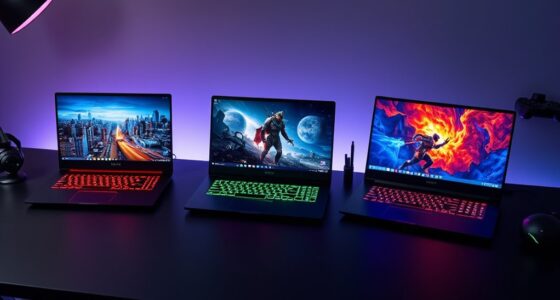
If you’re looking for the best GPUs for VR in 2026, I’ve found some great options. The lineup includes budget-friendly models like the GTX 1070 and GTX 1060, mid-range powerhouses like the RTX 3060 and RX 580, and premium compact choices like the RTX 5070 and ASUS RTX 3050. These cards support immersive visuals, smooth performance, and advanced features. Keep exploring to discover more about each GPU to boost your VR experience.
Key Takeaways
- The list includes a range of GPUs from budget-friendly to high-end, suitable for various VR setups in 2026.
- Key features like high VRAM, advanced ray tracing, and AI acceleration ensure immersive VR experiences.
- Compatibility with latest VR headsets and multiple connectivity options guarantee seamless setup.
- Efficient cooling solutions and thermal management prevent overheating during extended VR sessions.
- The GPUs support high resolutions up to 8K and 4K, delivering crisp visuals for immersive virtual environments.
| XFX Radeon RX 580 GTS XXX 8GB VR Ready Card |  | VR Ready Excellence | VR Compatibility: AMD VR Ready Premium | Memory Size: 8GB GDDR5 | Cooling System: Double Dissipation Cooling | VIEW LATEST PRICE | See Our Full Breakdown |
| XFX Radeon RX 9060 XT OC Gaming Graphics Card |  | High-Performance Gaming | VR Compatibility: Supports high-resolution VR | Memory Size: 8GB GDDR6 | Cooling System: Dual Fan Cooling | VIEW LATEST PRICE | See Our Full Breakdown |
| Nvidia GeForce GTX 1070 Founders Edition (Renewed) |  | Classic Powerhouse | VR Compatibility: VR-ready | Memory Size: 8GB GDDR5 | Cooling System: Not specified (refurbished) | VIEW LATEST PRICE | See Our Full Breakdown |
| GTX 1060 6GB Gaming Graphics Card with Dual Fans |  | Budget Gaming Champion | VR Compatibility: Supports VR devices | Memory Size: 6GB GDDR5 | Cooling System: Dual Fans | VIEW LATEST PRICE | See Our Full Breakdown |
| GIGABYTE RTX 5070 WINDFORCE OC Graphics Card | 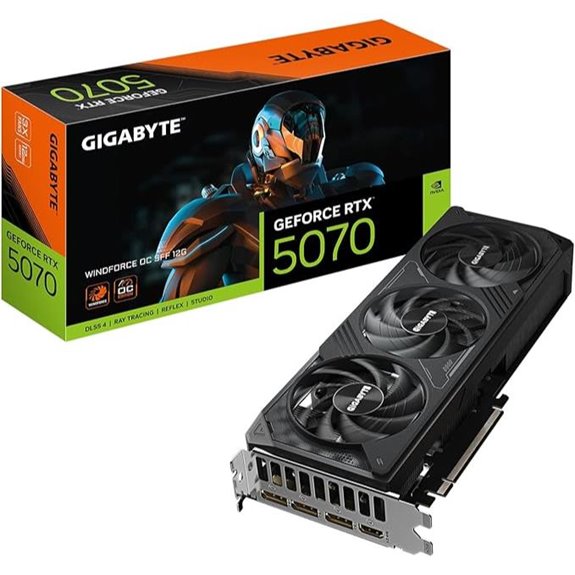 | Top-Tier Flagship | VR Compatibility: Supports VR content | Memory Size: 12GB GDDR7 | Cooling System: WINDFORCE 3X Cooling | VIEW LATEST PRICE | See Our Full Breakdown |
| GTX 1060 6GB Gaming Graphics Card with Dual Fans |  | Compact Power | VR Compatibility: Supports VRWorks | Memory Size: 6GB GDDR5 | Cooling System: Dual Fans | VIEW LATEST PRICE | See Our Full Breakdown |
| ASUS GeForce RTX 3050 OC Gaming Graphics Card |  | Small Form Factor | VR Compatibility: Supports VR devices | Memory Size: 6GB GDDR6 | Cooling System: Axial-tech Fans | VIEW LATEST PRICE | See Our Full Breakdown |
| XFX Radeon RX 580 GTS XXX 8GB VR Ready Card | | High Efficiency | VR Compatibility: AMD VR Ready | Memory Size: 8GB GDDR5 | Cooling System: Unspecified (cooling details) | VIEW LATEST PRICE | See Our Full Breakdown |
| GIGABYTE GeForce RTX 3060 Gaming OC 12G | 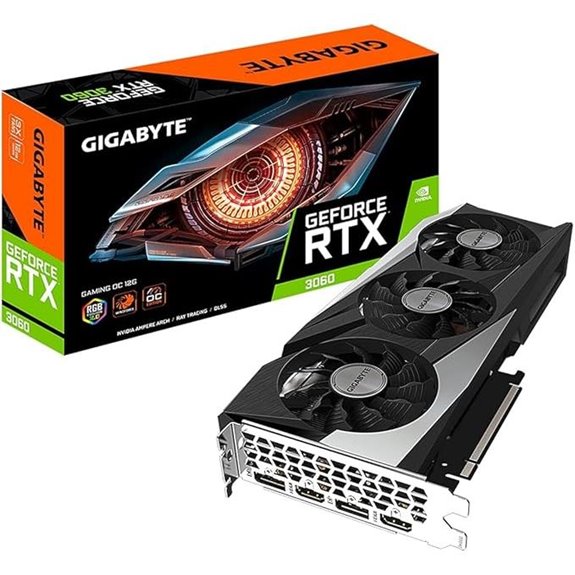 | Future-Proof Tech | VR Compatibility: Supports VR applications | Memory Size: 12GB GDDR6 | Cooling System: WINDFORCE 3X | VIEW LATEST PRICE | See Our Full Breakdown |
| XFX Radeon RX 570 RS 8GB GDDR5 Graphics Card | 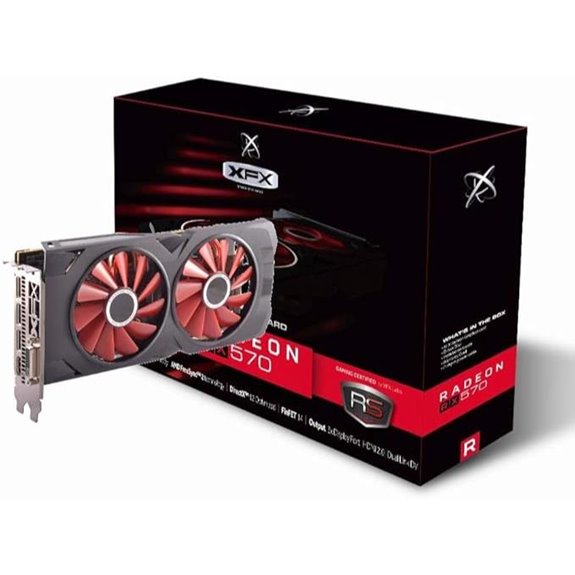 | Versatile Performance | VR Compatibility: Supports VR content | Memory Size: 8GB GDDR5 | Cooling System: Not specified (standard cooling) | VIEW LATEST PRICE | See Our Full Breakdown |
| MSI GeForce RTX 3060 12GB Gaming Graphics Card |  | Premium Streaming | VR Compatibility: Supports VR headsets | Memory Size: 12GB GDDR6 | Cooling System: Torx Twin Fans | VIEW LATEST PRICE | See Our Full Breakdown |
More Details on Our Top Picks
XFX Radeon RX 580 GTS XXX 8GB VR Ready Card
Looking for a GPU that can handle VR gaming smoothly? The XFX Radeon RX 580 GTS XXX 8GB VR Ready Card is a solid choice. It features Polaris architecture with 4th Gen GCN cores, a new display engine, and multimedia cores, boosting performance and efficiency thanks to its Next FinFET 14 process. With factory overclocked speeds of 1366MHz, it offers reliable performance and 8GB of GDDR5 memory for high-quality graphics. Its Dual Dissipation Cooling keeps temperatures in check, while AMD VR Ready Premium ensures compatibility with leading VR headsets. Overall, it’s a dependable, versatile GPU perfect for immersive virtual reality experiences.
- VR Compatibility:AMD VR Ready Premium
- Memory Size:8GB GDDR5
- Cooling System:Double Dissipation Cooling
- Connectivity Options:DisplayPort, HDMI, DVI
- Max Resolution Support:4096×2160
- Release Date:June 2025
- Additional Feature:Factory overclocked settings
- Additional Feature:Dual BIOS feature
- Additional Feature:AMD VR Ready Premium
XFX Radeon RX 9060 XT OC Gaming Graphics Card
The XFX Radeon RX 9060 XT OC Gaming Graphics Card is an excellent choice for gamers and professionals seeking high-performance VR experiences, thanks to its powerful AMD RDNA 4 RX 9060 XT chipset and 8GB GDDR6 memory. With a boost clock reaching up to 3320 MHz and support for a 3840×2160 resolution, it delivers smooth, immersive visuals. Its dual fan Swift cooling system keeps temperatures under control during intense use, while its compact design fits well in various builds. Rated 4.5 stars, it’s a reliable mid-to-high-end GPU that balances performance, efficiency, and space, making it ideal for demanding VR applications.
- VR Compatibility:Supports high-resolution VR
- Memory Size:8GB GDDR6
- Cooling System:Dual Fan Cooling
- Connectivity Options:HDMI, Dual DisplayPort
- Max Resolution Support:3840×2160
- Release Date:June 2025
- Additional Feature:Boost clock up to 3320 MHz
- Additional Feature:Compact dual-fan design
- Additional Feature:Supports 3840×2160 resolution
Nvidia GeForce GTX 1070 Founders Edition (Renewed)
If you’re seeking a reliable, VR-ready graphics card on a budget, the Nvidia GeForce GTX 1070 Founders Edition (Renewed) is an excellent choice. Powered by the GTX 1070 GPU with 8GB GDDR5 memory, it handles most VR experiences smoothly. Its PCI Express 3.0 x16 interface ensures compatibility with many systems, and its renewed condition offers significant savings. With an average rating of 4.4 stars from nearly 200 reviews, users appreciate its performance and value. Although used, it comes in the original box and maintains solid performance for immersive VR. If you want a dependable GPU without breaking the bank, this model is worth considering.
- VR Compatibility:VR-ready
- Memory Size:8GB GDDR5
- Cooling System:Not specified (refurbished)
- Connectivity Options:HDMI, DisplayPort, DVI
- Max Resolution Support:Not specified (refurbished)
- Release Date:June 2016
- Additional Feature:Discontinued model
- Additional Feature:Original box included
- Additional Feature:256-bit memory interface
GTX 1060 6GB Gaming Graphics Card with Dual Fans
For gamers and VR enthusiasts seeking reliable performance without breaking the bank, the GTX 1060 6GB Gaming Graphics Card with Dual Fans stands out as a top choice. It offers solid power for gaming, VR, and graphics-heavy tasks, thanks to its GDDR5 memory, support for DirectX 12, and 8K capability. The dual fans and thermal design keep temperatures in check, ensuring smooth performance and durability. With multiple connectivity options like HDMI and DisplayPort, it’s easy to set up multi-monitor and VR systems. Though it requires a 400W power supply, it’s a versatile option for those wanting immersive visuals without overspending.
- VR Compatibility:Supports VR devices
- Memory Size:6GB GDDR5
- Cooling System:Dual Fans
- Connectivity Options:HDMI, DisplayPort
- Max Resolution Support:8K (7680×4320)
- Release Date:September 2024
- Additional Feature:Supports 8K HDR
- Additional Feature:Dual cooling fans
- Additional Feature:VRWorks support
GIGABYTE RTX 5070 WINDFORCE OC Graphics Card
Designed for compact systems, the GIGABYTE RTX 5070 WINDFORCE OC Graphics Card packs powerful features like NVIDIA’s Blackwell architecture and DLSS 4, making it an excellent choice for VR enthusiasts who need high performance in a small form factor. With 12GB of GDDR7 memory and PCIe 5.0 support, it delivers stunning visuals, fast frame rates, and AI acceleration. Its compact size (11.1 x 4.33 x 1.97 inches) fits easily into smaller systems without sacrificing power. The WINDFORCE cooling system ensures ideal temperatures during intense VR sessions, providing a reliable, future-proof solution for immersive experiences.
- VR Compatibility:Supports VR content
- Memory Size:12GB GDDR7
- Cooling System:WINDFORCE 3X Cooling
- Connectivity Options:HDMI, DisplayPort
- Max Resolution Support:7680×4320
- Release Date:March 2025
- Additional Feature:PCIe 5.0 support
- Additional Feature:12GB GDDR7 memory
- Additional Feature:AI acceleration via RT/Tensor Cores
GTX 1060 6GB Gaming Graphics Card with Dual Fans
The GTX 1060 6GB Gaming Graphics Card with Dual Fans stands out as an excellent choice for gamers and VR enthusiasts seeking reliable performance without breaking the bank. It features GDDR5 memory, 192-bit bandwidth, and supports 8K HDR, VR readiness, and DirectX 12, making it suitable for demanding tasks. Its dual cooling fans ensure thermal efficiency during intense gaming sessions, maintaining low temperatures and extending lifespan. Compatible with PCIe 3.0 x16 slots, it offers multiple monitor connections via HDMI and DisplayPorts. While it requires a 400W power supply and a 6-pin cable, it delivers smooth gameplay and immersive visuals, making it a solid option for budget-conscious VR users.
- VR Compatibility:Supports VRWorks
- Memory Size:6GB GDDR5
- Cooling System:Dual Fans
- Connectivity Options:HDMI, DisplayPort
- Max Resolution Support:8K (7680×4320)
- Release Date:August 2024
- Additional Feature:Supports 8K HDR
- Additional Feature:Dual cooling fans
- Additional Feature:VRWorks support
ASUS GeForce RTX 3050 OC Gaming Graphics Card
If you’re building a compact VR gaming setup, the ASUS GeForce RTX 3050 OC Gaming Graphics Card stands out with its small 7.9-inch form factor and efficient cooling system. It features a PCIe 4.0 interface, 6GB GDDR6 memory, and supports high resolutions up to 7680 x 4320 pixels. Its dual Axial-tech fans and barrier ring guarantee excellent airflow and thermal performance in tight spaces. With NVIDIA Ampere architecture, 2nd Gen RT cores, and DLSS AI tech, it offers solid ray tracing and smooth gameplay. Available since February 2024, it boasts a 4.6-star rating from over 1,150 reviews, making it a reliable choice for immersive VR experiences.
- VR Compatibility:Supports VR devices
- Memory Size:6GB GDDR6
- Cooling System:Axial-tech Fans
- Connectivity Options:HDMI 2.1, DisplayPort 1.4a
- Max Resolution Support:7680×4320
- Release Date:February 2024
- Additional Feature:Axial-tech fan design
- Additional Feature:Supports PCIe 4.0
- Additional Feature:0dB silent technology
XFX Radeon RX 580 GTS XXX 8GB VR Ready Card
For gamers and VR enthusiasts seeking a reliable upgrade, the XFX Radeon RX 580 GTS XXX Edition 8GB stands out with its impressive 1386MHz boost clock and 8GB GDDR5 memory, ensuring smooth performance in demanding virtual environments. Built on AMD’s Polaris architecture with 4th gen GCN cores, it supports 4K resolution and VR with AMD LiquidVR technology. Its cooling system features a unibody heatsink and ultra-low noise inductors, maintaining lower temperatures during intense use. The dual BIOS offers flexibility for gaming or mining, while multiple output options ensure compatibility with various displays. Overall, it’s a solid choice for immersive VR experiences at an accessible price point.
- VR Compatibility:AMD VR Ready
- Memory Size:8GB GDDR5
- Cooling System:Unspecified (cooling details)
- Connectivity Options:HDMI, DisplayPort, DVI
- Max Resolution Support:4096×2160
- Release Date:April 2017
- Additional Feature:Dual BIOS modes
- Additional Feature:AMD LiquidVR technology
- Additional Feature:40% better thermal efficiency
GIGABYTE GeForce RTX 3060 Gaming OC 12G
With its 12GB GDDR6 memory and advanced NVIDIA Ampere architecture, the GIGABYTE GeForce RTX 3060 Gaming OC 12G stands out as an excellent choice for gamers and creators who demand high-resolution VR experiences. Its 1837 MHz boost clock and support for up to 7680×4320 resolution ensure smooth, detailed visuals. The card features efficient WINDFORCE 3X cooling, a durable metal backplate, and RGB Fusion 2.0 lighting for style. Compact and lightweight, it fits well in various builds. With strong performance, AI acceleration, and multiple output options, this GPU delivers immersive VR without compromising on reliability or aesthetics.
- VR Compatibility:Supports VR applications
- Memory Size:12GB GDDR6
- Cooling System:WINDFORCE 3X
- Connectivity Options:HDMI, DisplayPort
- Max Resolution Support:7680×4320
- Release Date:June 2021
- Additional Feature:RGB Fusion 2.0 lighting
- Additional Feature:WINDFORCE 3X cooling
- Additional Feature:Metal backplate
XFX Radeon RX 570 RS 8GB GDDR5 Graphics Card
The XFX Radeon RX 570 RS 8GB GDDR5 Graphics Card stands out as an excellent choice for gamers seeking a budget-friendly VR experience. It features the AMD RX 570 chipset with 8GB of GDDR5 memory, 2048 stream processors, and a core clock of 1286MHz, supporting DirectX 12 and VR readiness. Its dual BIOS system offers versatility for gaming or mining, while the XFX double dissipation cooling keeps temperatures in check. With multiple display outputs—DisplayPort, HDMI, and DVI—it handles high-resolution VR content up to 4096×2160. Weighing just 2 pounds, it’s compact, efficient, and perfect for those wanting solid VR performance without breaking the bank.
- VR Compatibility:Supports VR content
- Memory Size:8GB GDDR5
- Cooling System:Not specified (standard cooling)
- Connectivity Options:HDMI, DisplayPort, DVI
- Max Resolution Support:4096×2160
- Release Date:December 2017
- Additional Feature:Dual BIOS switching
- Additional Feature:7000 MHz memory speed
- Additional Feature:Supports cryptocurrency mining
MSI GeForce RTX 3060 12GB Gaming Graphics Card
If you’re looking to elevate your VR experience without breaking the bank, the MSI GeForce RTX 3060 12GB stands out as a solid choice. Built on NVIDIA’s Ampere architecture, it offers 12GB GDDR6 memory, supporting high-resolution gaming up to 8K. Its boosted clock speeds—1807 MHz memory and 1710 MHz GPU—ensure smooth performance. With PCIe 4.0 support, enhanced Ray Tracing, and streaming cores, it delivers realistic graphics and immersive visuals. The Torx Twin Fan cooling keeps temperatures in check during intense VR sessions. Rated 4.7 stars and widely praised, this card balances affordability with high performance, making it ideal for serious VR enthusiasts.
- VR Compatibility:Supports VR headsets
- Memory Size:12GB GDDR6
- Cooling System:Torx Twin Fans
- Connectivity Options:HDMI, DisplayPort
- Max Resolution Support:7680×4320
- Release Date:February 2021
- Additional Feature:Torx Twin Fan system
- Additional Feature:Supports 8K gaming
- Additional Feature:Enhanced Ray Tracing cores
Factors to Consider When Choosing a GPU for VR

When selecting a GPU for VR, I focus on its performance power to guarantee smooth experiences. Compatibility with different VR headsets and enough graphics memory are also key factors I consider. Additionally, I check cooling options and connection types to guarantee reliable operation and easy setup.
VR Performance Power
Choosing the right GPU for VR depends on several key performance factors. A high boost clock speed, like 3320 MHz, ensures smoother experiences by minimizing latency and stuttering, vital for immersive VR. Adequate GDDR6 memory with at least 8GB supports higher resolutions and complex virtual environments without compromise. Advanced RT and Tensor Cores improve real-time ray tracing and AI enhancements, boosting visual realism. Efficient cooling systems, such as dual fans or custom heatsinks, prevent thermal throttling during extended sessions, maintaining consistent performance. Additionally, support for HDMI 2.1 and DisplayPort 1.4a guarantees compatibility with high-bandwidth VR headsets and ultra-high-resolution displays. Together, these factors determine a GPU’s ability to deliver powerful, seamless VR experiences that fully immerse the user.
Compatibility With VR Headsets
Selecting a GPU that’s compatible with your VR headset requires attention to specific standards and features. First, verify the GPU is AMD VR Ready Premium or NVIDIA VR Ready certified to guarantee compatibility with leading headsets. Check that it supports low latency and stutter-free experiences through technologies like AMD LiquidVR or NVIDIA VRWorks. Additionally, confirm the GPU has the necessary output ports—such as HDMI 2.0/2.1 and DisplayPort 1.4 or higher—to connect your headset securely. It’s also essential to confirm that the GPU meets or exceeds the recommended specifications for your specific VR device, including performance benchmarks. Finally, consider the GPU’s ability to support high resolutions, like 4K or above, which are often vital for immersive VR visuals.
Graphics Memory Capacity
Having enough graphics memory is essential for a smooth VR experience. While 4GB of VRAM is the minimum, aiming for 8GB or more guarantees better performance, especially with high-resolution textures and demanding applications. Larger memory capacity allows for higher quality graphics and smoother virtual environments, reducing stuttering and load times. Insufficient VRAM can lead to reduced frame rates, which negatively impacts immersion and can cause discomfort. Modern VR headsets and complex scenes require at least 6GB of VRAM to manage detailed environments effectively. As VR content continues to improve in visual fidelity, future-proofing means selecting a GPU with ample memory. This ensures your setup remains capable of handling increasingly complex and immersive experiences without bottlenecks or performance issues.
Cooling and Thermal Management
Effective cooling and thermal management are essential for maintaining ideal GPU performance during VR sessions. High-quality cooling solutions, like dual or triple fans and advanced heatsinks, help keep temperatures in check. Technologies such as vapor chambers and direct heat transfer layers improve heat dissipation, reducing thermal throttling that can hinder performance. Proper airflow within the PC case, supported by well-placed fans and good ventilation, prevents overheating during extended VR use. Using thermal compounds and pads enhances heat transfer between the GPU chip and cooling components, boosting overall thermal efficiency. Additionally, monitoring GPU temperatures with software guarantees your cooling system functions properly and prevents overheating. Prioritizing these factors ensures your GPU remains cool, stable, and ready to deliver smooth, immersive VR experiences.
Connection Options Available
When choosing a GPU for VR, it’s important to contemplate the connection options it offers, as these determine compatibility with your headset and overall setup. Most modern GPUs support multiple options like HDMI, DisplayPort, and DVI, ensuring flexibility. HDMI 2.0 and higher are essential for VR because they provide the high bandwidth needed for 4K at 60Hz or higher, which is critical for smooth experiences. DisplayPort 1.4 and newer support higher resolutions and refresh rates, reducing latency and improving image clarity. Some GPUs feature dual or multiple outputs, allowing you to connect multiple headsets or monitors simultaneously for extended or multi-user VR scenarios. Ensuring your GPU’s connection options match your VR headset‘s input ports is essential for peak performance and compatibility.
Hardware Compatibility Needs
Choosing a GPU for VR requires careful attention to hardware compatibility to guarantee a seamless experience. First, check that your GPU has the right video output port—HDMI 2.0 or 2.1, or DisplayPort 1.4 or 1.4a—matching your headset’s requirements. Ensure the GPU supports essential VR technologies like AMD LiquidVR or NVIDIA VRWorks for low latency and smooth visuals. Power needs are also critical; verify that your power supply provides enough wattage and the correct connectors for stable operation. Additionally, confirm that the GPU’s physical size fits inside your PC case, allowing proper cooling and airflow. Finally, make sure your GPU’s drivers are current and compatible with your operating system to prevent performance issues during VR sessions.
Future-Proofing Features
Future-proofing your VR GPU means selecting features that will keep your system ready for upcoming advancements in virtual reality technology. I look for support for the latest display interfaces like HDMI 2.1 and DisplayPort 1.4a, which handle higher resolutions and refresh rates as VR headsets evolve. Compatibility with advanced VR tech such as AMD LiquidVR and NVIDIA VRWorks ensures low latency and smooth experiences with future content. An ample VRAM of 8GB or more helps manage higher-resolution displays and complex environments. Support for PCIe 4.0 or PCIe 5.0 guarantees faster data transfer for future updates and applications. Additionally, features like ray tracing and AI acceleration with RT and Tensor cores prepare the GPU to deliver increasingly realistic, immersive graphics down the line.
Frequently Asked Questions
How Do VR Headset Requirements Influence GPU Selection?
VR headset requirements directly influence my GPU choice because higher resolutions, faster refresh rates, and advanced features demand more graphics power. I look for GPUs that meet or exceed the headset’s specs to guarantee smooth, immersive experiences without lag or stuttering. If my headset needs high frame rates or ray tracing, I prioritize GPUs with robust performance and compatibility, so I can enjoy seamless virtual worlds every time.
What Is the Importance of Refresh Rate in VR GPUS?
Think of refresh rate like the beat of a song; it keeps everything moving smoothly. In VR, a higher refresh rate—ideally 90Hz or more—is vital because it reduces motion sickness and makes the experience feel natural. When my GPU supports higher refresh rates, I notice crisper visuals and less lag, which keeps me immersed and comfortable during intense virtual adventures. It’s all about maintaining that seamless flow.
Do Power Supply Limitations Affect VR GPU Performance?
Power supply limitations definitely impact VR GPU performance. If your power supply can’t deliver enough wattage, your GPU might throttle or fail to operate at its full potential, leading to lag or stuttering during immersive experiences. I always recommend checking your system’s power requirements and ensuring your PSU provides enough headroom. A stable, adequate power supply guarantees smooth gameplay and prevents performance issues that can ruin your VR adventures.
How Does GPU Compatibility Impact Multi-Gpu VR Setups?
Think of GPU compatibility like a well-rehearsed orchestra; if the instruments aren’t in harmony, the performance suffers. In multi-GPU VR setups, compatibility issues can cause stuttering, frame drops, or even crashes, ruining immersion. Choosing matching GPUs and ensuring your motherboard supports SLI or CrossFire is essential. When all components work seamlessly, your VR experience becomes smooth and immersive, much like a symphony flowing effortlessly.
What Future GPU Features Will Enhance VR Experiences in 2026?
Future GPUs in 2026 will likely feature advanced ray tracing, higher VRAM capacities, and improved latency reduction, all boosting VR immersion. I believe they’ll also adopt AI-driven rendering for smoother visuals and more realistic interactions. These enhancements will make virtual worlds feel more convincing and seamless. As a VR enthusiast, I’m excited about faster refresh rates and better hardware integration that’ll make our experiences even more immersive and responsive.
Conclusion
Choosing the right GPU for VR feels like finding the perfect key to open a world of immersive wonder. With options spanning from budget-friendly to high-end powerhouses, I know you’ll find one that fits your needs. Remember, a great GPU isn’t just a piece of hardware—it’s the gateway to your virtual adventures. So, gear up, choose wisely, and prepare to plunge into worlds more vivid than you ever imagined.