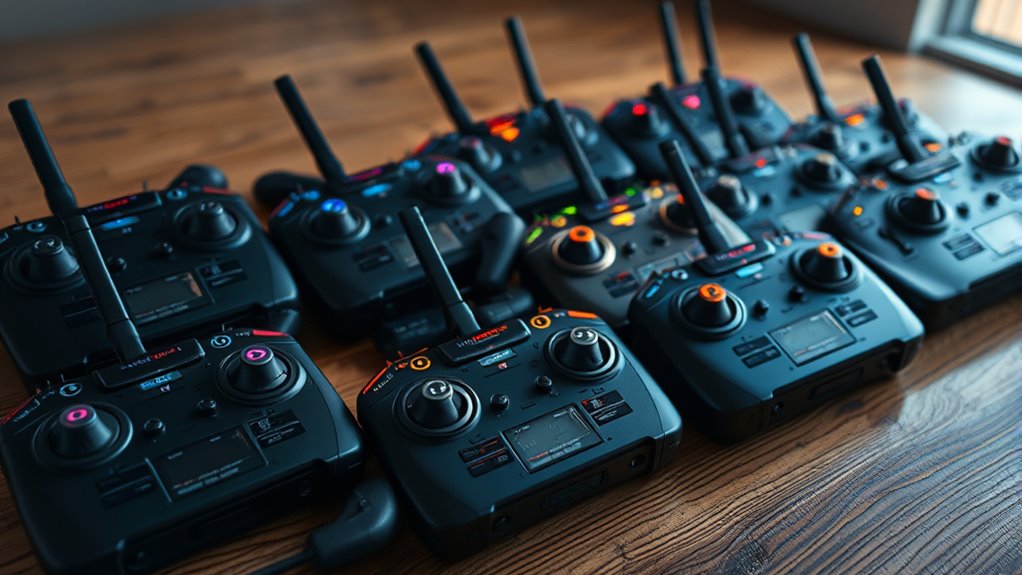

If you’re looking for the best FPV radio transmitters in 2025, I can help guide you through top models known for performance, long-range stability, and customization—like the Radiomaster Pocket ELRS and TBS Tango 2 PRO. I’ll cover their key features, ergonomics, protocols, and battery options to find what matches your flying style. Stick around, and you’ll discover everything you need to choose the perfect transmitter for your FPV adventures.
Key Takeaways
- Highlights top-rated FPV transmitters featuring advanced firmware, protocol support, and high responsiveness for 2025.
- Focuses on essential features like ergonomics, display quality, and long-range capabilities for optimal control.
- Includes insights on power options, battery life, and charging solutions for extended flight sessions.
- Emphasizes customization, firmware updates, and compatibility with various RC and FPV protocols.
- Provides pros and cons to guide users in selecting transmitters suited to different flying styles and budgets.
Radiomaster Pocket ELRS Remote Controller with LED Light

Looking for a versatile FPV radio transmitter that blends portability with advanced features? The Radiomaster Pocket ELRS Remote Controller is perfect. It’s compact, lightweight, and includes Hall gimbals for smooth control. Preloaded with EdgeTX firmware, it offers extensive customization, Lua scripting, and Crossfire compatibility. The built-in LED lights help visualize switch inputs, making flying more intuitive. Designed for both beginners and pros, it supports long-range control via ExpressLRS and features a durable ABS shell with ergonomic grips. Removable sticks and a foldable antenna boost portability. Just add two 18650 batteries, and you’re ready for up to 12 hours of flying.
Best For: hobbyists and professional drone pilots seeking a portable, customizable, long-range FPV radio transmitter with advanced features.
Pros:
- Compact and lightweight design for portability and ease of use
- Preloaded EdgeTX firmware with Lua scripting for extensive customization
- Supports long-range control via ExpressLRS with low latency and visual LED indicators
Cons:
- Requires two 18650 batteries (not included), adding to initial setup costs
- Slightly limited display size due to small backlit LCD screen
- No included batteries, which may inconvenience users expecting an all-in-one package
HelloRadio V14MAX ELRS FPV Radio Transmitter with CNC Hall Gimbals and OLED Display
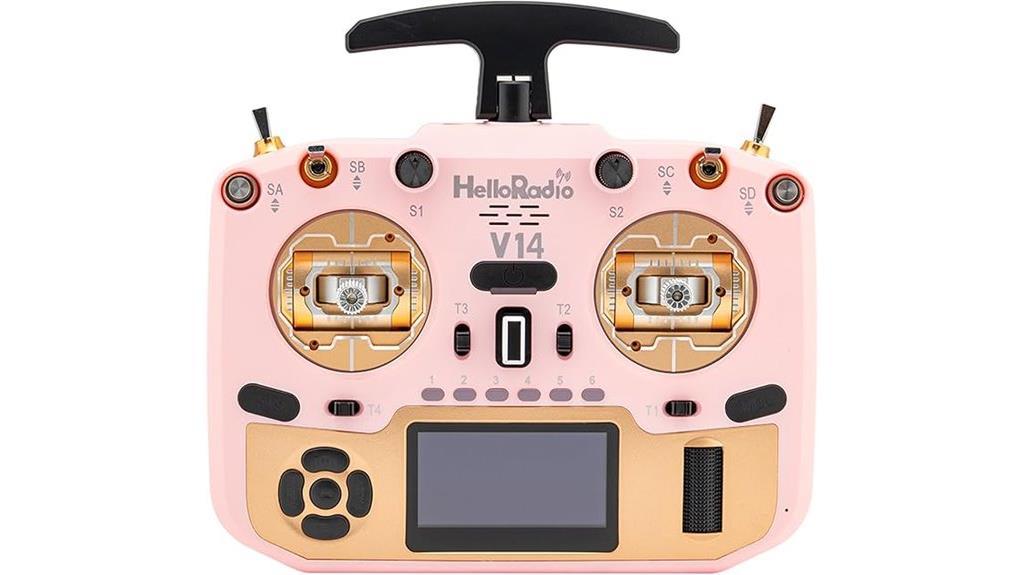
If you’re serious about high-precision control in FPV drone racing or videography, the HelloRadio V14MAX ELRS FPV Radio Transmitter stands out with its CNC Hall sensor gimbals. These gimbals deliver smooth, responsive, and durable handling, perfect for fast-paced flying. The OLED display makes navigation and customization straightforward, while the open-source ELRS system guarantees reliable, versatile communication. Its foldable T-antenna enhances portability, and the built-in AI voice assistant adds convenience with hands-free commands. Powered by standard batteries, it’s lightweight at around 100 grams, making it an excellent choice for professionals seeking precision, flexibility, and modern features in a compact package.
Best For: FPV drone pilots and videographers seeking high-precision, customizable control with durable hardware and modern features.
Pros:
- Equipped with CNC Hall sensor gimbals for smooth, responsive handling during high-speed flying.
- OLED display allows for easy navigation, customization, and real-time information.
- Open-source ELRS system provides reliable, versatile wireless communication options.
Cons:
- No rechargeable batteries included, requiring external power sources.
- Slightly higher weight at around 100 grams, which may impact long sessions for some users.
- Limited information on warranty details and support options at the time of release.
Radiolink AT10II 12-Channel RC Transmitter and Receiver
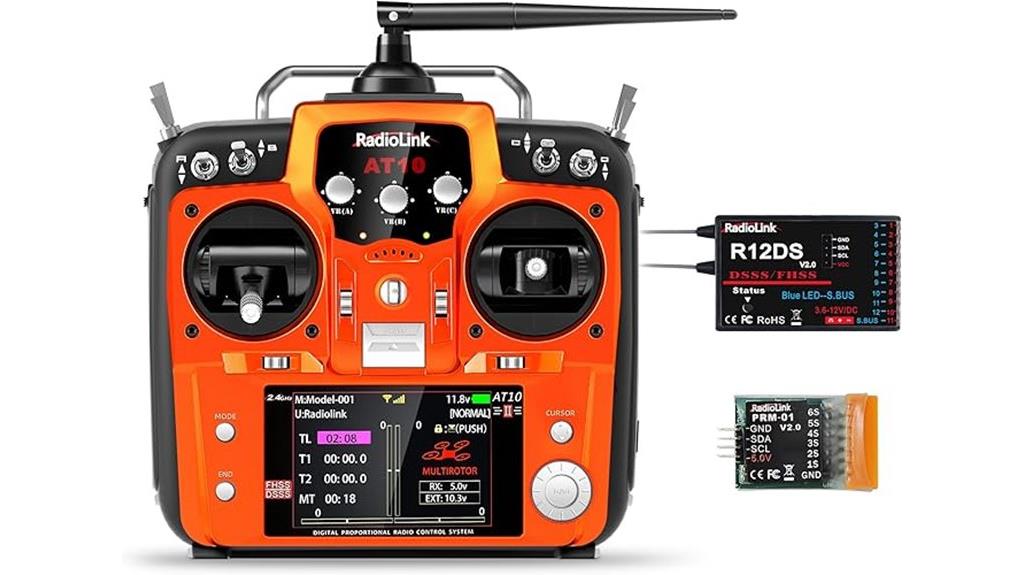
The Radiolink AT10II 12-Channel RC Transmitter and Receiver stands out as an excellent choice for serious RC hobbyists and FPV racers who demand reliable, long-range control. Operating on 2.4GHz with DSSS and FHSS protocols, it offers a stable connection up to 2.5 miles (4 km). Its user-friendly interface includes a 3.5-inch LCD screen for real-time data, telemetry support, and no binding hassle. With features like failsafe, low voltage alarms, and channel mixing, it ensures safe, precise operation. Built for versatility, it’s compatible with planes, drones, helicopters, cars, and boats, making it a versatile, dependable transmitter for serious enthusiasts.
Best For: serious RC hobbyists and FPV racers seeking reliable long-range control with advanced telemetry and safety features.
Pros:
- Stable 2.4GHz connection with up to 2.5 miles (4 km) range for long-distance control.
- User-friendly 3.5-inch LCD screen displays real-time telemetry data and system status.
- Rich feature set including failsafe, low voltage alarms, channel mixing, and customizable switch controls.
Cons:
- Requires 8 AA batteries, which may be less convenient than rechargeable options.
- Slightly bulky size at 7.1 x 3.7 x 8.7 inches, which might be heavy for extended hand-held use.
- Higher price point reflecting its advanced features may be a barrier for casual users.
FLYSKY FS-i6X 10CH 2.4GHz RC Transmitter Controller
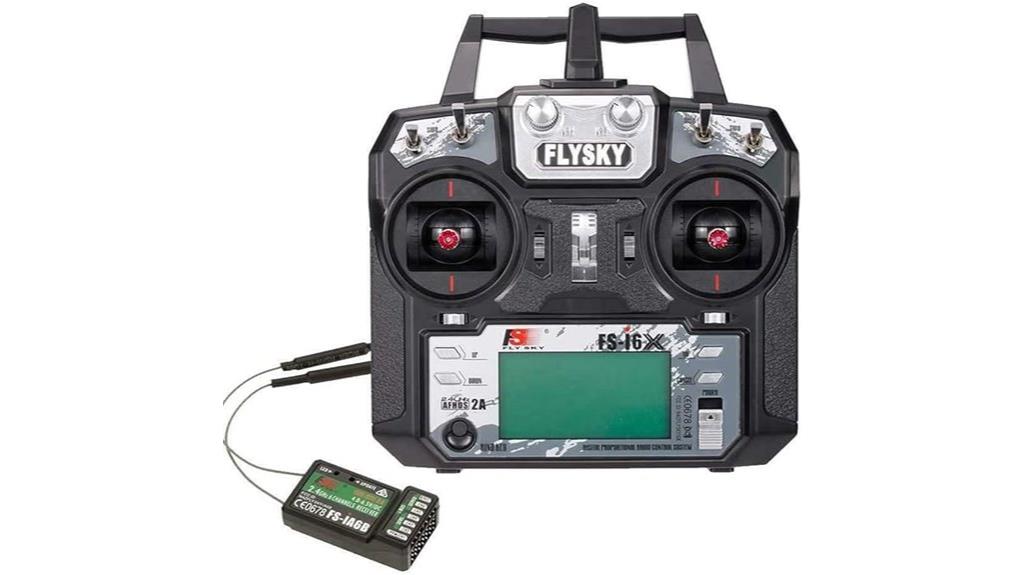
The FLYSKY FS-i6X 10CH 2.4GHz RC Transmitter Controller stands out for hobbyists and professionals seeking versatile communication capabilities, especially with its bidirectional data transfer and support for up to 10 channels. It features a robust 2.4GHz frequency hopping system that minimizes interference by hopping across 135 channels. Its high-gain antenna ensures strong signals and reduced interference, while low power consumption extends battery life. The LCD display provides easy monitoring, and the controller’s compatibility with both RC boats and drones makes it highly versatile. With a 90-day warranty and a solid 4.5-star rating, it’s a reliable choice for serious FPV enthusiasts.
Best For: hobbyists and professionals seeking a versatile, reliable 2.4GHz RC transmitter with advanced data transfer and multi-channel support for boats, drones, and other RC vehicles.
Pros:
- Supports up to 10 channels with the appropriate receiver, offering extensive control options
- Features bidirectional communication for real-time data transfer, including sensor info and calibration
- Equipped with a high-gain antenna and frequency hopping technology to ensure strong signals and minimal interference
Cons:
- Requires additional receivers (such as FS-iA10B) to unlock full 10-channel capability
- Slightly bulky dimensions (9.1 x 8.3 x 4.1 inches) may impact portability
- Powered by 4 AAA batteries, which may need frequent replacing during intense use
DTXMX FS-i6X 6CH RC Transmitter and Receiver for Quadcopter and FPV Drone

For drone enthusiasts seeking reliable control over their quadcopters and FPV drones, the DTXMX FS-i6X 6CH RC Transmitter stands out with its advanced frequency hopping system. Operating between 2.408-2.475GHz, it hops across 16 or 32 channels to minimize interference, ensuring stable connections. Compatible with FS-iA6B receivers and supporting up to 10 channels, it offers precise control for various models, including fixed-wing and helicopters. The transmitter features a clear 128×64 LCD, auxiliary switches, and online updates, all in a lightweight design. Its secure ID recognition and low power consumption make it a versatile, dependable choice for serious drone pilots.
Best For: drone enthusiasts and hobbyists seeking a reliable, frequency-hopping transmitter for controlling quadcopters, FPV drones, and fixed-wing models with secure pairing and up to 10 channels.
Pros:
- Advanced frequency hopping system minimizes interference for stable connections
- Supports up to 10 channels with auxiliary switches for versatile control
- Lightweight design with a clear LCD display and online update capability
Cons:
- Batteries are not included, requiring separate purchase
- Limited to 6 channels by default, requiring menu adjustment for 10-channel operation on IA10B
- Some users may find the setup process or menu navigation slightly complex initially
Radiomaster Boxer Transparent Version Radio Transmitter
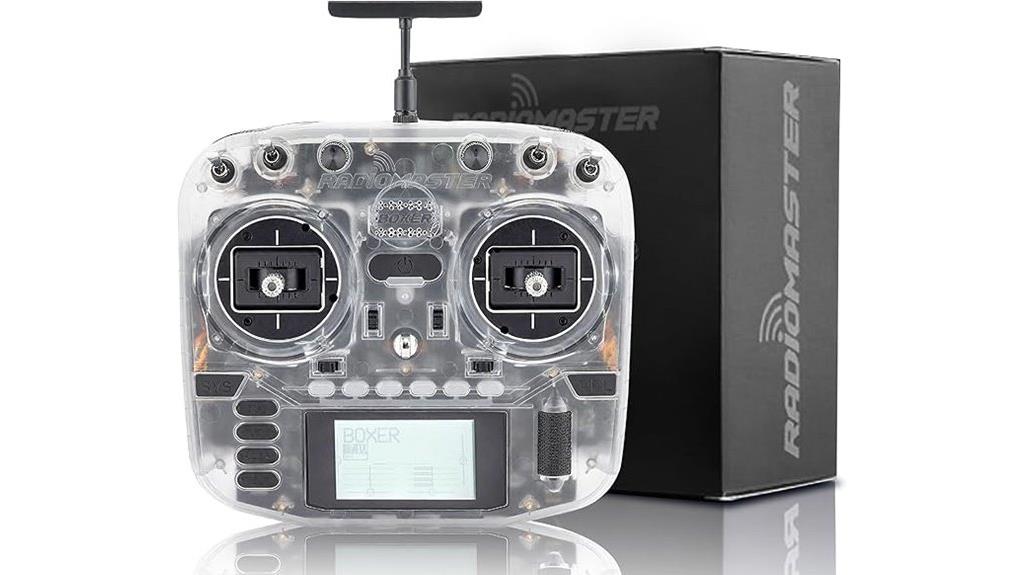
If you’re serious about FPV racing or freestyle flying, the Radiomaster Boxer Transparent Version stands out with its ultra-responsive ELRS module supporting up to 1000Hz refresh rate. Its transparent body and customizable white gimbal LEDs give it a sleek, personalized look. Compact and lightweight at 532.5g, it offers quick charging via QC3.0 and features full-size V4.0 Hall-effect gimbals for precise control. With a built-in cooling fan, robust firmware, and support for protocols like Crossfire, Tracer, and Ghost, it’s designed for high performance and durability. The included carry case and accessories make it practical for travel, making this transmitter a top choice for demanding pilots.
Best For: serious FPV racers and freestyle pilots seeking an ultra-responsive, customizable, and durable radio transmitter with high refresh rate performance.
Pros:
- Supports up to 1000Hz refresh rate for millisecond-level response
- Transparent, customizable design with replaceable ergonomic grips and LEDs
- Equipped with full-size V4.0 Hall-effect gimbals for precise control
Cons:
- Heavier than some compact transmitters at 532.5g, which may affect extended handheld use
- Requires external batteries (not included) and compatible with specific charging protocols
- May have a learning curve for beginners unfamiliar with advanced features and protocols
BETAFPV ELRS V3 LiteRadio 3 RC Transmitter with Nano Bay
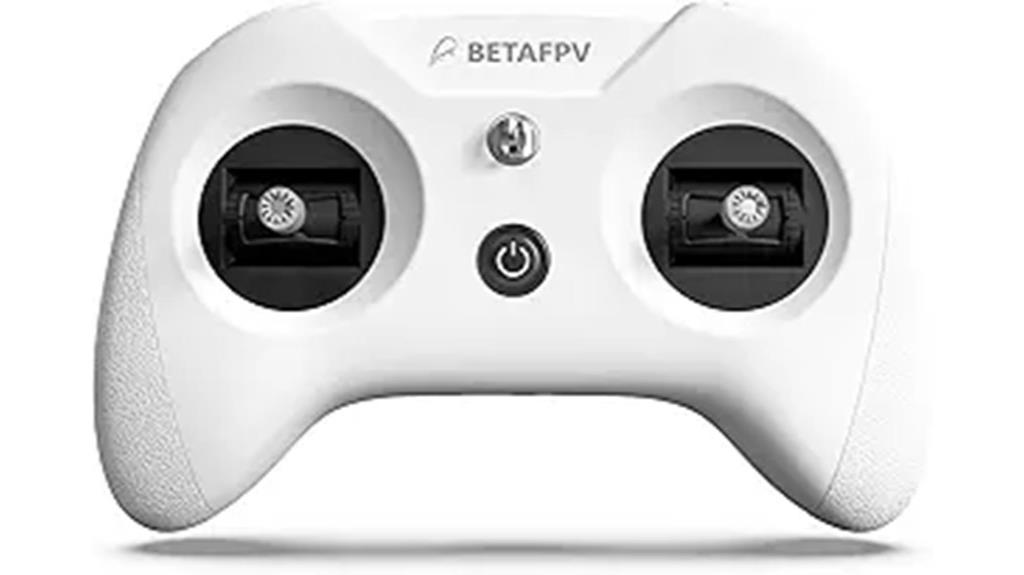
Designed for serious FPV drone pilots, the BETAFPV ELRS V3 LiteRadio 3 with Nano Bay stands out with its versatile external module support, allowing seamless integration of protocols like ELRS, CRSF, and TBS. It’s compatible with macOS, Linux, Windows, Android, and tablets, making it easy to use with popular simulators like VelociDrone, Liftoff, and DJI Flight Simulator. The device features a built-in 2000mAh battery that lasts up to 15 hours, plus a convenient charging module. Its nano bay supports external TX modules, giving you flexibility to upgrade your setup. Overall, it’s a reliable, customizable transmitter perfect for both virtual and real-world FPV flying.
Best For: serious FPV drone pilots seeking a versatile, customizable transmitter with broad compatibility, long battery life, and external module support.
Pros:
- Supports multiple platforms including macOS, Linux, Windows, Android, and tablets for versatile use.
- Offers up to 15 hours of battery life with a built-in 2000mAh battery, reducing downtime.
- Features a nano bay for external TX modules, enabling protocol upgrades like ELRS, CRSF, and TBS.
Cons:
- Firmware updates require connecting to a PC and using BETAFPV Configurator V2, which may be less convenient for some users.
- External module installation demands adherence to size and protocol specifications, potentially limiting compatibility if not matched correctly.
- The device’s complexity and customization options might be overwhelming for beginners unfamiliar with FPV equipment.
DTXMX FS-i6X 10CH Radio Transmitter and Receiver for RC Drone
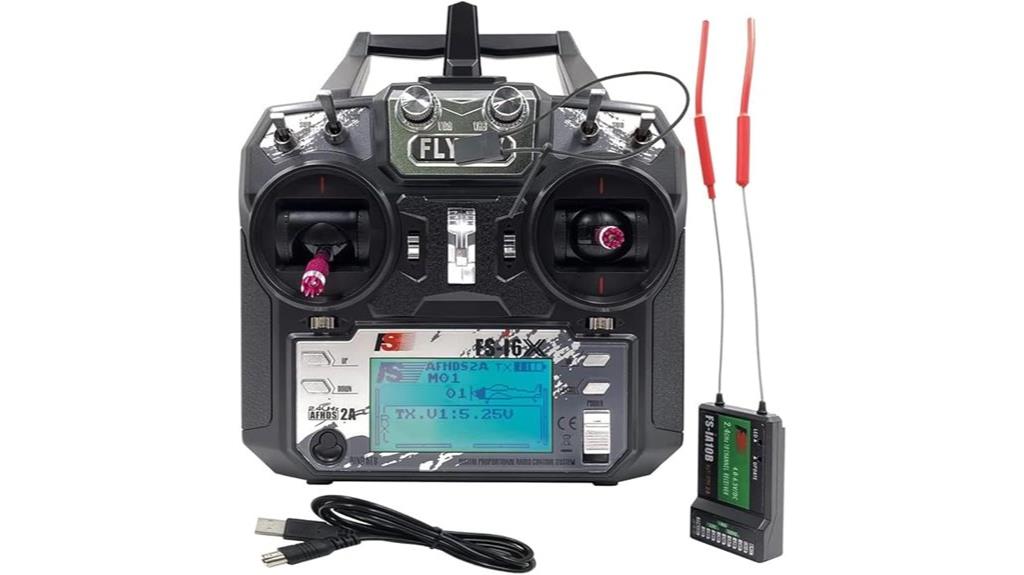
The DTXMX FS-i6X 10CH Radio Transmitter stands out for its advanced multi-channel hopping system, making it ideal for serious RC drone enthusiasts who need reliable, interference-resistant communication. It operates on 2.4GHz and supports 135 channels, ensuring stable signals even in crowded environments. The transmitter features bidirectional data transmission, including voltage monitoring, and uses omni-directional high-gain antennas that reduce interference while conserving power. With low power consumption, it offers extended flight times. Suitable for RC aircraft, helicopters, FPV drones, and quadcopters, the FS-i6X provides precise control and dependable performance in demanding flying conditions.
Best For: serious RC drone enthusiasts and hobbyists seeking reliable, interference-resistant control for complex flying conditions.
Pros:
- Advanced multi-channel hopping system with 135 channels for stable, interference-free communication
- Bidirectional data transmission with voltage monitoring enhances control and safety
- Low power consumption extends flight times and reduces battery replacement frequency
Cons:
- Slightly larger size may be less portable for some users
- Requires 4 AA batteries, which may need frequent replacement during intensive use
- Not suitable for beginners due to advanced features and setup complexity
BETAFPV Frsky D16 LiteRadio 2 SE Radio Transmitter Controller
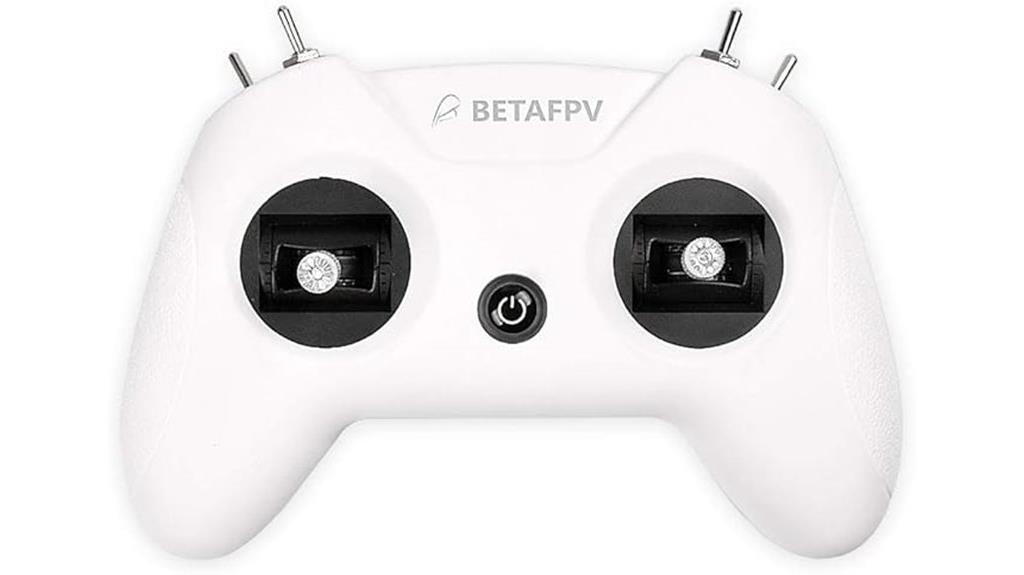
For beginners and hobbyists seeking a reliable, user-friendly transmitter, the BETAFPV Frsky D16 LiteRadio 2 SE stands out with its straightforward setup and versatile features. It supports Frsky D16 (FCC & LBT) protocol and is compatible with ACCST 1.X firmware XM+ receivers, with easy firmware updates via BETAFPV’s LiteRadio System. The transmitter integrates an FPV simulator function, working with platforms like Liftoff and DJI Flight Simulator, and offers up to 8 hours of operation thanks to its built-in 1000mAh battery. Its Mode 2 operation, USB-C charging, and simple calibration make it ideal for both beginners and experienced pilots.
Best For: beginners and hobbyists seeking an easy-to-use, versatile FPV transmitter with reliable protocol support and integrated simulation features.
Pros:
- Supports Frsky D16 (FCC & LBT) protocol and compatible with ACCST 1.X firmware XM+ receivers, ensuring broad compatibility.
- Built-in FPV simulator function works seamlessly with platforms like Liftoff and DJI Flight Simulator, enhancing virtual flying practice.
- Long battery life of up to 8 hours with easy USB-C charging and simple calibration for user convenience.
Cons:
- Does not support ACCST 2.0 or higher firmware, limiting future firmware upgrade options.
- Limited to Mode 2 operation, which may not suit all pilots’ preferences.
- Lacks advanced features found in more professional transmitters, such as customizable switches or extensive telemetry options.
BETAFPV LiteRadio 2 SE ELRS V3 Radio Transmitter Remote Controller
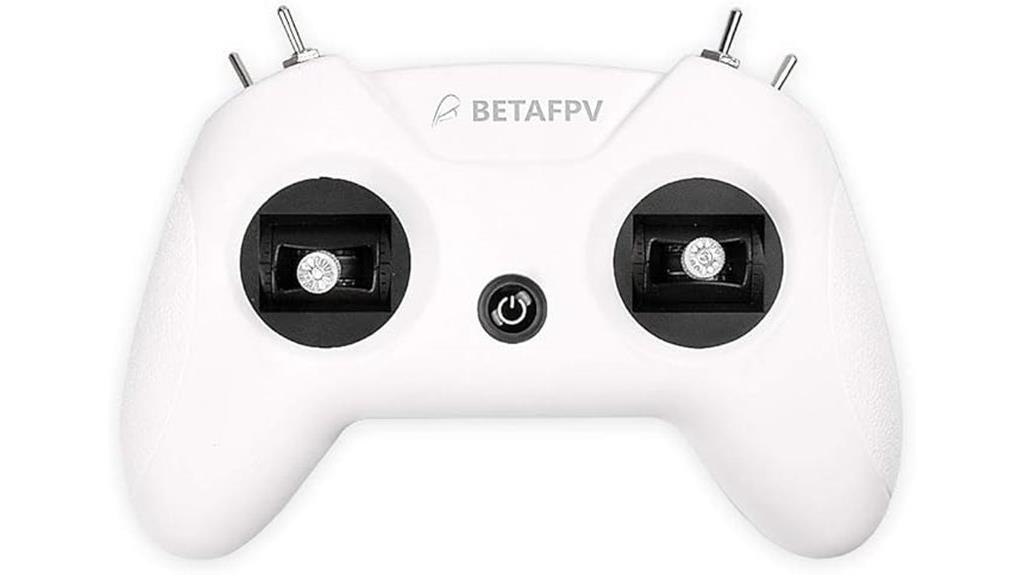
If you’re looking for a reliable and versatile FPV radio transmitter, the BETAFPV LiteRadio 2 SE ELRS V3 stands out thanks to its support for ELRS V3 firmware, ensuring faster response times and improved connectivity. It supports Mode 2 for FPV drones, with USB-C charging, joystick calibration, and compatibility with BETAFPV Configurator V2 for easy tuning. It doubles as a USB joystick for simulators like VelociDrone and DJI Flight Simulator, across desktop, Android, and tablets. Powered by a 1000mAh battery, it offers up to 8 hours of use, with a low-power warning system. Overall, it’s a solid choice for serious FPV pilots seeking performance and versatility.
Best For: FPV drone pilots seeking a reliable, versatile transmitter with fast connectivity and extensive simulator compatibility.
Pros:
- Supports ELRS V3 firmware for improved response times and connectivity
- Long battery life of up to 8 hours with a built-in 1000mAh battery
- Compatible with multiple FPV simulators and configurable via BETAFPV Configurator V2
Cons:
- Not compatible with ELRS 2.X receivers or modules
- Firmware updates require using the open-source BETAFPV configurator and may be complex for some users
- Limited to Mode 2 operation, which may not suit all pilots
APEX RC Radio Transmitter with FPV Controller and Built-in HF Head

Designed with FPV beginners in mind, the APEX RC Radio Transmitter with FPV Controller and Built-in HF Head offers a seamless combination of ease of use and advanced features. It supports dual protocols—ELRS 2.4G and autonomous TX—allowing flexible connectivity. With a built-in 500mW HF head and a 2000mAh battery, it delivers over ten hours of continuous flying. The transmitter also supports FPV simulator use on PC and Android devices without extra gear, making practice straightforward. Simple protocol switching, firmware updates via the ApexFlight app, and clear battery indicators make this transmitter a reliable choice for those starting out or looking for long-lasting performance.
Best For: FPV beginners and casual drone pilots seeking a user-friendly transmitter with long battery life and versatile connectivity options.
Pros:
- Supports dual protocols (ELRS 2.4G and autonomous TX) for flexible device compatibility
- Built-in 500mW HF head with over ten hours of continuous operation
- FPV simulator support on PC and Android without additional accessories
Cons:
- Requires configuration via ground station for ELRS-based aircraft re-pairing
- Firmware updates demand a continuous connection with the ApexFlight app, which may be cumbersome
- Limited advanced customization features compared to high-end transmitters
Radiolink AT9S Pro 10/12 Channel Radio Transmitter and Receiver
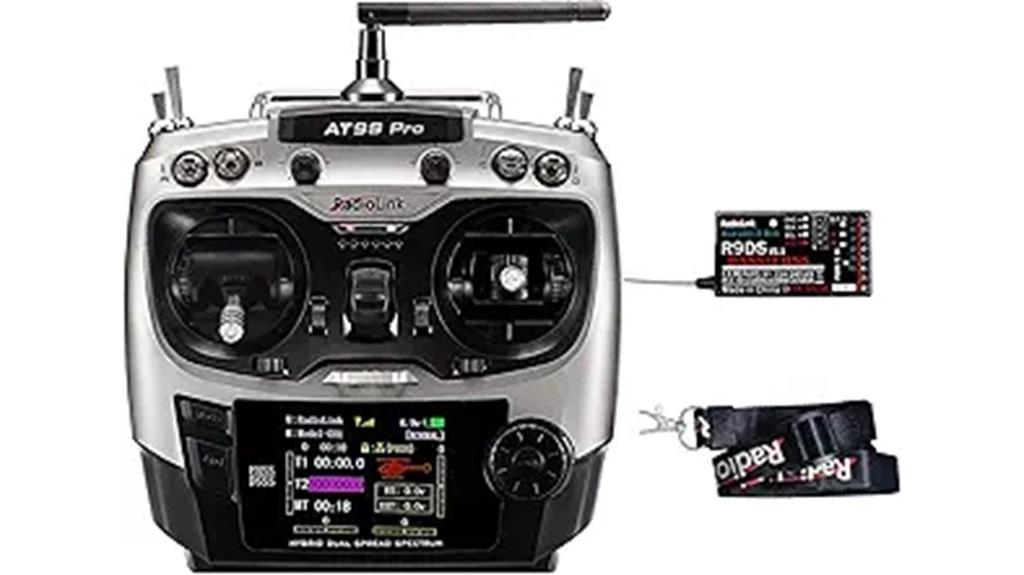
The Radiolink AT9S Pro stands out for enthusiasts who need reliable long-range control, thanks to its DSSS and FHSS communication technology that guarantees stable signals up to 2.1 miles (3.4 km). Its 10/12 channels support advanced telemetry features like battery voltage, speed, altitude, and RSSI, especially when paired with the PRM-01 or PRM-03 modules. The LCD screen provides real-time monitoring and alerts, including low voltage alarms and failsafe protection. With a 3-in-1 port supporting simulators, Long Range modules, and wireless training, this transmitter offers versatility and safety, making it an excellent choice for serious FPV pilots.
Best For: enthusiasts and professional FPV pilots seeking reliable long-range control with advanced telemetry and versatile compatibility.
Pros:
- Stable long-range transmission up to 2.1 miles (3.4 km) using DSSS & FHSS technology
- Supports extensive telemetry features including battery voltage, speed, altitude, and RSSI
- Versatile 3-in-1 port for simulators, Long Range modules, and wireless trainer mode
Cons:
- May require additional modules (PRM-01 or PRM-03) for full telemetry capabilities
- Slightly complex setup for beginners unfamiliar with advanced RC features
- Limited details on compatibility with some specific flight controllers or accessories
Radiomaster TX15 Radio Controller with 16 Channels and Touchscreen
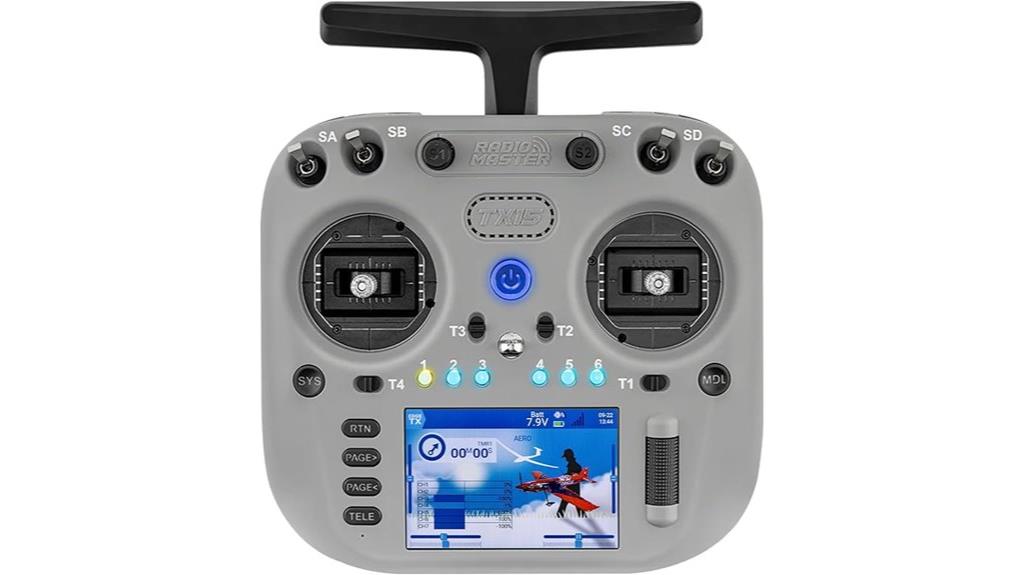
For serious FPV pilots seeking precision and versatility, the Radiomaster TX15 stands out with its 16-channel capability and intuitive touchscreen interface. It supports multiple modes, including Mode 2 (Iron Grey), and offers a JR-compatible module bay for extra flexibility. The high-precision V5.0 Hall Effect Gimbals ensure smooth, durable control, while the 3.5-inch IPS touchscreen makes model management effortless. Powered by the fast STM32 H7 chip and supporting long-range protocols like ExpressLRS, it guarantees stable, low-latency communication. Its robust build, versatile battery options, and all-encompassing accessories make the TX15 a top-tier choice for demanding FPV pilots.
Best For: FPV drone pilots and RC enthusiasts seeking a high-precision, versatile, and user-friendly transmitter with advanced features and long-range capabilities.
Pros:
- Supports 16 channels with a responsive touchscreen interface for effortless control and model management
- Equipped with high-precision V5.0 Hall Effect Gimbals for smooth and durable handling
- Compatible with multiple protocols like ExpressLRS and includes a JR module bay for added flexibility
Cons:
- Slightly larger size may be less portable for some users
- Batteries are not included, requiring additional purchase for setup
- Complex features might have a learning curve for beginners
FPV Controller C8 ELRS Transmitter & Receiver for Drones
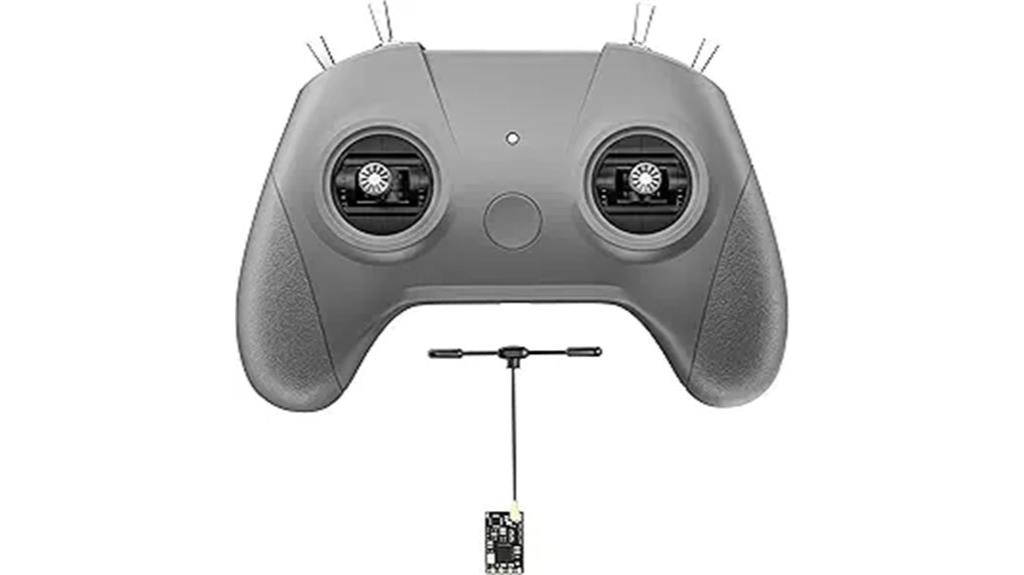
If you’re seeking a reliable all-in-one control system for your FPV drone, the FPV Controller C8 ELRS Transmitter & Receiver combo stands out. This setup combines the C8 ELRS transmitter with the CR8 ELRS receiver, making it easy to set up for various aircraft like Tiny Whoops, fixed-wings, and helicopters. Operating on 2.4GHz with a range of up to 2 miles, it offers stable, low-latency communication. The compact, durable design features impact-resistant components and long-lasting battery life—up to 2 hours—plus user-friendly controls suitable for all skill levels. It’s a versatile, reliable choice for any FPV pilot.
Best For: FPV drone pilots seeking a reliable, all-in-one control system with long-range, low-latency communication suitable for various aircraft types and skill levels.
Pros:
- Easy setup with all-in-one ELRS module system compatible with multiple aircraft and simulators
- Stable 2.4GHz connectivity with up to 2 miles (3 km) range in open areas
- Compact, impact-resistant design with long-lasting 2-hour battery and user-friendly controls
Cons:
- Limited to 2.4GHz frequency, which may be affected by interference in crowded areas
- Requires familiarity with ELRS system setup for optimal performance
- Battery life, while sufficient for most flights, may be limiting for extended sessions without recharging
TBS Tango 2 PRO RC FPV Radio Transmitter
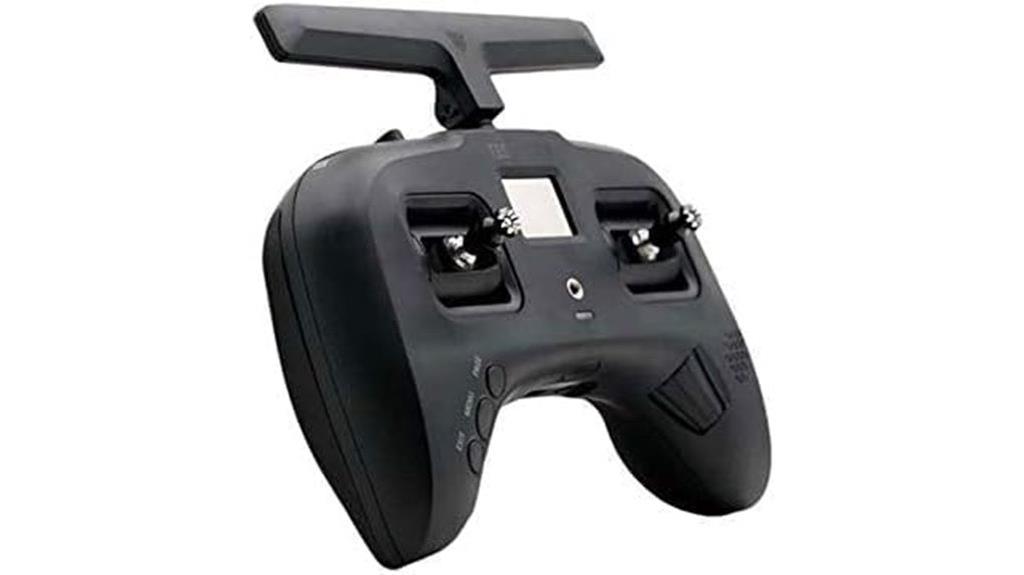
Designed with serious FPV enthusiasts in mind, the TBS Tango 2 PRO stands out thanks to its integrated Crossfire Micro TX, which supports 25-250mW output power for reliable, long-range control. Its compact, ergonomic design features rubber grips and foldable sticks that require minimal force, making it comfortable for extended flying sessions. The high-resolution OLED screen provides clear status updates, while the open-source FreedomTX firmware offers extensive customization options. Equipped with full-size hall sensor gimbals, a rocker dial, and intuitive menu buttons, it delivers precise control and easy navigation. The built-in 5000mAh LiPo battery and USB-C charging guarantee long-lasting use and quick recharges.
Best For: serious FPV hobbyists and drone pilots seeking a reliable, feature-rich, long-range RC transmitter with extensive customization options.
Pros:
- Integrated Crossfire Micro TX supports 25-250mW for dependable long-range control
- Open-source FreedomTX firmware allows extensive customization and LUA scripting
- Ergonomic design with foldable sticks, rubber grips, and high-resolution OLED screen for comfort and clarity
Cons:
- Relatively high weight at 8 ounces may be less ideal for extended handheld use
- Limited to users aged 15 and older, possibly restricting younger beginner pilots
- Customer rating currently at 4.0 stars from one review, indicating potential variability in user satisfaction
Factors to Consider When Choosing Fpv Radios (Transmitters)
When selecting an FPV radio transmitter, I consider several key factors to guarantee it matches my setup and flying style. Things like compatibility with my devices, frequency range, and control features matter a lot, along with battery life and firmware updates. Let’s explore these points to help you choose the best transmitter for your needs.
Compatibility With Devices
Choosing the right FPV radio transmitter requires ensuring it’s compatible with your drone’s communication protocols, such as ELRS, Frsky D16, or Crossfire. I always double-check that the transmitter supports the protocol used by my drone to avoid connectivity issues. It’s also essential to verify that the physical connector and external module bay match your receiver modules. Firmware support matters too—making sure it can be updated keeps your device compatible with new features. I pay attention to the operating frequency and modulation type to prevent signal conflicts with my receiver. Ultimately, I confirm that the hardware supports the necessary power levels and voltage inputs for my FPV gear. Ensuring these compatibility factors helps me maintain reliable communication and smooth flying experiences.
Frequency and Range
The frequency band you select for your FPV radio substantially impacts signal penetration, interference susceptibility, and overall control range. Typically, these radios operate on 2.4GHz or 5.8GHz bands. 2.4GHz offers longer range and better penetration through obstacles but can be more prone to interference from Wi-Fi and other devices. Conversely, 5.8GHz provides a shorter range but tends to resist interference better, making it ideal for crowded flying environments. For long-range flights, many pilots opt for systems capable of transmitting several miles, sometimes over 10 miles under ideal conditions. Factors like transmitter power, antenna quality, and environmental obstacles also influence effective control range. Technologies such as frequency hopping and spread spectrum improve stability by reducing interference, ensuring a more trustworthy connection during flight.
Firmware and Updates
Keeping your FPV radio’s firmware up to date is essential for peak performance, security, and compatibility. Firmware updates enhance signal stability, introduce new features, and fix bugs that could cause connection issues. Many transmitters support upgrades through dedicated software or open-source tools like Betafpv Configurator or OpenTX, making updates accessible. Regularly checking your firmware version and updating when needed helps prevent problems such as signal loss or connectivity drops. It’s important to affirm the update supports your receiver modules and protocols to avoid compatibility issues. Connecting to a PC or using a specific app is usually required, but staying current guarantees you’re leveraging the latest security patches and performance improvements. In the long run, keeping firmware up to date ensures your FPV experience remains reliable and secure.
Control Features and Comfort
When selecting an FPV radio transmitter, prioritizing control features and comfort can make a significant difference in your flying experience. An ergonomic design and a comfortable grip are crucial for long sessions, reducing fatigue. High-quality gimbals, like those with Hall-effect sensors, provide smooth, precise control movements that enhance responsiveness. The placement and number of switches, buttons, and dials should allow for intuitive operation and quick access to essential functions, minimizing distraction. A bright, high-contrast display helps me read telemetry and settings clearly in various lighting conditions. Additionally, adjustable trigger and stick tension let me customize the feel for ideal control and comfort, ensuring I stay focused and confident during flights.
Battery Life and Charging
Long battery life is essential for extended FPV sessions, so I can focus on flying without constantly worrying about recharging. Many FPV radios support rechargeable batteries like LiPo or Li-ion, allowing me to quickly recharge and keep flying. USB-C charging is becoming standard on newer models, offering fast charging and convenient power options. Battery indicators or low-battery warnings are critical, helping me monitor power levels and avoid unexpected shutdowns mid-flight. External battery packs or replaceable batteries further extend operational time, giving me flexibility during long sessions. When choosing a transmitter, I prioritize models with long-lasting batteries and efficient charging options, ensuring I stay in the air longer and maintain focus on my flights without interruptions.
Expandability and Modules
Choosing a FPV radio with good expandability guarantees I can easily adapt my setup as my flying needs evolve. I look for radios with modular bay systems that support external modules like ELRS, Crossfire, or TBS, ensuring compatibility with various protocols. It’s important that the transmitter supports a wide range of modules so I can upgrade or switch standards without hassle. I also check if swapping modules is straightforward, avoiding complex disassembly or technical barriers. Firmware updates for external modules are vital, as they enhance performance and add features over time. Additionally, expandability options like extra ports or slots for accessories such as GPS, external antennas, or telemetry modules give me flexibility for future upgrades. This approach keeps my setup versatile and future-proof.
Ease of Use
A FPV radio with intuitive controls and a user-friendly interface makes flying more enjoyable and less frustrating. Clear menus and straightforward setup simplify daily use, especially for beginners. Features like adjustable gimbals, labeled switches, and customizable buttons allow for quick adjustments and personalized control layouts. An ergonomic design with comfortable grips and well-placed controls helps reduce fatigue during long flights. Compatibility with popular firmware and software guarantees easy calibration and configuration, saving time and effort. Lightweight, compact transmitters are easier to handle and carry, making them ideal for on-the-go flying. Additionally, straightforward binding processes help newcomers get flying faster. Overall, a radio that prioritizes ease of use lets you focus on flying and enjoying your flights without unnecessary complications.
Frequently Asked Questions
How Do Firmware Updates Impact Transmitter Compatibility?
Firmware updates can greatly impact transmitter compatibility by introducing new features, fixing bugs, and improving performance. When I update my transmitter’s firmware, I make sure it stays compatible with the latest receivers and flight controllers. Sometimes, updates may cause temporary compatibility issues or require firmware updates on other devices. So, I always check manufacturer notes before updating, and I keep all my gear synchronized to avoid any hiccups.
What Are the Best Ergonomics for Long FPV Sessions?
For long FPV sessions, I prioritize ergonomic design that fits comfortably in my hands. I look for transmitters with adjustable grips, textured surfaces, and ergonomic contours that reduce fatigue. Lightweight models with balanced weight distribution help prevent strain, while thumb or finger sticks should be easy to reach and operate. Ultimately, finding a transmitter that feels natural and reduces tension makes my flying sessions more enjoyable and sustainable.
How Important Is Cross-Brand Compatibility for Receivers?
Think of cross-brand compatibility like a universal translator at a global conference. It’s pretty vital because it guarantees your receiver can understand signals from various transmitters, giving you flexibility and peace of mind. Without it, you’re stuck with limited options, risking signal loss or extra gear. I believe it’s indispensable for seamless flying and future-proofing your setup, so I always prioritize compatibility when choosing my gear.
Do Certain Transmitters Support Multiple Protocols?
Yes, some transmitters do support multiple protocols, and I find that really useful. It allows me to fly different types of drones with a single transmitter, saving me from juggling multiple radios. Brands like FrSky and TBS offer multi-protocol compatibility, making my setup more versatile. If you’re into experimenting or flying various models, I recommend choosing a transmitter that supports multiple protocols for maximum flexibility.
What Safety Features Should I Look for in a Transmitter?
When choosing a transmitter, I look for safety features like failsafe options that prevent crashes if signal drops, and built-in alarms to alert me of low battery or interference. Encryption is also key, ensuring my control signals stay secure. I also prefer transmitters with robust anti-interference tech, so my flights stay safe and smooth, even in busy or challenging environments. These features give me peace of mind during every flight.
Conclusion
Choosing the right FPV radio transmitter can truly elevate your drone flying experience. Did you know that over 60% of pilots report better control and confidence with transmitters that fit their style? Whether you prefer compact designs or advanced features like touchscreens, there’s an option for everyone. Take your time, consider your needs, and you’ll find the perfect match to open new levels of flight fun and precision. Happy flying!