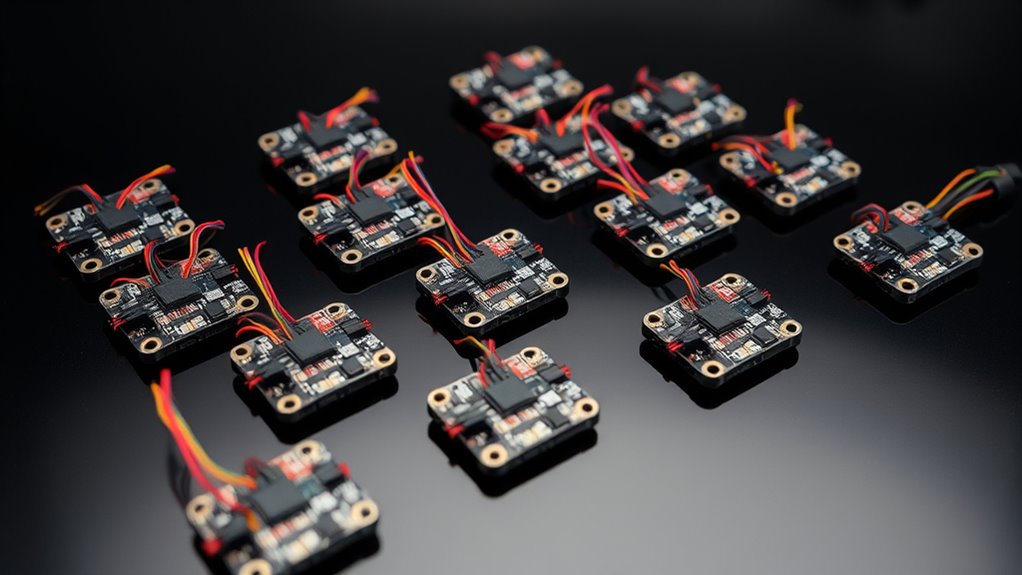

For most FPV pilots, I’d start with the DYS F7 F722 30×30 stack: its F7 controller and 65A 4-in-1 ESC make it a strong fit for performance-focused builds. The BETAFPV ELRS Matrix 1S stands out for compact 1S drones with integrated receiver and video hardware, while the H743 Flight Controller with Dual IMU offers more connectivity and broader firmware support for complex aircraft. The main tradeoffs are board size, ESC capacity, soldering and setup demands, and whether you need Betaflight alone or support for other firmware. A feature-rich controller may be wasted in a simple build, while a compact all-in-one board can limit upgrades. Read on for the full comparison and guidance on matching a controller to your frame and flying style.

Get the latest gadgets delivered free with Prime
- Fast, free delivery on millions of items
- Prime Video, Amazon Music and more included
- Member-only deals all year
Complete the kit



Key Takeaways
- The DYS F7 F722 stack is the performance-led pick: its 65A ESC rating and 30×30 format suit builds that need more current headroom than compact or lower-rated options.
- The BETAFPV ELRS Matrix is a different kind of choice: its 1S 5-in-1 design prioritizes low weight and integrated components over modular upgrades.
- F405 boards dominate the practical middle ground: several picks pair F405 controllers with ESCs, but the 35A, 45A, 60A, and 8S configurations serve different power and build needs.
- H743 boards make sense when features extend beyond ordinary Betaflight use: dual IMU, barometer, compass, and wider firmware support bring flexibility, but add setup and integration demands.
- Mounting format and firmware details matter as much as headline specs: 20×20, 30×30, and 30.5×30.5 stacks are not interchangeable by default, and a preconfigured Betaflight 4.2.0 board may need firmware attention.


| betaflight flight controller | BEC outputs |
|---|---|
| F4V3S Betaflight Flight Contro | — |
| BETAFPV ELRS Matrix 1S Brushle | — |
| DYS F7 F722 Flight Controller | 3.3V/1A, 5V/3A, 12V/3A |
| AERO SELFIE F405NC Flight Cont | — |
| CORVON F405 Flight Controller | 5V 3A and 9V 3A |
| F722 Flight Controller 30.5×30 | 5V and 10V |
| H743 Flight Controller for Dro | 5V 3A and 9V 3A |
| F405 Mini Stack | 5V 2A and 9V 3A |
| Preconfigured F4DC Flight Cont | — |
| F405 NC Drone Flight Controlle | 5V 3A and 9V 3A |
| HGLRC F405 8S V2 Flight Contro | — |
| AERO SELFIE F405NC Flight Cont | — |
| MicoAir H743 Flight Controller | 5V 3A and 9V 3A |
More Details on Our Top Picks
F4V3S Betaflight Flight Controller Board for Quadcopter RC Drone
The F4V3S is a standalone F405 controller for builders who want to choose their own ESC and peripherals rather than buy a complete stack. Its BMP280 barometer and OSD support add flight-data options that the compact BETAFPV ELRS Matrix 1S combines with its ESC, receiver, and VTX instead. That makes the F4V3S a more flexible fit for custom wiring, but also means more parts and setup work. The listed SBUS/PPM, DSM-X, SD card, IR, and ESC connections give it room for varied equipment, though the product data does not spell out every port’s implementation. I’d favor it for a conventional 30.5mm build where firmware familiarity matters; newcomers may find the limited setup guidance a hurdle.
Pros:- STM32F405 processor supports Betaflight and INAV firmware
- BMP280 barometer and OSD support expand flight-data options
- Multiple listed ports accommodate varied receivers and peripherals
- 30.5mm mounting pattern suits common full-size builds
Cons:- A separate ESC and other components add wiring and build work
- Product information gives limited setup and port-configuration guidance
Best for: FPV builders who already know Betaflight setup and want an F405 board with a barometer, OSD support, and room to select a separate ESC.
Not ideal for: First-time builders seeking a documented plug-and-play stack, or 1S micro-drone pilots who need an integrated receiver and VTX.
- MCU:STM32 F405
- Gyro and accelerometer:IC268G (MPU6500)
- Barometer:BMP280
- Mounting pattern:30.5 × 30.5mm
- Board size:36 × 36mm
- Power:5V 3A SBEC
- Listed ports:SBUS/PPM, Spectrum DSM-X, SD card, IR, ESC
- Firmware support:Betaflight and INAV
Our verdict“Choose the F4V3S for a customizable F405 build with barometer and OSD support, but not for an all-in-one or beginner-friendly setup.”
BETAFPV ELRS Matrix 1S Brushless Flight Controller, 5-in-1 FC with Built-in Serial ELRS RX/VTX for FPV Racing Drones
For a small 1S quad, the BETAFPV ELRS Matrix saves space and soldering by combining the flight controller, 5A ESC, ELRS receiver, and 5.8GHz VTX on one board. That is a different proposition from the F4V3S, which leaves the ESC and radio components to the builder and offers a more conventional separate-board approach. The Matrix also pairs an STM32G473 with 16MB of blackbox memory, giving it a strong feature set for a micro build. Its limits are equally specific: it accepts 1S power only, the ESC is rated for 5A continuous, and the receiver requires a matching ELRS version and firmware target. The integrated design cuts wiring, but makes component upgrades or replacements less modular.
Pros:- Combines FC, ESC, serial ELRS receiver, and VTX on one board
- No-weld installation design can reduce wiring work
- STM32G473 and 16MB blackbox memory provide useful processing and logging capacity
- Built-in 5.8GHz VTX supports up to 400mW
Cons:- Limited to 1S power and a 5A continuous ESC rating
- ELRS receiver compatibility depends on matching firmware and protocol versions
- Integrated components are less modular than the F4V3S standalone board
Best for: Pilots building compact 1S brushless FPV quads who want onboard ELRS and video transmission with fewer separate components to wire.
Not ideal for: Builders using 2S-or-higher packs, higher-current motors, or a preferred receiver and VTX they want to install separately.
- FC MCU:STM32G473CEU6
- Gyro:ICM42688P
- Power input:1S
- ESC:5A continuous
- Receiver:Serial ELRS 2.4GHz (V3.4.3)
- VTX:5.8GHz, up to 400mW, 48 channels
- Blackbox memory:16MB
- Mounting pattern:26 × 26mm
- Weight:3.92g
Our verdict“Pick the Matrix for a compact 1S build where integrated ELRS and VTX matter more than power headroom or component flexibility.”
DYS F7 F722 Flight Controller 30×30 AM32 65A 4-in-1 Brushless ESC for Racing and FPV Drones
The DYS F7 F722 pairs an F722 controller with a 65A 4-in-1 ESC, making it the most power-oriented option in this group. Its 2–8S input range and listed 80A burst current offer more battery and current headroom than the 2–6S CORVON F405 stack. Six UARTs, 16MB flash, a barometer, and an OSD chip also give builders room for a receiver, peripherals, and flight-data features. That capability comes with a larger 30.5mm mounting footprint and a setup burden that may not suit a first build. The product description mentions Bluejay firmware while listing Betaflight for the controller, so I’d verify the exact ESC firmware and configuration before choosing it. It is better suited to a demanding build than a minimal micro quad.
Pros:- 65A continuous and 80A burst ESC ratings suit higher-current setups
- 2–8S input range is broader than the CORVON F405 stack’s 2–6S range
- Six UARTs and I2C pads allow varied peripheral connections
- 16MB flash, BMP280 barometer, and AT7456E OSD chip are included
Cons:- 30.5mm mounting pattern and 38 × 38mm dimensions limit fit in smaller frames
- Firmware details mention both Bluejay and Betaflight without clarifying ESC configuration
- Setup complexity and limited documentation may challenge newer builders
Best for: Experienced freestyle or racing builders running 2–8S who need a bundled high-current ESC, multiple UARTs, and extensive peripheral connections.
Not ideal for: Beginners seeking straightforward documentation, pilots building compact 20mm or 26mm frames, or buyers who need clearly specified telemetry support.
- MCU:STM32F722
- Gyro:ICM42688P
- ESC current:65A continuous, 80A burst
- Input voltage:2–8S LiPo
- Mounting pattern:30.5 × 30.5mm
- UARTs:6
- Flash:16MB
- BEC outputs:3.3V/1A, 5V/3A, 12V/3A
- Dimensions and weight:38 × 38mm; 10.0g
Our verdict“Choose the DYS F7 stack for a high-current 2–8S build with broad connectivity, provided you can verify and configure its firmware details.”
AERO SELFIE F405NC Flight Controller with 45A 8-bit ESC for Drones
The AERO SELFIE F405NC is the standout here for builders who value two listed IMUs and a barometer alongside a bundled 45A ESC. Its six UARTs, ten PWM outputs, I2C, and USB Type-C give it more listed connection options than the CORVON F405 stack, while the CORVON counters with a higher 60A ESC rating and specified dual BEC outputs. The F405NC’s 2–6S support suits many full-size FPV builds, and the dual-IMU arrangement offers another sensor option in the controller package. However, the description does not identify the ESC firmware or provide detailed setup guidance, and the 23.2g total weight is not especially light beside a standalone board like the F4V3S. I’d shortlist it for connectivity and sensor redundancy, not minimum weight.
Pros:- Dual listed IMUs and a DPS310 barometer expand sensor options
- Six UARTs, ten PWM outputs, I2C, and USB Type-C offer broad connectivity
- 45A per-channel continuous current with over 60A burst rating
- Listed compatibility includes Betaflight, INAV, and ArduPilot
Cons:- 23.2g stack weight is higher than a standalone flight controller
- 45A continuous rating is below the CORVON stack’s listed 60A
- Product details provide limited guidance on setup and ESC firmware
Best for: Builders of 2–6S racing, freestyle, or cinematic drones who want a stack with dual IMUs, a barometer, and many peripheral connections.
Not ideal for: Weight-sensitive builds, pilots who need a clearly documented ESC firmware setup, or anyone seeking the higher stated ESC current of the CORVON stack.
- Processor:STM32F405, 168MHz
- Dual IMUs:BMI42688 / BMI42688
- Barometer:DPS310
- Battery support:2–6S LiPo
- ESC current:45A per channel continuous; over 60A burst
- Connectivity:6 UART, 10 PWM, I2C, USB Type-C
- Mounting pattern:30.5 × 30.5mm
- Weight:23.2g
Our verdict“Pick the F405NC if dual IMUs and extensive connections matter more than a lighter stack or the CORVON’s higher ESC current rating.”
CORVON F405 Flight Controller with 60A 8-bit ESC 30×30 Stack
The CORVON F405 stack is a versatile 2–6S package with a 60A ESC, six UARTs, and support for Betaflight, INAV, and ArduPilot. Its BMI088 IMU and SPL06 barometer give the controller a sensor set that is more fully specified than the AERO SELFIE F405NC’s dual-IMU listing, while its 5V and 9V BEC outputs offer defined power options for accessories. The tradeoff is the ESC: it uses 8-bit firmware, unlike buyers seeking a newer 32-bit ESC platform, and the description does not spell out its protocol capabilities. At 22.8g for the stack, it is not a featherweight choice, though the split FC and ESC weights help with build planning. I’d choose it for firmware flexibility and connectivity over the DYS F7’s wider 2–8S range and higher current rating.
Pros:- Listed support for Betaflight, INAV, and ArduPilot
- 60A ESC rating and 2–6S input suit a broad range of full-size builds
- Six UARTs plus SBUS, I2C, and USB-C support varied connections
- 5V and 9V 3A BEC outputs provide distinct accessory power options
Cons:- 8-bit ESC firmware may be less appealing than a 32-bit ESC option
- 2–6S range is narrower than the DYS F7 stack’s listed 2–8S support
- 22.8g total stack weight may not suit builds focused on minimizing mass
Best for: Builders who want a 30mm stack for 2–6S aircraft and may switch among Betaflight, INAV, and ArduPilot while using several peripherals.
Not ideal for: Pilots who prioritize 32-bit ESC firmware, need more than 60A continuous current, or are building a compact 1S quad.
- Processor:STM32F405
- IMU:BMI088
- Barometer:SPL06
- ESC:60A, 8-bit
- Voltage support:2–6S LiPo
- Stack mounting:30 × 30mm
- Connectivity:6 UART, 10 PWM, SBUS, I2C, USB-C
- BEC outputs:5V 3A and 9V 3A
- Stack weight:22.8g total; FC 9g, ESC 13.8g
Our verdict“Choose the CORVON for multi-firmware flexibility and a 60A 2–6S stack, but skip it if 32-bit ESC firmware is a priority.”
F722 Flight Controller 30.5×30.5MM FC Stack with 4in1 60A ESC for FPV RC Racing Drone
I’d put this F722 stack on the shortlist for builds that need more motor outputs than a standard quad. Its eight motor outputs allow an X8 layout, while the 60A 4-in-1 ESC and dual 5V/10V BECs give the build room to power several components. Onboard OSD, a barometer, and black-box logging add flight information and tuning data without requiring separate modules. Compared with the compact F405 Mini Stack, this is a larger 30.5mm-format option aimed at more involved builds, not small frames. The tradeoff is setup complexity: beginners may find the wiring and configuration demanding, and the large solder pads call for careful work. I’d choose it for a capable multi-motor build, not a simple first quad.
Pros:- Supports up to eight motor outputs for complex layouts such as X8 builds
- 60A 4-in-1 ESC pairs with dual 5V and 10V BEC outputs
- Onboard OSD, barometer, and black-box logging provide useful flight and tuning data
- TVS protection and support for Bluejay firmware and bidirectional DSHOT add configuration options
Cons:- The feature set and wiring demands can make setup difficult for beginners
- Large solder pads require careful soldering
- The 30.5mm mounting pattern rules it out for many compact frames
Best for: Experienced builders assembling an X8 or another drone that needs up to eight motor outputs, onboard flight data, and a 60A ESC.
Not ideal for: First-time builders and compact-frame pilots who do not need eight motor outputs or the 30.5mm mounting format.
- Main chip:F722
- Mounting size:30.5 x 30.5 mm
- Motor outputs:Up to 8
- ESC:4-in-1, 60A
- BEC outputs:5V and 10V
- Onboard features:OSD, barometer, black box, TVS protection
- Firmware and ESC support:Bluejay firmware and bidirectional DSHOT
Our verdict“Choose this F722 stack for a larger, feature-rich multi-motor build; skip it if you need a straightforward compact quad controller.”
H743 Flight Controller for Drones with Dual IMU, Barometer, Compass, STM32H743, 7 UART, 10 PWM, Supports Betaflight, INAV, Ardupilot, PX4, USB-C, Blackbox Logging, 5V/9V BEC Outputs
This H743 is the most sensor- and connection-rich option in this batch, aimed at builders who want to move between Betaflight, INAV, ArduPilot, and PX4. The STM32H743 processor, dual IMUs, barometer, and compass suit projects that need more than a basic racing-quad setup, while seven UARTs and ten PWM outputs leave room for peripherals and control channels. Compared with the F722 stack, it offers broader firmware support and navigation sensors, but it does not include the F722’s specified 60A 4-in-1 ESC. That makes this a controller for a more modular build, not a complete FC-and-ESC stack. Configuration is also more demanding, and I’d verify firmware support for the exact build before choosing it.
Pros:- STM32H743 processor and 2MB flash support a feature-rich controller platform
- Dual IMUs, barometer, and compass provide a broad sensor set
- Seven UARTs and ten PWM outputs accommodate many peripherals and control channels
- Supports Betaflight, INAV, ArduPilot, and PX4
Cons:- No 4-in-1 ESC is specified, so the build needs a separate ESC solution
- Advanced firmware and sensor configuration can be demanding
- Its broader navigation feature set may be unnecessary for a standard FPV racing quad
Best for: Experienced UAV builders who need multiple firmware choices, navigation sensors, and many UART and PWM connections.
Not ideal for: Pilots seeking a plug-together Betaflight stack with an included ESC or a simple setup for a basic racing quad.
- Processor:STM32H743VIT6, 480MHz
- Flash and RAM:2MB flash, 1024KB RAM
- Dimensions and mounting:36 x 36 x 8 mm; 30.5 x 30.5 mm mounting
- Voltage range:2S–6S
- Connectivity:7 UART ports, 10 PWM outputs, 1 I2C
- Sensors:Dual BMI088/BMI270 IMUs, DPS310 barometer, IST8310 magnetometer
- BEC outputs:5V 3A and 9V 3A
- Firmware support:Betaflight, INAV, ArduPilot, PX4
Our verdict“Pick the H743 when firmware flexibility and navigation sensors matter more than having an ESC bundled into the stack.”
F405 Mini Stack, 20×20, 35A ESC, Bluetooth, APP Control
The F405 Mini Stack stands out for buyers who want a 20x20mm build with Bluetooth-based configuration rather than a full-size board and wired setup for every adjustment. Its built-in Bluetooth and app control can make routine configuration more convenient, while the 35A ESC suits builds that do not need the higher current capacity of the 60A F722 stack. Dual 5V and 9V BEC outputs help power accessories, including compatible DJI Air Units. Against the brushed-motor F4DC, this is the more relevant choice for a compact FPV stack, but its app workflow depends on a compatible smartphone and may not suit every pilot. I’d also check frame mounting and component fit before buying; compact dimensions limit installation space.
Pros:- 20x20mm stack format fits many compact frames
- Built-in Bluetooth enables wireless configuration through an app
- Dual 5V 2A and 9V 3A BEC outputs support different accessories
- Listed compatibility with DJI Air Units and analog video transmission
Cons:- The 35A ESC offers less current capacity than the 60A F722 stack
- App-based control requires a compatible smartphone
- Four UART ports provide fewer connection options than the CORVON H743’s seven
Best for: FPV builders fitting a 20x20mm frame who want Bluetooth app configuration and power outputs for compatible video equipment.
Not ideal for: Pilots who prefer wired configuration, lack a compatible smartphone, or need a higher-current ESC for a demanding build.
- Stack size:20 x 20 mm
- ESC current:35A
- Bluetooth:Built in
- UART ports:4
- BEC outputs:5V 2A and 9V 3A
- Battery indicator:4-level
- Listed video compatibility:DJI Air Units and analog video transmission
- Frame compatibility:M2/M3 frames
Our verdict“Choose this mini stack for a compact FPV build where wireless setup and a 35A ESC meet your needs.”
Preconfigured F4DC Flight Controller with Betaflight 4.2.0 Firmware for FPV Racing Drones and Quadcopters
This F4DC is a niche pick for small brushed-motor drones, not a general-purpose controller for modern 2S–6S FPV builds. It arrives with Betaflight 4.2.0 preconfigured, which may shorten initial setup for compatible builds, and its 8g weight suits compact frames. The listed support for 615 and 8520 brushed motors and 1S–2S batteries sets it apart from the F405 NC, which is specified for higher-voltage builds and a wider set of peripherals. The F4DC also lists a barometer and flight modes including Height Hold and Position Hold. Those details do not make it a substitute for a full-featured modern FPV controller: the narrow voltage and motor compatibility are real limits, and installation still calls for technical care.
Pros:- Preconfigured with Betaflight 4.2.0 for compatible builds
- 8g weight suits small, lightweight quadcopters
- Supports listed 615 and 8520 brushed motors
- Includes an MPU6500 IMU and BMP280 barometer
Cons:- Limited to 1S–2S battery configurations
- Brushed-motor compatibility makes it unsuitable for typical brushless FPV builds
- The supplied firmware version is an older Betaflight release
Best for: Hobbyists building compact 100mm-class quadcopters with compatible 615 or 8520 brushed motors and 1S or 2S batteries.
Not ideal for: FPV pilots building brushless, higher-voltage quads or seeking broad peripheral connections and current Betaflight feature headroom.
- Processor:STM32F411CEU6
- IMU:MPU6500
- Barometer:BMP280
- Firmware:Betaflight 4.2.0
- Motor compatibility:615 and 8520 brushed motors
- Battery voltage:1S–2S (3.0V–8.4V)
- Weight:8g
- Module length:5.8cm / 2.28in
Our verdict“Choose the F4DC for a compact brushed-motor project, not as a flexible controller for a standard brushless FPV quad.”
F405 NC Drone Flight Controller, 2-6S LiPo, BMI42688 IMU, SPL06 Barometer, OSD, 6 UART, 10 PWM, BEC 5V/9V, MicroSD Slot, Supports Betaflight, Ardupilot, INAV
The F405 NC makes a practical middle ground for builders who want a Betaflight-capable controller with more connections and sensors than a basic racing board. Its six UARTs and ten PWM outputs leave room for receivers and other peripherals, while the BMI42688 IMU, barometer, OSD, and microSD slot support flight information and logging. It also supports INAV and ArduPilot, making it more firmware-flexible than a Betaflight-focused setup. Compared with the CORVON H743, this model uses an STM32F405 rather than an H743 processor, but its specified input range extends to 10S, beyond the H743’s 6S limit. Confirm the voltage specification against your intended setup, since the listing description says 2–6S while the detailed specs say 2S–10S.
Pros:- Six UARTs and ten PWM outputs provide room for peripherals
- BMI42688 IMU and SPL06/DPS310 barometer provide onboard sensing
- OSD and microSD slot support flight information and logging
- Supports Betaflight, ArduPilot, and INAV
Cons:- The listing description and detailed specs give conflicting voltage ranges
- No ESC is specified, so a separate ESC is needed
- The F405 processor is less powerful than the CORVON H743’s STM32H743
Best for: FPV or long-range builders who need several UARTs, onboard logging, and the option to run Betaflight, INAV, or ArduPilot.
Not ideal for: Beginners seeking a simple all-in-one stack, or builders who need unambiguous voltage documentation before selecting a battery setup.
- Processor:STM32F405RGT6, Cortex-M4 at 168MHz
- IMU:Bosch BMI42688 6-axis
- Barometer:SPL06 / DPS310
- Input voltage:Detailed specs: 2S–10S LiPo; description: 2–6S LiPo
- Size and weight:36 x 36 x 7.4 mm; 9.5g
- Connectivity:6 UARTs, 10 PWM outputs
- BEC outputs:5V 3A and 9V 3A
- Other features:OSD and microSD slot
- Firmware support:Betaflight, ArduPilot, INAV
Our verdict“Pick the F405 NC for a sensor-rich, expandable controller, but verify its voltage range with the seller before wiring a battery.”
HGLRC F405 8S V2 Flight Controller for Racing and Freestyle FPV Drones
The HGLRC F405 8S V2 is the focused choice here for pilots building around higher-voltage packs: its input range reaches 8S, while the AERO SELFIE F405NC stack is specified for up to 6S. That headroom suits a compatible racing or freestyle setup without requiring the extra connectivity and multi-firmware ambitions of the MicoAir H743. Its STM32F405, ICM42688 gyro, six UARTs, and 16MB black box cover the core Betaflight needs, with logging useful for inspecting flight behavior and tuning changes. The tradeoff is that this is a flight controller, not a bundled ESC stack, so buyers must plan a compatible power system and handle firmware configuration themselves. Its listed firmware is HGLRC F405_S, so check Betaflight target and configuration compatibility before building around it.
Pros:- Supports a broad 2S–8S input range, including higher-voltage builds
- 16MB black box provides onboard flight data logging
- Six UARTs allow connections for receivers and other peripherals
- 36.3mm board with a standard 30.5mm mounting pattern
Cons:- No ESC is included, so the power system must be sourced and matched separately
- HGLRC F405_S firmware listing means buyers should verify Betaflight target compatibility before purchase
- Setup and firmware configuration may be challenging for newer pilots
Best for: Experienced racing and freestyle builders who need a flight controller specified for 4S–8S packs and will select a separate compatible ESC.
Not ideal for: First-time builders or pilots seeking a ready-to-install FC-and-ESC stack; this board requires firmware setup and the product listing includes no mounting hardware or accessories.
- Firmware:HGLRC F405_S
- MCU:STM32F405
- Gyro:ICM42688
- Black box:16MB
- UARTs:6
- Input voltage:7.4V–33.6V; 2S–8S LiPo
- Mounting:30.5 x 30.5mm M3
- Weight:9.6g
Our verdict“Choose this FC for an experienced build that needs 8S input and onboard logging, but skip it if you want a complete stack or plug-and-play Betaflight setup.”
AERO SELFIE F405NC Flight Controller with 60A 8-bit ESC Stack for Drones
The AERO SELFIE F405NC 60A stack is the more build-ready pick than the HGLRC F405 8S V2 because it pairs its controller with a 60A 4-in-1 ESC. That integrated power stage can reduce component matching and wiring work for a 30.5mm build, although its supported voltage stops at 6S rather than the HGLRC’s 8S ceiling. The STM32F405, dual listed IMUs, and six UARTs give advanced pilots useful control and peripheral options, while Betaflight support keeps it relevant to this roundup. It also advertises INAV and Ardupilot support, but buyers should confirm the exact firmware target and setup instructions for their intended use. At 23.2g, and with no mounting or wiring accessories included, it is less appealing for weight-sensitive builds or beginners who need a supported, simple installation.
Pros:- Includes a 60A-per-channel 4-in-1 ESC, reducing separate component selection
- STM32F405 processor and dual listed IMUs
- Six UARTs and ten PWM outputs support multiple peripherals
- Supports 2S–6S LiPo and 30.5 x 30.5mm mounting
Cons:- 6S voltage limit falls short of the HGLRC F405 8S V2
- 23.2g stack weight may be a drawback for weight-conscious builds
- Advanced configuration and missing mounting or wiring accessories add setup work
Best for: Experienced Betaflight pilots assembling a 2S–6S 30.5mm quad who want a matched FC and 60A 4-in-1 ESC with room for peripherals.
Not ideal for: Builders targeting 8S, ultralight frames, or a beginner-friendly kit with mounting hardware and clear setup guidance.
- Processor:STM32F405, 168MHz
- IMUs:Dual BMI42688
- Barometer:DPS310
- ESC:4-in-1, 60A continuous per channel; over 80A burst
- Supported voltage:2S–6S LiPo
- Mounting pattern:30.5 x 30.5mm
- Connectivity:6 UART, 10 PWM, I2C, USB Type-C
- Weight:23.2g
Our verdict“Pick this for a 6S Betaflight build where a bundled 60A ESC matters more than 8S capability or minimum weight.”
MicoAir H743 Flight Controller Stack with 4-in-1 50A Bluejay ESC for O3 Air Unit FPV
The MicoAir H743 stack is the most feature-rich and firmware-flexible option in this group, rather than the straightforward choice for a conventional Betaflight racing quad. Its STM32H743 at 480MHz, dual IMUs, compass, microSD slot, and seven UARTs suit builds that need extensive peripherals or may run Betaflight alongside INAV, Ardupilot, or PX4. That contrasts with the AERO SELFIE F405NC: the MicoAir offers more interfaces and listed firmware breadth, while the AERO includes a higher-rated 60A ESC and has a simpler F405-based setup. The MicoAir’s bundled 50A Bluejay ESC and O3 Air Unit compatibility make it attractive for capable HD builds, but the extra options bring configuration work. Betaflight support is listed from v4.5.0, so older setups may need firmware changes.
Pros:- STM32H743 processor with 480MHz operation and 2MB flash
- Dual IMUs, compass, barometer, and microSD card slot
- Seven UARTs, ten PWM outputs, CAN, and I2C provide broad expansion
- Listed Betaflight v4.5.0-and-later support alongside INAV, Ardupilot, and PX4
Cons:- More interfaces and firmware choices mean a steeper configuration burden than the F405 options
- 50A ESC rating is lower than the AERO SELFIE F405NC stack’s 60A rating
- Older Betaflight versions may require an update for listed compatibility
Best for: Experienced builders creating an O3-compatible FPV platform that needs multiple peripherals, navigation sensors, and support for several open-source firmware options.
Not ideal for: Pilots who only need a basic Betaflight racing FC, want a simpler setup, or rely on Betaflight versions older than v4.5.0.
- MCU:STM32H743VIT6, 480MHz, 2MB flash
- IMUs:BMI088 and BMI270
- Barometer and compass:DPS310 barometer; IST8310 compass
- ESC:4-in-1 50A Bluejay ESC
- Betaflight support:v4.5.0 and above
- Connectivity:7 UARTs, 10 PWM outputs, CAN, I2C, USB Type-C
- BEC outputs:5V 3A and 9V 3A
- Additional features:MicroSD card slot; O3 Air Unit compatibility
Our verdict“Choose the MicoAir when advanced connectivity, sensors, and firmware flexibility matter more than a simpler Betaflight setup or a 60A ESC.”

How We Picked
I ranked these Betaflight flight controllers by how well their advertised features match common FPV build needs, not by feature count alone. The comparison weighs controller family, ESC current rating and format, mounting dimensions, power compatibility where stated, onboard connectivity, and whether a board is a standalone FC or a combined stack. I also look at the work each option can save or create: integrated receiver and video hardware can simplify a tiny build, while extra UARTs and sensor options can help a more involved aircraft.
The ranking favors useful capability with a clear build role, then accounts for compatibility and setup tradeoffs. That puts a versatile performance stack near the top, but gives specialized products credit when they solve a distinct problem. Product details do not establish every connection, firmware version, or included accessory, so buyers should confirm the exact pinout, mounting pattern, and firmware target before ordering. A high ESC rating or advanced processor alone does not make a controller the right match for every quad.
Factors to Consider When Choosing Betaflight Flight Controllers
I’d choose a flight controller as part of the whole electrical and mechanical build, rather than treating it as a standalone upgrade. These factors help separate a board that fits your frame and workflow from one that only looks stronger on a spec sheet.
Match the mounting pattern to the frame
Start with the frame’s FC mounting holes and available stack height, then compare them with the controller’s stated pattern. 20×20, 30×30, and 30.5×30.5 refer to different mounting layouts, and an adapter can add height or complicate installation. Check the frame manual rather than assuming a familiar stack size will fit. Leave room for the USB port, wiring, and any receiver or video system you plan to install. A smaller board can help a tight build, but tiny pads may make soldering and later repairs harder. For a first build, convenient access can matter more than saving a few millimeters.
Size the ESC for the motors and battery
An ESC’s current rating should match the motors, propellers, and battery voltage in your planned setup, with appropriate headroom for the way you fly. Higher amperage is not a universal upgrade: it can bring a larger or heavier stack without improving a build that draws less current. Confirm whether the rating applies to each ESC channel and check the manufacturer’s voltage and burst-current specifications. Do not infer battery support from an amp rating alone. An 8S-capable product may suit a particular high-voltage build, but the rest of the electronics must also support that voltage. When specifications are incomplete, verify them before connecting a battery.
Choose the processor for your configuration, not the label
F4, F7, and H7 identify controller families, but the best choice depends on the features and firmware your build needs. More processing capacity and UARTs can help with added peripherals, sensors, or complex configurations, yet they do not automatically make a quad fly better. Count the serial ports needed for your receiver, GPS, telemetry, and other devices before buying. Also check the Betaflight target and supported firmware version for the exact board revision. A preconfigured board can reduce initial setup, but an older firmware image may not match your preferred version or hardware. If your setup is simple, a well-matched F4 can be a more sensible choice than a feature-heavy H7.
Decide how much integration you want
Integrated boards combine components to cut wiring and save space, while separate FC and ESC modules are easier to replace or configure independently. All-in-one convenience trades away some modularity: a failed onboard component can mean replacing more of the assembly. Before choosing a board with built-in receiver or video functions, confirm that its protocols and frequency options match your existing gear. A separate stack may be the better path if you expect to change receivers, video systems, or ESCs later. On the other hand, fewer connections can simplify a compact build. Think about repair access and future upgrades, not just the initial wiring.
Treat sensors and alternate firmware as requirements to verify
Barometers, compasses, dual IMUs, and support for INAV, Ardupilot, or PX4 are useful only when your aircraft and software plan can use them. Sensor availability does not guarantee a ready-to-fly feature; the board target, firmware build, configuration, and wiring still need to line up. If you intend to use Betaflight exclusively, prioritize reliable compatibility with the intended Betaflight release over a long list of alternate firmware options. For navigation or larger aircraft, check which sensors are supported and how they are mounted to limit electrical noise and vibration. Confirm firmware support for the specific hardware revision, not just the product family name. This check can prevent a controller with attractive specifications from becoming a time-consuming setup project.
Plan for soldering, power, and service access
Compare pad size, connector layout, BEC outputs, and access to the USB port before deciding how easy a controller will be to build around. Power outputs must match the devices you intend to connect, including their voltage requirements and current draw. A 5V or 9V BEC label does not by itself confirm that it can power every camera or air unit in your setup; check its current capacity. Consider where wires will cross the stack and whether you can remove the FC without disturbing the ESC. Beginners may benefit from clearer labeling and more working room, even if a compact stack saves space. Leave enough clearance to inspect joints and troubleshoot after a crash.
Frequently Asked Questions
Can I use any Betaflight flight controller with my existing frame?
No. The frame must support the controller’s mounting pattern, and the board also needs enough physical clearance for connectors, wiring, and any attached modules. Compare the frame’s hole spacing with the product’s exact dimensions rather than relying on a general size label. A stack can sometimes be adapted, but adapters may raise the electronics or reduce room for other components. I’d check the frame layout before choosing between 20×20 and larger stack formats.
Is an F7 or H7 controller worth choosing over an F4 for a Betaflight quad?
It depends on the build, not just the processor family. An F7 or H7 may offer more room for peripherals, sensors, or complex configurations, while an F4 can be sufficient for a simpler quad. Check the board’s UART count, firmware target, and supported features against your actual equipment list. If you do not need the extra connectivity or processing capacity, the more capable family may add cost and setup complexity without a practical benefit. Firmware support for the exact board revision should guide the decision.
Should I choose a 5-in-1 board or a separate FC and ESC stack?
A 5-in-1 board can reduce wiring and suit a compact, lightweight build, especially when its integrated receiver and video functions match your gear. A separate stack generally gives you more flexibility to replace components or select them independently. The integrated option can be harder to service if one section fails, while separate parts can take more space and require more soldering. Check the exact receiver protocol, video compatibility, and power requirements before choosing integration. The right balance depends on whether you value compactness or repair flexibility more.
Does a higher ESC amp rating mean a flight controller stack is better?
Not by itself. The ESC must suit the current draw, battery voltage, motors, and propellers in your build, and a higher rating can add size or weight without improving performance for a lower-draw setup. Confirm how the manufacturer defines the rating and review voltage support and burst specifications. Also check that the FC and ESC stack’s mounting pattern fits the frame. A correctly matched lower-rated stack can be a better choice than an oversized one.
What should I check before buying a preconfigured Betaflight controller?
Confirm the installed Betaflight version, board target, and hardware revision, then compare them with the firmware you intend to run. A preloaded setup can save initial work, but it may not match your receiver, ESC protocol, or preferred configuration. Check whether the product provides a clear path to update or reflash the board if needed. Review the pinout and UART assignments before wiring peripherals. I would also confirm that the mounting pattern and power connections suit the rest of the build rather than assuming preconfiguration covers compatibility.
Conclusion
For a capable general-purpose performance build, I’d choose the DYS F7 F722 30×30 stack as the best overall option in this lineup, provided its format and ESC rating match the build. The F405 Mini Stack is the best value-style choice for a compact setup where its 20×20 layout and 35A ESC fit the motors and frame. Beginners should favor a straightforward, frame-compatible F405 stack with accessible wiring over a board whose advanced features require extra configuration; the AERO SELFIE F405NC 45A stack is a sensible starting point if its fit and specifications check out. For a premium, feature-led build, the H743 dual-IMU controller offers the broadest sensor and firmware scope, though it is not the simplest Betaflight-only choice. Choose the BETAFPV ELRS Matrix 1S for a compact 1S drone, or the MicoAir H743 stack when an O3 Air Unit-oriented build is the priority. Match the board to your frame, power system, and firmware plan before committing.