
TL;DR
Wireless earbuds for travel are compact and handy, but the right pair depends on your trip. Prioritize a comfortable seal, realistic battery life with noise cancellation on, and controls you can use without your phone; pack a charging cable and check whether your plane needs an audio adapter.
Compare advertised battery life with ANC on, and leave a buffer for delays, calls, and higher volume.
Try different ear-tip sizes at home; a comfortable seal can improve both stability and noise isolation.
Check whether your plane’s entertainment system needs a compatible Bluetooth audio transmitter.
Use transparency mode or one earbud when you need to hear announcements or stay aware while walking.
Check water-resistance ratings for the earbuds and case separately; resistance does not mean safe for submersion.

Get the latest gadgets delivered free with Prime
- Fast, free delivery on millions of items
- Prime Video, Amazon Music and more included
- Member-only deals all year
Choose earbuds that solve the problems on your trip
Wireless earbuds for travel work best when their features match your route: noise cancellation helps with steady cabin rumble, while a reliable fit and awareness of your surroundings matter more on foot. Start with the longest stretch when you expect to listen without charging, then think about where you’ll use them. That simple order can keep you from paying extra for a feature that stays switched off.
For example, imagine a morning flight followed by a train ride and a long walk to your hotel. You may want active noise cancellation on the plane, a compact case in your pocket, and transparency mode near station announcements or traffic. On a weekend city break, though, a stable fit and water resistance for light rain may matter more than immersive spatial audio.
Noise cancellation (ANC) uses microphones and processing to reduce steady sounds such as engine noise. It generally handles sudden speech less well, and a good seal from the ear tips makes a real difference. ANC can make the cabin quieter; it does not turn earbuds into earplugs or guarantee silence.
Wireless earbuds are popular travel companions because they are compact and easy to carry, but earbuds aren’t always the best tool for every traveler. Some people find over-ear headphones more comfortable over several hours, and those headphones may offer longer battery life at the cost of extra bag space. Your ears, listening habits, and luggage decide the tradeoff.
Products Worth Considering

EcoFlow DELTA 3 Classic Solar Generator with 220W Solar Panel

Bose QuietComfort Wireless Headphones – Twilight Blue (Limited Edition)

Bose QuietComfort Wireless Bluetooth Headphones – Active Over‑Ear Noise Cancelling with Mic, USB‑C Charging, Deep Bass, up to 24 h Playtime,
As an affiliate, we earn on qualifying purchases.
Get a comfortable fit before the airport rush
Comfort and fit decide whether earbuds stay useful after the first hour. A snug ear tip can improve the sound and reduce outside noise, while a poor fit can leave you adjusting the buds every few minutes. Since ear shapes vary, the pair that feels secure for a friend may press or slip in your ears.
Try the included tip sizes at home, then wear the earbuds for a podcast or video that lasts about as long as your usual commute. If one side feels loose, test another tip size on that side instead of assuming both ears need the same one. For a traveler running to catch a connection, a stable fit is the difference between listening and repeatedly fishing an earbud out of a scarf.
A quick check before packing helps:
- Try each tip size and look for a comfortable seal without sharp pressure.
- Walk and turn your head for a few minutes to see whether the earbuds shift.
- Test the controls for pausing, volume, and transparency without reaching for your phone.
- Check the case closes securely and the earbuds charge when stored inside.
If you use one earbud at a time, check the instructions for your model. Many pairs allow single-earbud listening, but microphone behavior and controls can differ. That option can help when you want to keep one ear open for a station call or a conversation at the ticket counter.
Estimate battery life for the longest stretch you’ll listen
Battery life should cover your longest expected listening stretch, with extra room for delays. Compare the advertised listening time with ANC on and off, then check how much additional charge the case provides. A headline estimate may not match a day of calls, high volume, cold weather, and noise cancellation.
Say your flight and airport wait add up to seven hours, and you expect to listen for most of that time. A pair advertised for eight hours with ANC off may leave little margin if ANC is on; the charging case helps only if it has charge and you can pause long enough to use it. For a train ride with cafés and charging outlets along the way, that same battery may be plenty.
USB-C charging is common and can reduce the number of cables you pack. Some cases also support wireless charging, and quick-charge features can provide useful listening time after a short top-up. Treat quick charging as a convenient rescue, not a substitute for checking total battery life and the case’s charge.
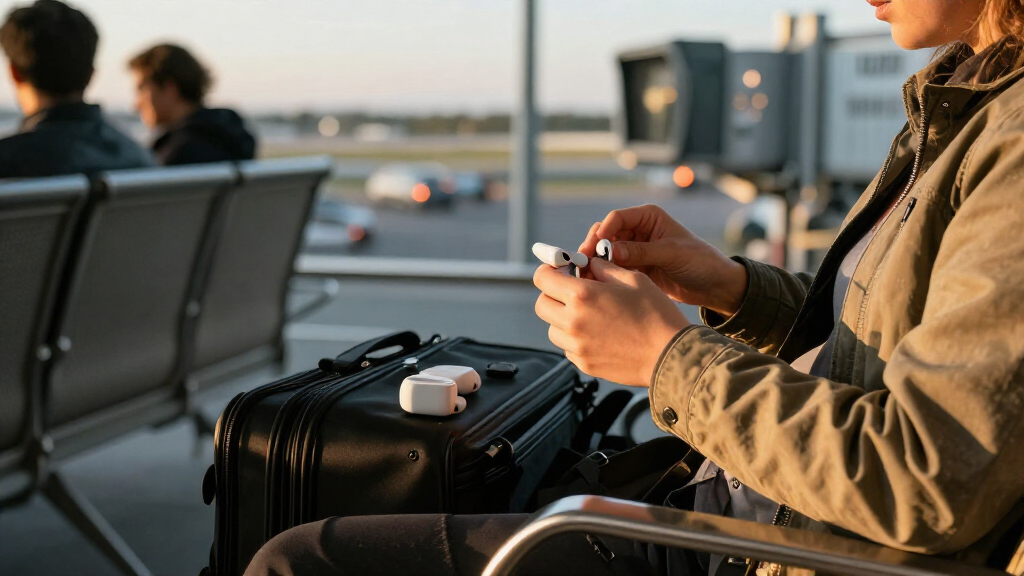
Manufacturer estimates are most useful when you know the conditions behind them. Look for separate figures with ANC enabled and disabled, and remember that listening volume, calls, and software settings can affect real use. Before leaving home, charge both the earbuds and their case; a case that looks like a tiny black pebble won’t help if it is empty.
Know what noise cancellation and transparency can do
ANC reduces steady background sounds, while transparency mode feeds outside sound into your listening experience. Neither setting replaces your attention. That distinction matters when you move between a droning cabin, a gate announcement, and a busy airport crossing.
On a flight, ANC may soften the continuous engine hum so a podcast is easier to hear at a comfortable volume. It will not reliably erase a nearby conversation or every sudden clatter. The ear tips’ passive seal works alongside ANC, so comfort and fit still matter when you want less noise.
At the gate, switch to transparency mode or pause audio before listening for an announcement. Some newer models offer adaptive listening that changes noise control based on what’s around you, and some aim to make outside sound feel more natural. Those features vary by model and personal preference; manual controls can be simpler when you need to react quickly.
Recent generations have also improved voice pickup and transparency processing, but vendor feature claims are not a guarantee of the same result for every traveler. Look for comparisons made under similar conditions, and try the controls if you can. A traveler who wants to hear a walking companion may prefer transparency or one earbud, while someone settling into a seat may choose ANC.
Check airplane audio before you expect Bluetooth to work
Bluetooth earbuds may not connect directly to a plane’s entertainment system. Some seatback systems use a wired headphone jack, so you may need a compatible Bluetooth audio transmitter. Check the airline setup and the transmitter’s compatibility before relying on the onboard screen for a film.
Picture boarding a long flight, opening the seatback menu, and finding a wired socket beside the armrest. Your phone pairs happily with your earbuds, but that does not automatically make the plane’s screen a Bluetooth source. A small transmitter can bridge the gap on compatible systems, though the connection and controls can vary.
If you would rather skip another device, download shows or podcasts to your phone before departure and check that they play offline. Multipoint Bluetooth lets some earbuds stay connected to two devices, such as a phone and laptop, but behavior differs by model. A traveler alternating between a laptop film and phone calls should check how easily the earbuds switch sources before the trip.
For a practical packing check, bring the charging case, a suitable cable, and an audio adapter or transmitter if your setup needs one. Keep tiny accessories in the same pocket or pouch as the earbuds. The cable you can find quickly is more useful than the one buried at the bottom of an overpacked bag.
Pack for rainy walks, airport awareness, and safe storage
Travel practicality includes more than listening: look for a case that fits your pocket, dependable pairing, easy-to-clean tips, and controls you can use without your phone. Water resistance can help during a rainy walk or workout, but check the stated rating for both earbuds and case. A resistance rating does not automatically mean either is safe to submerge.
For instance, you might wear earbuds on a drizzle-soaked walk from a train station and then put them away while the case is still damp. Follow the product instructions before charging, and don’t assume the case shares the earbuds’ rating. Drying them and cleaning the tips gently can help keep the small parts ready for the next leg.
In an airport or unfamiliar city, stay aware of people, traffic, and announcements. Transparency mode or one-earbud listening may help you hear what’s happening nearby, but pause audio when crossing a road or speaking with staff. Airline rules about device use during takeoff and landing vary; follow crew instructions and make announcements easy to hear.
ANC is not hearing protection. A quieter cabin may tempt you to raise the volume less, but earbuds are not necessarily rated to protect your hearing. Keep volume comfortable, especially during long sessions. When you stop listening, return the earbuds to the case rather than leaving them loose in a seat pocket where they can disappear during cleanup.
Use a simple checklist to pick your travel pair
The right pair fits your longest listening stretch and your day outside the plane. Compare comfort, battery life, and practical controls before spending extra on optional features. For a traveler facing an early flight, a short checklist is easier to use than a spreadsheet of specifications.
- Set your listening target: Estimate the longest time you’ll listen without access to charging, including delays. Leave a buffer and check the figure with ANC on.
- Test comfort and seal: Try different tip sizes and walk around at home. If pressure builds quickly, a longer flight may feel much longer.
- Check the controls you’ll use: Confirm you can pause, change volume, and hear outside sound without hunting for your phone.
- Match the connection to your devices: Check multipoint behavior if you switch between a laptop and phone, and investigate an audio adapter for seatback entertainment.
- Review durability and charging: Check the earbuds’ and case’s ratings, the charging connector, and how much charge the case adds.
For example, a light packer on a short train commute may choose compact earbuds with reliable controls and skip a transmitter entirely. Someone taking an overnight flight may put more weight on fit, ANC performance, and enough listening time, then bring a compatible airplane adapter. A feature earns its place when it solves a problem you expect to face.
Frequently Asked Questions
Are noise-cancelling earbuds good enough for a flight?
They can reduce steady cabin rumble and make listening more comfortable, especially when the ear tips form a good seal. They generally won’t silence nearby speech or every sudden sound, so pause audio or use transparency mode when you need to hear announcements.
Are earbuds or over-ear headphones better for travel?
Earbuds take up less room and are easy to carry in a pocket. Over-ear headphones may suit you better for long listening sessions or offer longer battery life, but they need more bag space. Try both if comfort is your deciding factor.
Will my Bluetooth earbuds connect to the airplane entertainment system?
Some airplane systems use a wired headphone jack instead of Bluetooth. A compatible Bluetooth audio transmitter may connect your earbuds, but check the airline setup and transmitter before you travel. Downloaded audio on your phone is a useful backup.
How long should the battery last?
Start with the longest stretch you expect to listen without charging, including possible delays, and allow a buffer. Compare battery claims with ANC on, and check how much charge the case adds. The case cannot extend listening time if it is empty.
Can I use one earbud at a time while traveling?
Many models support listening with one earbud, but controls and microphone behavior vary. Check your model’s instructions before you travel. One-earbud listening can be handy when you want to hear station announcements or keep in touch with a walking companion.
Are wireless earbuds waterproof?
Some models have a stated water-resistance rating, but that does not mean they can go swimming or be submerged. Check the ratings for the earbuds and their case separately, and follow the manufacturer’s care instructions after a rainy walk.