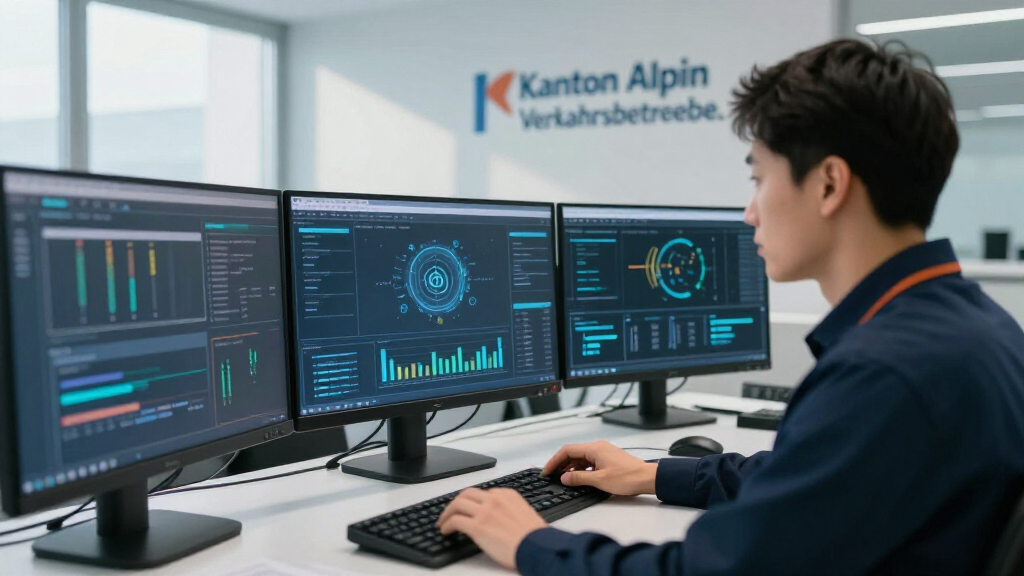

📊 Full opportunity report: The Secrets Of Using AI In 'Kanton Alpin Verkehrsbetriebe' Production on ThorstenMeyerAI.com — validation score, market gap, and execution plan.
Open a free Amazon Business account
Business pricing, bulk buying and tax-exempt orders.
Create a free accountAs an affiliate, we earn on qualifying purchases.
TL;DR
An AI-generated exhibition demonstrates how artificial intelligence can produce highly precise Swiss-style transit visuals, including clocks and departure boards. The project highlights AI’s role in digital design and automation. Details about the specific AI techniques used remain limited.
An AI-driven exhibition at ‘Kanton Alpin Verkehrsbetriebe’ showcases how artificial intelligence can be used to produce highly precise Swiss-style transit visuals, including clocks and departure boards, emphasizing automation and meticulous design. This development highlights AI’s expanding role in digital design and real-time interface creation, attracting interest from both technical and design communities, as detailed in the original analysis.
The exhibit, hosted in Room 23 of 175 at the ‘Kanton Alpin Verkehrsbetriebe’ online site, features a meticulously crafted digital replica of a Swiss alpine railway station, as described in the original analysis. Its centerpiece is a real-time SVG clock modeled after the Mondaine style, synchronized with actual time and exhibiting authentic behavior such as a sweeping second hand and pause at 12 seconds. All visual components, including pictograms, maps, and departure boards, are generated entirely through code—using CSS, SVG, and JavaScript—without external assets or images, demonstrating a fully self-contained, code-driven design process.
According to the creators, the project employs AI techniques to automate the generation of visual elements and ensure pixel-perfect precision, as discussed in the original analysis. This includes the use of AI to optimize layout, timing, and animation sequences, resulting in a cohesive, disciplined aesthetic aligned with Swiss International Style principles. The exhibit emphasizes obsessive attention to detail, from typography to timing synchronization, all achieved through a strict code-based approach.
The Secrets of Using AI in “Kanton Alpin Verkehrsbetriebe” Production
An AI-driven exhibition explores how precise Swiss-style clocks, departure boards, maps and pictograms can emerge from a disciplined, code-first production system. Its clearest achievement is not spectacle, but consistency: tightly controlled visuals, synchronized motion and an interface built without external image assets.
Precision is treated as a production system
The digital station replica applies artificial intelligence to a tightly constrained visual language. Layout, timing and consistency are approached as programmable behaviors rather than isolated design decisions.
Authentic clock behavior
A real-time SVG clock echoes the Mondaine visual tradition, including a sweeping second hand and a characteristic pause at the top of the minute.
Live departure logic
Departure boards are rendered as structured interface components, allowing typography, spacing and operational information to remain systematically aligned.
Swiss-style discipline
Grid-based composition, high contrast, legible type and restrained ornament reflect the clarity associated with Swiss International Style.
No external imagery
Pictograms, maps, interface panels and the station environment are generated through CSS, SVG and scripted behavior rather than imported visual assets.
Rules over repetition
AI is described as helping automate visual generation and optimize sequences, reducing repeated manual adjustments across related components.
Pixel-level consistency
Typography, geometry and synchronized movement are coordinated within one code-based framework, making design drift easier to detect and limit.
From design rules to a synchronized interface
The reported workflow suggests that AI operates inside a constrained pipeline: interpreting the visual system, generating code, refining spatial relationships and coordinating time-dependent behavior.
Set Swiss-style rules for grid, typography, contrast and iconography.
Translate those rules into reusable CSS, SVG and interface structures.
Adjust spacing, alignment and hierarchy toward pixel-level precision.
Coordinate real-time clock behavior, pauses and display sequences.
Deliver a cohesive digital station without conventional image assets.
The artifact is not merely AI-themed. Its visual environment is assembled as an executable design system in which components can share the same measurements, timing rules and aesthetic constraints.
What changes when transit visuals become code-first
Traditional transit production can already use digital tools, but AI-assisted generation may accelerate iteration and strengthen consistency. The exhibition demonstrates feasibility; it does not yet prove operational scalability.
| Production factor | Static asset workflow | AI-assisted code workflow | Operational status |
|---|---|---|---|
| Reusable visual rules | ~ Often document-based | ✓ Encoded in components | ✓ Demonstrated |
| Real-time synchronization | ~ Added separately | ✓ Native to the interface | ✓ Clock example live |
| Cross-screen consistency | ~ Manual QA intensive | ✓ Shared programmatic logic | ~ Broader testing unknown |
| External image dependency | ✗ Commonly required | ✓ Avoided in the exhibit | ✓ Demonstrated |
| Known AI methodology | ✗ Not applicable | ✗ Models undisclosed | ✗ Unconfirmed |
| Transit-system scalability | ✓ Established workflows | ~ Technically plausible | ✗ Not yet established |
Strong visual proof, limited technical disclosure
The project communicates its design outcome more clearly than its underlying AI architecture. The relative levels below summarize the evidence available in the supplied analysis, not independently measured performance.
Reported confidence by claim
How the central idea connects
The exhibition links design constraints to generated components, synchronized behavior and potential infrastructure applications.
What the exhibition tells us—and what it does not
Which AI techniques are used?
The project reportedly uses AI to automate layout, timing and visual consistency, but the specific models and algorithms have not been publicly detailed.
Could this work in real transit?
The exhibit demonstrates technical feasibility at showcase scale. Adoption in operational displays remains uncertain and would require reliability, accessibility and systems testing.
How does AI improve production?
Its apparent value lies in accelerating component generation, coordinating complex timing and applying shared design constraints with less repetitive manual work.
Will it influence interface design?
Potentially. The project provides a visible proof of concept for automated maps, passenger information, operational dashboards and other precision public interfaces.
Where the idea could go next
Future work may test real-world display hardware, expand dynamic passenger information, validate scalability and disclose enough of the AI workflow for independent evaluation.
Implications of AI in Precision Digital Design
This project illustrates how artificial intelligence can assist in creating highly precise, automated visual interfaces that adhere to strict aesthetic standards. It demonstrates AI’s potential to streamline complex design tasks, reduce human error, and produce consistent, code-based visuals suitable for high-precision environments like transit systems. The exhibit also signals a broader shift toward AI-assisted design in digital infrastructure, with potential applications in real-world transportation displays, public information systems, and automated content generation.

wudhank 3D Puzzle for Adults Clock – Swiss Chalet Design Model Kit-Mechanical DIY Pendulum Clock with Roman Numerals-Desk Home Office Decor Personalized Gift for DIY Lovers
- 3D Swiss Chalet Design: Features a cozy mountain cabin scene
- Dual Functionality: Serves as a decorative puzzle and clock
- Requires Battery: Uses 1 AA battery (not included)
As an affiliate, we earn on qualifying purchases.
Historical Role of Digital and AI Tools in Transit Design
Traditional transit interfaces rely heavily on manual design and engineering, often involving static images and pre-rendered assets. Recent advances have seen the integration of digital tools and automation, but the use of AI to generate and optimize visuals in real-time remains limited. This project at ‘Kanton Alpin’ marks a notable step in exploring AI’s capacity to produce dynamic, precise, and code-driven transit visuals that mimic Swiss design standards—an approach that aligns with the Swiss International Style’s emphasis on clarity and discipline.
Previous efforts in transit display automation have focused on hardware and basic software updates. The integration of AI to enhance visual accuracy, timing, and aesthetic consistency is a new frontier, with this exhibit serving as a test case and proof of concept for future applications.
“The use of AI in generating precise, code-based transit visuals demonstrates a significant leap in digital design automation.”
— an anonymous researcher

Canlarriz 18.5" Digital Signage Display, 700 Nits Digital Menu Board
- Lifetime Cloud CMS & Remote Management: Control display remotely via cloud or USB
- Bright 700 Nits Commercial Display: Clear visibility in various lighting conditions
- Designed for 24/7 Business Use: Reliable operation for continuous use
As an affiliate, we earn on qualifying purchases.
Unclear Aspects of AI Implementation and Scale
Details about the specific AI techniques, algorithms, or models used in automating the visual generation remain undisclosed. It is also unclear whether this approach is a prototype, a scalable solution, or a one-off artistic experiment. The extent of AI’s role—whether it is merely assisting or fully automating the design process—is still unconfirmed.
As an affiliate, we earn on qualifying purchases.
Future Prospects for AI-Driven Transit Visuals
Further developments may include expanding AI integration into real-world transit displays, testing scalability, and refining automation techniques. Additional projects could explore AI’s potential to generate other elements such as dynamic maps, passenger information, and operational data visualization. Observers will likely watch for official adoption or pilot programs inspired by this exhibition’s success.

Digital Menu Board for Restaurants. AI Digital Signage Player, Plug & Play HDMI Display, Easy Content Creation, Remote Control, Multi-Screen Support
- Restaurant & Café Compatible: Easily update digital menus in minutes
- AI-Generated Content: Create menus and promotions instantly
- Plug & Play Installation: Connect via HDMI, no IT required
As an affiliate, we earn on qualifying purchases.
Key Questions
What AI techniques are used in creating the visuals?
The specific techniques and algorithms are not publicly detailed, but the project employs AI to automate layout, timing, and visual consistency within a code-driven framework.
Is this approach applicable to real-world transit systems?
While the exhibit demonstrates technical feasibility, it remains uncertain whether this AI-driven approach will be adopted in operational transit displays or is mainly a conceptual showcase.
How does AI improve the design process in this project?
AI helps automate complex visual generation, optimize timing, and ensure pixel-perfect precision, reducing manual effort and enhancing consistency.
Will this influence future transit interface designs?
Potentially, as the project highlights AI’s capacity to produce high-quality, automated visuals that could streamline design workflows and improve display accuracy in transit systems.
Source: ThorstenMeyerAI.com
Grilling season Picks
grills
As an affiliate, we earn on qualifying purchases.