
🔍 Read the full analysis: The 10 Best Mobile Laptops For Workstation-Class AI Projects on ThorstenMeyerAI.com

Get the latest gadgets delivered free with Prime
- Fast, free delivery on millions of items
- Prime Video, Amazon Music and more included
- Member-only deals all year
TL;DR
The supplied source names 10 laptop models for workstation-class AI and professional workloads, but provides detailed recommendations for only three and incomplete specifications for the rest. Its rankings and performance claims are not independently documented, so buyers should verify configurations, sustained-load tests, pricing and software certification before choosing.
ThorstenMeyerAI.com’s buying guide identifies 10 mobile workstation laptops for professional computing and AI projects, but the supplied material gives specific recommendations and supporting detail for only a small part of the list. It favors the Lenovo ThinkPad P1 Gen 7 as its overall pick, while pointing to compactness in the ThinkPad P14s Gen 7 and sustained heavy-load capacity in the Dell Precision 7680; the guide does not provide enough model-by-model evidence to verify all 10 rankings.
The guide frames workstation selection as a balance among computing performance, portability and cooling. It says newer Intel Core Ultra and AMD Ryzen AI processors can improve battery efficiency, while cautioning that they may not match older HX-series chips in peak multi-core performance for heavy rendering. It does not provide benchmark results, test conditions or exact configurations for that comparison.
For graphics-intensive work, the source favors professional NVIDIA RTX graphics and drivers for software stability in CAD, simulation and creative applications. It advises checking certification for the particular software and version in use. These are the guide’s recommendations, not independently verified findings in the material supplied.
The source’s detailed examples include the ThinkPad P1 Gen 7 for a balance of performance and a relatively sleek design, the ThinkPad P14s Gen 7 for a 14-inch form factor, and the Dell Precision 7680 for workloads that benefit from a larger cooling system. It also cites the ThinkPad P16s Gen 4 as an OLED-display example. The remaining named models are listed as picks, but the source gives no accompanying model-specific rationale, test results or configuration details for them.
The 10 picks
- 1
 Dell Precision 7680 16-Inch Workstation Laptop, Intel Core i7-13850HX, NVIDIA…View on Amazon →
- 2
 Dell Precision 7680 Laptop, NVIDIA RTX 2000 Ada 8GB, Intel i7-13850HX, 32GB DDR5View on Amazon →
- 3
 Lenovo ThinkPad P1 Gen 7, w/ Ultra 7, NVIDIA RTX 3000, 16" 2.8K, 32GB RAMView on Amazon →
- 4
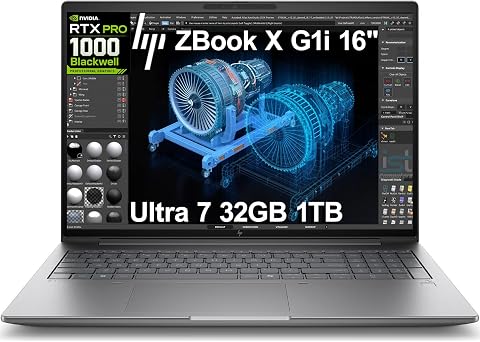 HP ZBook X G1i 16-inch Laptop, Intel Core Ultra 7 265H, NVIDIA RTX PRO 1000 B…View on Amazon →
- 5
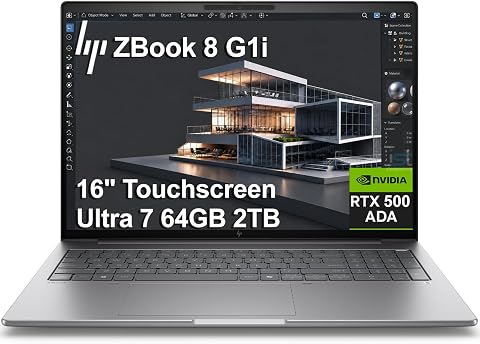 HP ZBook 8 G1i AI Mobile Workstation Laptop (16" FHD+ Touchscreen, Intel Ultr…View on Amazon →
- 6
 HP ZBook 8 G1i AI Mobile Workstation Laptop (16" 4K 120Hz, Intel Ultra 7 265H…View on Amazon →
- 7
 Lenovo ThinkPad P16s Gen 4 16-inch OLED Touchscreen Mobile WorkstationView on Amazon →
- 8
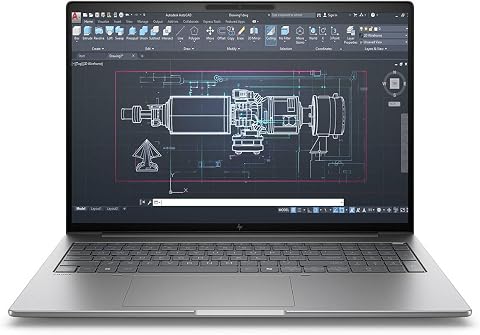 HP ZBook 8 G1i 16" Mobile Workstation – WUXGA – 60 Hz – Intel Core Ultra 7 25…View on Amazon →
- 9
 Lenovo ThinkPad P16s Gen 4 16-Inch Business LaptopView on Amazon →
- 10
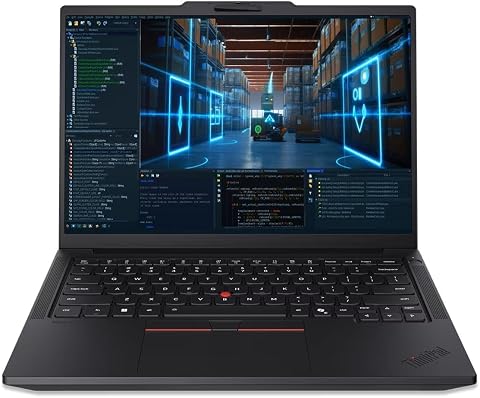 Lenovo ThinkPad P14s Gen 7 Mobile Workstation (2026) – 14" Touch, AMD Ryzen A…View on Amazon →
Choosing for Sustained AI Work
For AI development, a laptop’s headline processor or graphics specification does not by itself show whether it can handle long training, rendering or compilation sessions. Thermal limits and sustained performance can affect how quickly a machine completes work when CPU and GPU resources are loaded for extended periods. The guide’s emphasis on cooling is relevant, but it supplies no standardized long-duration tests to establish how these 10 machines compare.
There are practical trade-offs beyond speed. A thinner laptop may be easier to carry but provide less room for cooling; an OLED screen can suit visual work but may draw more power than some IPS alternatives; and a port-light design can require a dock. Buyers should match screen, battery, ports and software support to their own tasks rather than treating the guide’s overall pick as a universal choice.
Products Worth Considering

Apple AirPods Pro 3 Wireless Earbuds with Active Noise Cancellation

Amazon Kindle Paperwhite Signature Edition (12th Generation, 2024), 32 GB, Metallic Raspberry

DJI Mini 4K Drone with 4K UHD Camera
As an affiliate, we earn on qualifying purchases.
How the Guide Frames Its Picks
The source says it assessed laptops by performance under extended workloads, build quality, serviceability, software compatibility and everyday usability, including keyboards and webcams. It argues that sustained-load behavior is more useful than a short burst benchmark for people who render or work with complex CAD assemblies. However, the supplied text does not document a testing method, named benchmark results, or independent measurements behind its selections.
Its advice also distinguishes between users of professional software and people whose work is mainly coding or office productivity. It recommends checking ISV certification for the exact application and weighing whether a professional GPU is needed. Model names alone are not enough to establish specifications: options can vary by region and configuration, and the source does not state the prices or hardware configurations it compared.
“The Lenovo ThinkPad P1 Gen 7 stands out as the best overall pick for professionals who need a sleek chassis without sacrificing the reliability of dedicated NVIDIA RTX graphics.”
— ThorstenMeyerAI.com guide
Missing Tests and Configurations
The supplied source does not give a complete, clearly enumerated list of 10 distinct laptop models with individual descriptions. It names the ThinkPad P1 Gen 7, ThinkPad P14s Gen 7, Dell Precision 7680 and ThinkPad P16s Gen 4, but does not identify the other six selections in the provided text. It also omits prices, exact processor and GPU configurations, benchmark scores, battery-test results and dated availability.
The guide’s references to RTX Ada and Blackwell products, professional drivers, thermal design and display characteristics are not tied to precise configurations or cited testing in the supplied material. It is therefore unclear which versions were assessed, whether all recommendations remain available, and how the models compare for local AI workloads such as inference or model training. No product maker or independent reviewer is quoted in the source excerpt.
Verify Models Before Buying
The guide does not announce a launch, product update or upcoming review date. Readers considering a purchase should check current manufacturer listings for configuration, price, ports and warranty, then look for independent tests that measure sustained CPU and GPU performance, battery life and fan noise. Availability and specifications can change, so the guide’s model names should be treated as a starting point rather than a current, verified ranking.
For a specific AI or engineering workflow, confirm software and driver support, memory and graphics requirements, and whether the workload must run locally. Those checks can determine whether a thin mobile workstation is sufficient or whether a larger system, docked setup or desktop is a better fit.
Key Questions
Which laptop does the guide name as its overall pick?
The source calls the Lenovo ThinkPad P1 Gen 7 its overall pick. The supplied text does not include comparative benchmark data or configurations that independently verify the ranking.
Which models does the guide highlight for compactness and heavy workloads?
It describes the ThinkPad P14s Gen 7 as a compact 14-inch option and the Dell Precision 7680 as suited to heavier workloads that benefit from more thermal headroom. These are source recommendations, not independently tested conclusions here.
Does the supplied source identify all 10 laptops?
No. It names four models in the provided material: the ThinkPad P1 Gen 7, ThinkPad P14s Gen 7, Dell Precision 7680 and ThinkPad P16s Gen 4. The other six picks are not identified in the excerpt.
What should buyers verify before choosing a workstation for AI?
Check the exact CPU, GPU, memory, software and driver support for your workload, along with sustained-load tests, battery life, ports, price and availability. The source does not provide enough configuration detail to settle those comparisons.
Source: ThorstenMeyerAI.com