
TL;DR
Listen free for 30 days with Audible
Thousands of audiobooks and originals — cancel anytime.
Start your free trialAs an affiliate, we earn on qualifying purchases.
Mercedes-Benz has announced the start of large-scale production of its electric axial flux motors. This development could influence EV design and manufacturing, marking a significant step in automotive electrification.
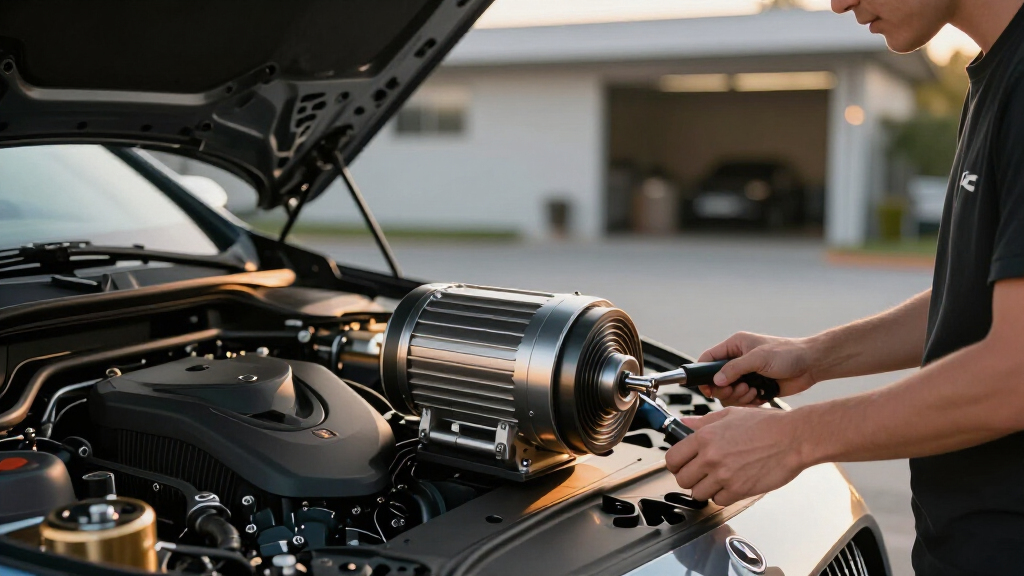
Mercedes-Benz has begun large-scale production of its electric axial flux motors, a move that could significantly impact electric vehicle (EV) design and manufacturing. This development is confirmed by the automaker and signals a shift toward more efficient motor architectures in the EV industry, making it highly relevant for industry stakeholders and consumers alike.
According to official statements, Mercedes-Benz has started mass production of its electric axial flux motors. These motors are designed to offer higher efficiency, improved power density, and better thermal management compared to traditional radial flux motors. The company claims that this technology will enable lighter, more compact EVs with extended range and enhanced performance.
Industry analysts note that this move aligns with Mercedes-Benz’s broader strategy to lead in EV innovation, aiming to differentiate its offerings in a competitive market. The company has not yet disclosed specific models that will feature these motors, but the production scale indicates a rollout in upcoming vehicle lines.
Technical sources suggest that axial flux motors, which have been under development for several years, are now reaching commercial viability at scale. Mercedes-Benz’s investment signals confidence in this architecture’s potential to reshape EV powertrain design.
Implications for EV Industry Leadership
This development matters because it could set new standards for EV motor efficiency and performance, influencing competitors and suppliers. By adopting axial flux technology at scale, Mercedes-Benz positions itself at the forefront of EV innovation, potentially gaining a competitive edge in range, weight reduction, and power delivery. It also indicates a shift in manufacturing priorities toward more advanced motor architectures, which could accelerate industry-wide adoption.
For consumers, this could translate into vehicles with longer range, faster acceleration, and possibly lower costs as production scales. For the industry, it signals a move toward more sophisticated, compact motors that could redefine vehicle design and engineering.
As an affiliate, we earn on qualifying purchases.
Evolution of Electric Motor Technologies
Electric axial flux motors have been under development for several years, primarily in research labs and niche applications. They are known for their high efficiency and compact form factor, making them attractive for EVs aiming to maximize space and performance. Major automakers and suppliers have invested in this architecture, but mass production has remained a challenge due to manufacturing complexities and cost considerations.
Mercedes-Benz’s announcement marks one of the first instances of a major automaker scaling axial flux motor production, signaling a potential shift from prototype to mainstream manufacturing. Prior to this, most EVs relied on radial flux motors, which are simpler to produce but less efficient in certain applications.
This move follows industry trends toward more innovative, lightweight, and efficient motor designs to meet stricter emissions standards and consumer demand for longer-range EVs.
“Our new axial flux motors are a key part of our strategy to deliver higher efficiency and better range in our electric vehicles.”
— company spokesperson
As an affiliate, we earn on qualifying purchases.
Unconfirmed Details About Model Integration
It is not yet clear which specific Mercedes-Benz models will feature the axial flux motors or when they will be introduced in consumer vehicles. Details about production volume, cost implications, and performance benchmarks are still emerging.
As an affiliate, we earn on qualifying purchases.
Next Steps in Deployment and Industry Impact
Mercedes-Benz is expected to announce specific vehicle models equipped with axial flux motors in the coming months. Industry observers will watch for further technical disclosures, performance data, and potential collaborations with suppliers. The broader auto industry may accelerate adoption of this motor architecture if the technology proves successful at scale.
As an affiliate, we earn on qualifying purchases.
Key Questions
What are axial flux motors?
Axial flux motors are a type of electric motor characterized by their high efficiency and compact design, with magnetic flux flowing parallel to the axis of rotation, unlike traditional radial flux motors.
Why is this development important for EVs?
This technology can enable lighter, more efficient, and longer-range electric vehicles, potentially transforming EV performance and design standards.
When will Mercedes-Benz vehicles with these motors be available?
Specific models and timelines have not yet been announced, but industry insiders expect details in the upcoming months as production ramps up.
How does this compare to existing motor technologies?
Axial flux motors generally offer higher efficiency and power density than traditional radial flux motors, but have historically been more challenging to produce at scale.
Could this impact other automakers?
Yes, if Mercedes-Benz’s mass production proves successful, it could accelerate industry adoption of axial flux motors and influence supply chain developments.
Source: IdeaNavigator AI
Flea & tick season Picks
flea and tick prevention
As an affiliate, we earn on qualifying purchases.