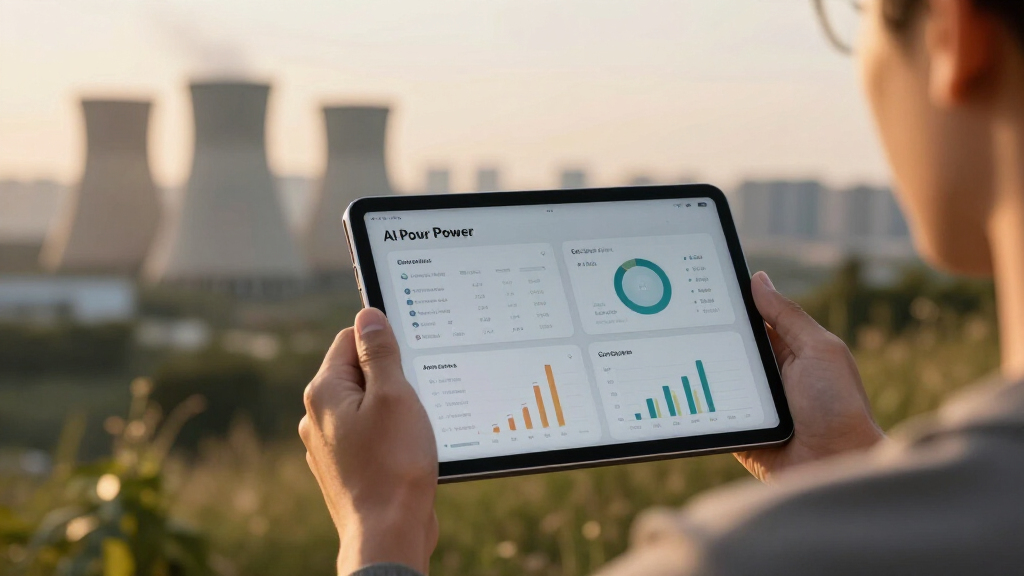

📊 Full opportunity report: AI Power Metrics Evolved: The Case For Agents Per Gigawatt on ThorstenMeyerAI.com — validation score, market gap, and execution plan.

Get the latest gadgets delivered free — and shop member deals
- Fast, free delivery on millions of items
- Access to Prime Big Deal Days deals on October 6–7
- Prime Video, Amazon Music and more included
TL;DR
The emerging metric for AI capacity is now agents per gigawatt, reflecting how energy enables autonomous cognition. This shift redefines how industry and nations measure AI progress and power.
Researchers and industry leaders are now measuring AI capacity in terms of agents per gigawatt, a new unit that directly links energy production to autonomous cognitive work. This shift reflects a fundamental change in how we understand technological and national power, emphasizing energy availability as the core constraint for AI expansion.
The concept of agents per gigawatt redefines the traditional metrics like GDP or chip count, focusing instead on how much autonomous cognitive work can be produced from a given energy supply. This measure is grounded in the fact that running AI agents requires compute power, which in turn depends on electricity. As Thorsten Meyer explains, the limit on AI capacity is now physical: how much gigawatt power can be reliably generated and converted into computation.
Industry developments support this perspective. Data centers, hardware innovations, and energy strategies are all aimed at increasing the agents-per-gigawatt ratio. For example, advances in low-voltage inference chips and optical interconnects are designed to maximize the number of AI agents that can operate per unit of power. This has led to a reevaluation of national and corporate AI power, with energy infrastructure becoming the bottleneck rather than hardware or software capabilities.
Every era measures power in whatever is scarce: land, then steel, then GDP. The binding constraint is changing again — and the new unit is how much autonomous cognition a nation or company can produce per unit of energy it can command.
▲ Opinion & analysis · not investment adviceMore agents means more tokens, which takes compute, which takes chips, which take one thing above all — power. The energy story and the AI story became the same story.
Once you hold it, the separate stories of the moment stop being separate — they’re all the same ratio, seen from different angles.
Adopting it drags three things into the open that softer framings let you avoid.
And the unit rewards concentration — unless we deliberately build against it.
Why Agents-Per-Gigawatt Redefines AI Power Measurement
This new metric matters because it shifts the focus from traditional indicators—like chip counts or model releases—to energy efficiency and capacity for autonomous cognition. It clarifies why countries and companies are investing heavily in power generation and energy infrastructure. As Meyer notes, the 'power story' and the 'AI story' are now one and the same. The ability to produce more agents per gigawatt directly correlates with an entity’s AI strength and sovereignty, especially as autonomous cognition becomes central to economic and military power.
For policymakers and industry leaders, understanding this metric emphasizes the importance of energy security and infrastructure. A nation’s AI capacity is no longer just about hardware or talent but also about its energy resources and technological capacity to convert power into intelligence. This reframing could influence future investments, geopolitical strategies, and technological development priorities.
As an affiliate, we earn on qualifying purchases.
The Shift from Traditional Metrics to Energy-Linked AI Capacity
Historically, measures like GDP and labor productivity served as proxies for national power, reflecting the dominance of human labor and capital. Over the past century, the focus shifted to technological infrastructure—factories, chips, and software. Now, a new era is emerging where autonomous agents and energy consumption define the limits of AI growth. Thorsten Meyer’s analysis highlights how the buildout of data centers, hardware innovation, and energy strategies are converging into a single effort to maximize agents per gigawatt.
This transition is driven by the realization that autonomous cognition is not bounded by population or traditional capital, but by the physical constraints of power generation and delivery. Recent industry trends, including the reopening of nuclear plants and the siting of data centers next to power sources, exemplify this shift. The focus is now on converting energy into intelligence efficiently, making the energy infrastructure the new battleground for AI dominance.
"The binding constraint on how many agents you can run is how many gigawatts of electricity you can generate, deliver, and turn into computation without melting the infrastructure."
— Thorsten Meyer
As an affiliate, we earn on qualifying purchases.
Unresolved Questions About Energy and AI Capacity
It remains unclear how quickly energy infrastructure can scale to meet the demands of increasing agents-per-gigawatt, especially in different geopolitical contexts. The precise impact of emerging hardware innovations on overall energy efficiency and capacity is still under evaluation. Additionally, there is debate over whether this metric fully captures AI's strategic and economic value, or if other factors might influence future assessments.
high-performance data center power supplies
As an affiliate, we earn on qualifying purchases.
As an affiliate, we earn on qualifying purchases.
Next Steps in Measuring and Expanding AI Power
Industry and policymakers are expected to prioritize investments in energy infrastructure, including renewable and nuclear power, to increase agents-per-gigawatt capacity. Further research and development will focus on hardware improvements that maximize energy efficiency. Additionally, international discussions may emerge around standardizing this metric for national AI power, influencing future geopolitical strategies and energy policies.
As an affiliate, we earn on qualifying purchases.
Key Questions
Why is 'agents per gigawatt' considered a better measure of AI capacity than traditional metrics?
Because it directly links energy availability to autonomous cognitive work, reflecting the physical constraints of AI expansion rather than just hardware or model complexity.
How does energy infrastructure influence a country's AI power?
Energy infrastructure determines how much power can be reliably generated and converted into AI agents, making it a critical factor in autonomous cognition capacity and strategic sovereignty.
What hardware innovations are helping increase agents per gigawatt?
Advances include low-voltage inference chips, pooled-memory interconnects, and optical transceivers, all aimed at improving energy efficiency and maximizing autonomous agents within power limits.
Could this metric reshape global AI competition?
Yes, nations that invest effectively in energy infrastructure and hardware to maximize agents per gigawatt could gain a significant strategic advantage in AI capabilities.
Source: ThorstenMeyerAI.com
Evergreen bestsellers Picks
bestsellers
As an affiliate, we earn on qualifying purchases.