
🔍 Read the full analysis: The Craft Behind “Luciole — The Synchronous Fireflies Of Vallon Creux” on ThorstenMeyerAI.com

Get the latest gadgets delivered free with Prime
- Fast, free delivery on millions of items
- Prime Video, Amazon Music and more included
- Member-only deals all year
TL;DR
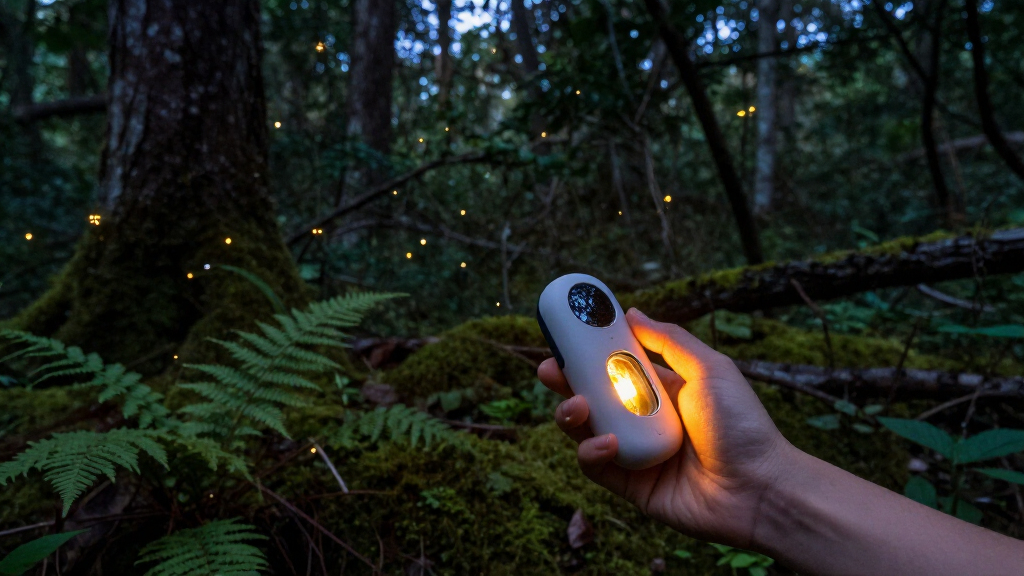
“Luciole — The Synchronous Fireflies of Vallon Creux” is Room 155 in an AI-built web exhibition, presenting a fictional firefly field through an interactive simulation. Its 96 simulated lights can move toward a shared rhythm under a local-interaction model, and visitor input can disrupt that pattern. The site and its fireflies are creations for the exhibit, not a real place or field study.
Room 155 of the FABLE/175 exhibition presents “Luciole — The Synchronous Fireflies of Vallon Creux,” an AI-built interactive web piece in which 96 simulated fireflies gradually settle into a shared flashing rhythm. Visitors can disturb the pattern and watch the simulation respond, turning synchronization into the central event rather than a prerecorded visual effect. Vallon Creux and Luciole are fictional; the work is an exhibit, not a real field study.
The exhibit represents each firefly as an oscillator with its own phase and tempo, influenced by nearby signals. A control changes the strength of that influence, so visitors can loosen or strengthen the collective rhythm. A live coherence measure summarizes how closely the simulated lights align. Pointer interaction scatters their phases, after which the same rules drive the field toward coherence again.
The page also makes that behavior inspectable. A trace records the measured fall and return in coherence, while a phase diagram draws on the simulation rather than serving as an unrelated illustration. The source describes these displays as evidence of the on-screen behavior. The underlying model is identified as Kuramoto synchronization in the supplied art-direction brief; the exhibit’s naturalist notebook framing places explanatory notes beside the animated field.
According to the source description, the visuals are made with HTML, CSS, SVG and canvas, without downloaded image assets or a prerecorded firefly sequence. CSS shapes form the insects, and prepared glow sprites support the animation. The site is also described as pausing animation when relevant views are offscreen or the page is hidden, with a calmer presentation for reduced-motion settings. It includes focus styling, announced state changes and a compact mobile field map.
FABLE / 175 · ROOM 155 · INTERACTIVE WEB EXHIBIT
The Craft Behind “Luciole”
A fictional firefly field turns synchronization into something visitors can watch, disturb, and understand. The room’s central event is order emerging from individual rhythms.
A field that finds its rhythm
The simulation shows how separate flashing cycles can move toward a shared pattern—and how a visitor can interrupt that movement.
96 independent lights
Each simulated firefly has its own phase and tempo. Nearby signals influence how its rhythm shifts.
Change the coupling
A control changes the strength of local influence, letting visitors loosen or strengthen collective timing.
Scatter, then watch
Pointer interaction disrupts phases. The same rules then drive the field toward coherence again.
From individual phases to collective order
The art-direction brief identifies the behavior as Kuramoto synchronization: oscillators with distinct rhythms influence one another and may align over time.
Here, the model is an interactive exhibit device. It helps make synchronization visible; it does not establish how a real firefly population behaves.
See the pattern. Read the signal.
The account describes both measurement views as evidence of the behavior on screen, not decoration borrowed from an unrelated idea.
Coherence trace
A live measure summarizes how closely the simulated lights align. The trace records disruption and the return toward order.
Conceptual reading of the described measure · not reported results
Phase diagram
The diagram draws on the simulation itself, giving visitors another view of how the oscillators relate.
Illustrative schematic · not a captured exhibit state
Built as a small, self-contained world
The source describes an AI-built, single-page showcase at a Netlify address. Its footer reportedly links to the production prompt, credited to “Claude Fable 5 (art director)” and executed by the FABLE/175 pipeline.
The brief requested a site without a build step, frameworks, external requests, or image assets. It also specified a forest-dark palette, chartreuse signals, mauve notes, and a notebook-like typographic treatment.
Keep the claims in bounds
The source distinguishes the described core experience from requested details and from evidence it does not provide.
A fictional setting
Vallon Creux and Luciole are fictional. This is an exhibit, not a real habitat or field study.
Requested details are not all confirmed
The brief asks for species notes, a two-week season calendar, and a “wait for it” section. The description does not verify that each appears in the rendered site.
Review steps are not independently documented
The brief outlines three passes, including critique and art direction. The supplied account does not confirm completion of every pass or provide screenshots.
No outcome metrics supplied
No release date, visitor numbers, performance measurements, accessibility audit, or browser-by-browser results are reported.
What you can explore
Open the live room to observe the field, adjust coupling, and perturb its simulated phases. The footer reportedly links to the creative prompt.
Is Vallon Creux a real firefly habitat?
No. The place and the fireflies are fictional; the work is a designed exhibit.
What is being simulated?
Ninety-six fireflies modeled as oscillators, each with its own phase and tempo, influenced by nearby signals.
Can visitors change the simulation?
Yes. The description says visitors can change coupling strength and use pointer interaction to disturb the phases.
Was the website made with AI?
The source describes it as AI-built, credits the brief to “Claude Fable 5,” and says the FABLE/175 pipeline executed it.
Does it prove how wild fireflies synchronize?
No. The supplied material reports no biological observations or validation against a real population.
What comes next?
The source points to continued access to the interactive room; it gives no update schedule or further milestone.
Making Synchronization Visible
The piece gives visitors a way to see an abstract group behavior develop over time. Rather than showing a finished, perfectly coordinated display, it makes the path from individual rhythms to collective order observable—and lets people interrupt that process. That approach can make the simulation’s governing idea easier to grasp than a static diagram alone, while the coherence trace offers a quantitative view alongside the visual one.
Its presentation also makes the construction of an AI-generated website part of the subject. The source says the site itself was built by AI and that its production prompt is exposed through a link in the footer. That combination gives the room two related topics: an interactive model of synchronization and a visible record of the creative brief behind the digital exhibit. The work’s claims should be read within those limits: it is a designed simulation, not evidence about a particular population of wild fireflies.
interactive firefly simulation kit
As an affiliate, we earn on qualifying purchases.
As an affiliate, we earn on qualifying purchases.
From Creative Brief to Field
“Luciole” is described as Room 155 of 175 in the FABLE/175 pipeline. The source identifies the installation as a single-page showcase at a Netlify address and says the footer’s “Prompt” link exposes the brief used to produce it. The supplied text credits the original brief to “Claude Fable 5 (art director)” and says it was executed by the FABLE/175 pipeline.
That brief called for a self-contained site, with no build step, frameworks, external requests or image assets. It specified a forest-dark palette, chartreuse signals and mauve notes, as well as a notebook-like typographic treatment. It also requested a three-pass process covering an initial build and critique, an external critique and fixes, and a final art-direction pass. The source describes those as instructions in the brief; it does not independently document the review process or provide screenshots verifying each pass.
The source material also includes additional requested features, such as invented species and flash-pattern notes, a two-week season calendar, and a “wait for it” section rewarding stillness. It does not establish which of these requested elements appear in the rendered site. The confirmed core described in the exhibit account is the interactive oscillator field, its controls and measurement views, and the code-generated visual design.
“Its signature move is to make patience visible.”
— Exhibit description supplied by ThorstenMeyerAI.com
Kuramoto oscillator model educational kit
As an affiliate, we earn on qualifying purchases.
As an affiliate, we earn on qualifying purchases.
What the Exhibit Does Not Verify
The source does not provide a date for the room’s release, visitor numbers, performance measurements, or independent testing of its accessibility and mobile behavior. It describes intended measures such as reduced-motion support and pausing when the page is hidden, but does not supply audit results or browser-by-browser findings.
There is also a distinction between requested features and verified contents. The brief asks for a range of naturalist-style details and a three-pass review, but the supplied description does not confirm that every requested element was implemented or that the review steps were completed as specified. The firefly population and Vallon Creux remain explicitly fictional, and the simulation should not be treated as field data about real insects.
firefly synchronization science kit
As an affiliate, we earn on qualifying purchases.
As an affiliate, we earn on qualifying purchases.
What Visitors Can Explore
The source directs readers to open the live room in a browser, where they can observe the field, adjust coupling and perturb the simulated phases. The exhibit’s footer reportedly links to the creative prompt that shaped the work. No further release, research milestone or update schedule is given, so the next development described is continued access to the interactive room rather than a scheduled announcement.
visualization tools for complex systems
As an affiliate, we earn on qualifying purchases.
As an affiliate, we earn on qualifying purchases.
Key Questions
Is Vallon Creux a real firefly habitat?
No. The source describes Vallon Creux and Luciole as fictional and says the room is an exhibit, not a real place or field study.
What is being simulated?
The room models 96 fireflies as oscillators, each with its own phase and tempo. Nearby signals influence them, allowing their flashes to move toward a shared rhythm.
Can visitors change the simulation?
Yes. The description says visitors can change the strength of coupling and use pointer interaction to disturb the phases. The field then responds under the same local-interaction rules.
Was the website made with AI?
The source describes the site as AI-built and says its creative prompt is linked from the footer. It credits the brief to “Claude Fable 5” and execution to the FABLE/175 pipeline.
Does the simulation prove how wild fireflies synchronize?
No. It is a designed interactive simulation, not a field study. The supplied material does not report biological observations or validation against a real firefly population.
Source: ThorstenMeyerAI.com
Halloween Picks
halloween
As an affiliate, we earn on qualifying purchases.