

📊 Full opportunity report: StreetComplete’s Map Quests: A Small-Step Approach To OpenStreetMap on IdeaNavigator AI — validation score, market gap, and execution plan.

Get the latest gadgets delivered free — and shop member deals
- Fast, free delivery on millions of items
- Access to Prime Big Deal Days deals on October 6–7
- Prime Video, Amazon Music and more included
TL;DR
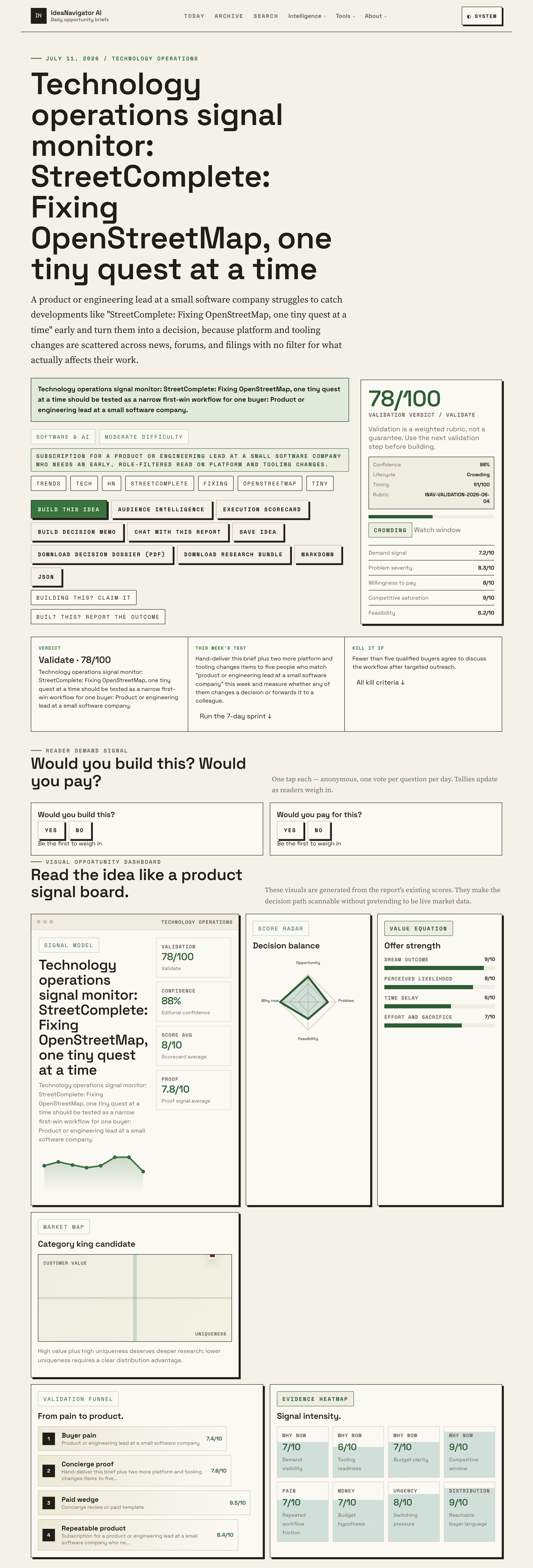
IdeaNavigator AI presents StreetComplete as an example for a proposed news-monitoring product aimed at product and engineering leads at small software companies. The brief recommends testing demand by hand-delivering three technology updates to five potential users; it provides no evidence that the test has taken place or that StreetComplete itself is newly changed.
The proposal targets people who struggle to track platform and tooling developments scattered across news sites, forums and filings. Its suggested product would monitor Hacker News and similar feeds, select items judged relevant to a small-company product or engineering lead, then summarize what changed, why it matters and what to do. The material does not specify how relevance would be assessed or which feeds would be included beyond those examples.
StreetComplete appears as a sample item under the wording “Fixing OpenStreetMap, one tiny quest at a time.” The brief gives no product announcement, release date, feature description or reported change to the app. It also supplies no details supporting the claim that the item surfaced with an 88/100 signal: the scale, measurement method and comparison baseline are not stated, so the figure cannot establish audience interest or news importance.
For an initial check, IdeaNavigator AI suggests hand-delivering the StreetComplete brief and two other platform or tooling updates to five people matching the target role “this week.” The proposed measures are whether any recipient changes a decision or forwards a brief to a colleague. This is a suggested validation exercise; there are no reported participants, results, subscription commitments or evidence that a service has been built.
Testing Demand for Filtered Tech Briefs
The proposal addresses a practical problem for small teams: leads may have limited time to monitor tools and platforms that could affect product or engineering choices. A concise, role-specific summary could help them decide which developments merit attention, if it reliably identifies relevant changes and gives enough evidence for a decision.
The suggested five-person exercise is a small demand check, not proof of a market. A forwarded brief or changed decision could indicate usefulness to an individual recipient, while the proposal offers no results on repeat use, willingness to pay, accuracy or the time needed to prepare the summaries. Those questions matter because the business model rests on subscription revenue from the same audience.
From StreetComplete to a Monitor
The item is framed as a technology operations signal monitor, with StreetComplete serving as an example of the kind of development it might surface. The proposal’s intended users are product or engineering leads at small software companies, rather than OpenStreetMap contributors specifically.
The brief says faster-moving platform and tooling changes make a same-day read preferable to a generic weekly roundup. That is the rationale behind the proposed timing, but it does not provide examples of missed decisions, compare daily and weekly products, or establish how quickly the suggested service could identify a consequential update.
No User-Test Results Yet
It is unclear whether the 88/100 signal reflects a defined scoring system, how the StreetComplete item was selected, or whether the number represents engagement, relevance or another measure. The proposal also does not describe a specific recent StreetComplete development, so the app’s role here is limited to an example title.
No evidence is given that the monitor exists, that five target users have received briefs, or that anyone changed a decision, shared an item or would pay for access. The brief does not identify its intended feeds beyond Hacker News and similar sources, explain its filtering criteria, or set out how it would check summaries for accuracy.
The Proposed Five-Person Trial
The next step proposed by IdeaNavigator AI is to send three briefs—including the StreetComplete example—to five qualifying product or engineering leads during the week, then record whether recipients change a decision or forward an item. The brief does not give a calendar date for the trial or name participants.
Any findings would help assess whether the format earns attention, but the proposed measures alone would not settle whether readers would subscribe or continue using a monitor. No trial outcome or launch schedule has been reported.
Source: IdeaNavigator AI
Key Questions
Is this a new StreetComplete announcement?
No. The brief uses StreetComplete as an example item for a proposed monitoring product. It does not describe a new release or feature.
What product is being proposed?
A monitor that would track Hacker News and similar feeds, filter updates for small-company product and engineering leads, and provide short summaries of what changed, why it matters and what to do.
Has the proposed user test happened?
No results are reported. The brief recommends sending three updates to five potential users and tracking whether they change a decision or forward a brief.
What does the 88/100 signal mean?
The brief does not explain the score’s scale, method or comparison baseline. Its meaning and significance are unclear.
Source: IdeaNavigator AI
Fall Picks
fall essentials
As an affiliate, we earn on qualifying purchases.