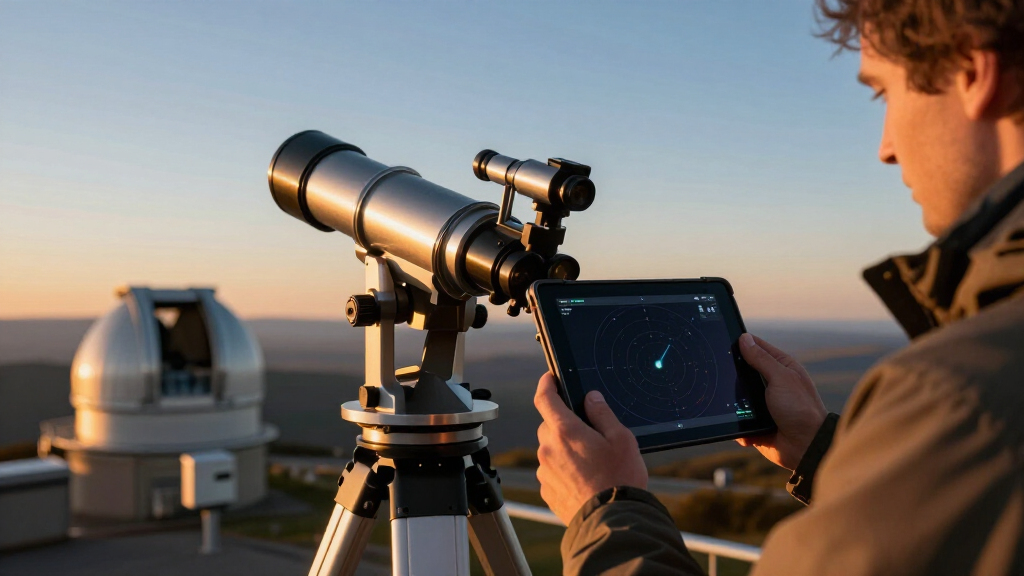

🔍 Read the full analysis: Held Light, AI, And A Comet On Watch: Inside “OORT — Comet Vigil For P/2043 K1 Vesper” on ThorstenMeyerAI.com

Get the latest gadgets delivered free with Prime
- Fast, free delivery on millions of items
- Prime Video, Amazon Music and more included
- Member-only deals all year
TL;DR
OORT — Comet Vigil for P/2043 K1 Vesper is an AI-built online art exhibition centered on a fictional observatory and fictional comet. Its page accumulates seeded star trails during a visit, while scrolling and controls animate imagined orbital readings; the comet is not presented as a real astronomical discovery.
OORT — Comet Vigil for P/2043 K1 Vesper is an AI-built web exhibition about a fictional comet, as described in the original project analysis. The page features star trails that lengthen with time spent on the site. Its observatory and astronomical subject are presented as invented rather than as a real discovery.
The exhibition places visitors inside an imagined observatory tracking P/2043 K1 Vesper. Its defining visual feature is a canvas of seeded stars whose curved trails grow as time passes. According to the project description, the same local sky resumes when a visitor returns on the same device, with elapsed time saved in local storage. The artwork therefore treats a visit as an exposure that accumulates, rather than as a short prelude to static content.
Other elements simulate the tools and routines of a comet watch. Scrolling moves a comet through an inline SVG, with an ion tail directed away from the sun and a dust tail curving along the imagined orbit. Both respond to a shared progress value, linking the graphic to displayed distance and year. A range control changes a defocus view and its associated brightness estimate. Visitors can also hold a control to open a simulated shutter; the site records a timestamp as a record of attention, not as evidence that the comet was observed.
The page uses a dark observatory palette, with cyan for the ion tail and readings, red-orange for actions, and pale dust-toned text for longer passages. The supplied project description says the animation stops when the page is hidden and that people with reduced-motion preferences receive a still version. The exhibition is identified as room 170 of 175 in the FABLE/175 collection. Its source also links the room to a design guide and identifies the displayed build brief as part of the exhibition’s footer prompt.
FABLE/175 · Room 170 · Digital exhibition
Held Light, AI, and a Comet on Watch: Inside OORT
An imagined observatory keeps vigil for P/2043 K1 Vesper. Here, a visit becomes an exposure: seeded star trails gather over time as the page turns a fictional comet watch into an online artwork.
01 / A visit becomes an exposure
Making waiting visible
OORT makes time spent on the page part of its visual language. The sky accumulates while visitors stay, inviting attention to feel like a long vigil rather than a quick scroll.
Trails lengthen
A canvas of seeded stars draws curved trails that grow over time, so remaining on the page visibly changes the scene.
The sky resumes
The project description says elapsed time is saved locally, allowing the same device to continue its exposure on a later visit.
A shutter records a moment
Holding a control opens a simulated shutter and records a timestamp as a mark of attention, not as a comet observation.
02 / The imagined orbital instrument
One progress value, two tails
Scrolling advances an inline SVG comet illustration. Its orbital position and displayed readings move together as one imagined system.
Scroll → orbital progress
A graphic built around direction
The ion tail points away from the sun. The dust tail bends along the imagined path of the comet. Both respond to the same progress value, tying the drawing to distance and year readouts.
A range control also shifts a defocus view and its associated brightness estimate—details within the artwork’s invented observatory.
Enter
The page opens on a seeded night sky.
Remain
Star trails gather as the visit continues.
Move
Scroll to advance the illustrated orbit.
Return
The saved local sky can resume on that device.
03 / Fiction meets implementation
What the source says—and what it leaves open
The observatory and P/2043 K1 Vesper are described as fictional. Dates, readings, brightness estimates, provenance and observer accounts belong to the story; they are not verified astronomical information.
Built for the web
The accompanying brief describes a single-page observatory made with HTML, CSS and JavaScript, using code-generated visuals and goals for mobile use, accessibility and performance.
Motion with a still option
The project description says animation stops when the page is hidden and reduced-motion preferences receive a still version.
Details remain unknown
The supplied material does not verify behavior across browsers or explain trail reset, storage limits, persistence duration or cross-device syncing.
“Your visit is the exposure; leave for the guide and return, your trails remain.” The art-direction brief, as presented in the exhibition
04 / Key questions
Reading the work clearly
Is P/2043 K1 Vesper a real comet?
No. The project describes it as fictional. Its dates, readings and provenance are part of the artwork, not verified astronomy.
Does the shutter record a sighting?
No. It logs a timestamp as a record of attention. The exhibition says the comet remains unseen and in transit.
What changes when someone stays?
The seeded canvas extends the stars’ curved trails. The description says the local sky can resume on the same device.
Where does OORT sit in the collection?
It is listed as room 170 of 175 in FABLE/175, with links to a design guide and the wider collection.
Making Waiting Visible Online
OORT incorporates the passage of time into its interface: remaining on the page changes the star field, while returning can continue the same local exposure. Visitors affect the visual state of the work, while the site makes clear that this is not new astronomical evidence. The simulated shutter logs a moment of attention; the comet remains fictional and unseen.
The project uses web technologies to support its premise of a long vigil. Canvas animation, an SVG orbit, scrolling and local storage contribute to the experience. The site’s measurements, orbital story and observatory community are fictional and are not current data about a real comet.
astronomy star trail photography kit
As an affiliate, we earn on qualifying purchases.
As an affiliate, we earn on qualifying purchases.
A Room in the FABLE/175 Collection
The source presents OORT as one of 175 rooms in an online collection of AI-built exhibition pieces, and labels it room 170. The project’s accompanying brief describes a single-page observatory built with HTML, CSS and JavaScript, using code-generated visuals rather than image assets. It also sets out design goals for mobile layouts, accessibility, reduced motion and animation performance. These are stated aims in the brief; the supplied material does not independently document a technical audit of the live site.
The exhibition’s story includes a decades-long watch and a comet with invented provenance, including a reference to a last sighting in 1608. Those details are part of the fictional setting, not a verified astronomical record. The source says the room exposes its art-direction prompt through a footer link and provides a separate design guide, positioning the site as both an artwork and a documented design exercise.
“The page makes duration part of the artwork instead of treating it as time spent before the content.”
— OORT project description
As an affiliate, we earn on qualifying purchases.
Fictional Data, Real Site Behavior
The source explicitly describes both the observatory and P/2043 K1 Vesper as fictional. It does not provide evidence that the comet exists, nor should the invented dates, readings, brightness estimates or observer accounts be treated as real-world astronomy. The supplied material also does not give an independent technical review confirming that every stated accessibility, performance or persistence behavior works across devices and browsers.
It is not clear from the source how long locally stored trails persist, whether they can be reset, or how the site behaves when opened on a different device. The description says the seeded sky resumes on the same device, but gives no further detail about storage limits or synchronization. These open points concern the implementation, not the fictional status of the subject.
As an affiliate, we earn on qualifying purchases.
Visit the Room and Design Guide
The source directs readers to visit the live OORT room and to consult its design guide for more detail on the seeded exposure, SVG orbit, visual palette and typography. Visitors can also browse the wider FABLE/175 collection. The supplied material does not announce a future release, event or change to the exhibition, so what comes next beyond those links is not specified.
digital observatory simulation software
As an affiliate, we earn on qualifying purchases.
As an affiliate, we earn on qualifying purchases.
Key Questions
Is P/2043 K1 Vesper a real comet?
No. The project describes P/2043 K1 Vesper as a fictional comet within an imagined observatory. Its dates, readings and provenance are part of the artwork, not verified astronomical information.
What changes when someone stays on the page?
A seeded canvas adds length to the stars’ curved trails as time passes. The project says elapsed time is stored locally so the same sky can resume when the visitor returns on that device.
Does the shutter interaction record a comet sighting?
No. Holding the control opens a simulated shutter and records a timestamp, which the exhibition frames as a record of attention. The site says the comet remains unseen and in transit.
How does the comet graphic move?
Scrolling advances an inline SVG illustration. Its ion tail points away from the sun, while its dust tail follows a curve along the imagined orbit; both are tied to the same progress value.
Where does OORT sit in the collection?
The source lists OORT as room 170 of 175 in the FABLE/175 collection of AI-built exhibition pieces. It also points to a design guide and the wider collection hub.
Source: ThorstenMeyerAI.com
Fall Picks
fall essentials
As an affiliate, we earn on qualifying purchases.