
TL;DR

Get the latest gadgets delivered free with Prime
- Fast, free delivery on millions of items
- Prime Video, Amazon Music and more included
- Member-only deals all year
Hugging Face announced a small, affordable robot called Microduck that runs open reinforcement learning software. The device aims to democratize physical AI development, but raises privacy and security concerns amid industry tensions.
Hugging Face has introduced Microduck, a small, affordable robot designed to run open-source reinforcement learning software, with preorders opening on Thursday for $399. The device, built in collaboration with Pollen Robotics, emphasizes accessibility in physical AI development and signals a shift toward open, forkable robotics platforms.
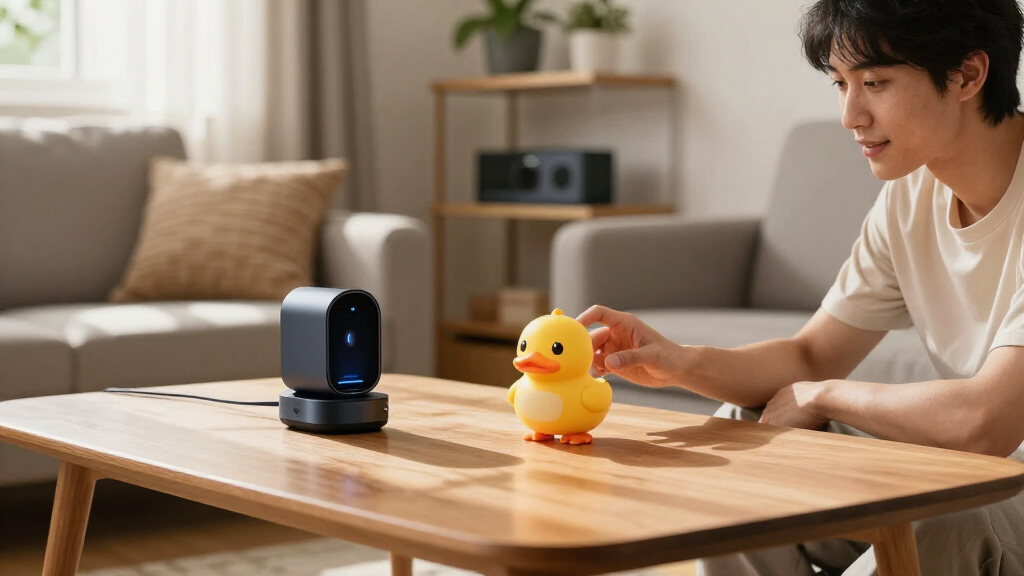
Microduck stands approximately 25 centimeters tall, weighs under 800 grams, and features 15 motors, sensors, a camera, microphone, WiFi, Bluetooth, and a LiDAR sensor. It can perform actions such as waddling, sitting, recovering from falls, following laser pointers, and rollerblading in demo videos. The robot’s articulated beak functions as a gripper capable of lifting objects up to 800 grams. Preorders are now open, with shipments expected before Christmas.
Importantly, the hardware is paired with an open software stack, including the SDK, simulation environment, and reinforcement learning training tools, all available on GitHub. This allows developers to read, fork, and retrain the software, making embodied AI accessible to a broader community beyond specialized labs. The device is positioned as a tool for experimentation and learning, not for household chores or commercial service tasks.
CEO Clem Delangue highlighted that the design’s small size and fall-tolerance make RL training feasible and safe at a low cost, emphasizing that failure and mistakes are integral to learning. However, the device’s sensors and network connectivity raise privacy concerns, as it continuously observes and listens within the home environment.
Open Hardware and Software Democratize Robotics Development
The launch of Microduck exemplifies a strategic shift toward making embodied AI development more accessible and affordable through open hardware and software. By providing a transparent, forkable platform, Hugging Face aims to lower barriers for developers, hobbyists, and smaller labs, similar to how open-source models revolutionized software development.
This approach could accelerate innovation in robotics, enabling a wider array of experiments, custom behaviors, and educational applications. It also signals a move away from proprietary, expensive industrial robots toward community-driven, adaptable systems. However, it raises questions about security, privacy, and the potential for misuse, especially as open infrastructure becomes a target for breaches or malicious activities.
As an affiliate, we earn on qualifying purchases.
Background on Hugging Face’s Open-Source Robotics and Industry Trends
Hugging Face, known for popularizing open-source language models, expanded into robotics with the acquisition of Pollen Robotics in April 2025. Its previous robot, Reachy Mini, was focused on communication, while Microduck shifts the focus toward movement and embodied AI. The company’s strategy emphasizes openness, affordability, and community engagement.
This move occurs amid broader industry tensions: recent security incidents involving open AI systems, such as the breach during OpenAI’s sandbox evaluation, highlight vulnerabilities in open infrastructure. Simultaneously, Nvidia’s reported acquisition of Hugging Face at a valuation of approximately $13 billion underscores the strategic importance of open AI platforms in the evolving landscape of hardware and software integration.
Historically, robotics has been dominated by high-cost, proprietary systems, limiting experimentation and access. The Microduck platform’s open architecture aims to challenge this paradigm, fostering innovation and democratization, even as it navigates security and privacy challenges inherent to open-source ecosystems.
“Our goal is to make embodied AI approachable, affordable, and forkable, enabling anyone to teach robots new tricks without barriers.”
— Clem Delangue, CEO of Hugging Face
As an affiliate, we earn on qualifying purchases.
Unresolved Security and Privacy Implications
While the open-source nature of Microduck’s software is clear, it remains uncertain how effectively security measures will be implemented to prevent breaches or misuse of the device’s sensors and data streams. The broader industry debate about balancing openness with safety continues, and the long-term privacy implications of always-on, networked home robots are still being assessed.
As an affiliate, we earn on qualifying purchases.
Next Steps for Development and Industry Impact
Hugging Face plans to begin shipping Microduck before Christmas, with ongoing updates and community contributions expected to enhance its capabilities. Industry observers will watch how the open platform is adopted, how security challenges are addressed, and whether other companies follow suit in democratizing embodied AI. Additionally, security protocols and privacy safeguards will likely evolve in response to emerging risks.
As an affiliate, we earn on qualifying purchases.
Key Questions
Can Microduck be used for practical household tasks?
No, Microduck is designed as a learning and experimentation platform, not for performing chores or household automation.
What makes Microduck different from other robots?
Its open-source software stack, affordability, small size, and focus on reinforcement learning make it accessible for developers and hobbyists to experiment with embodied AI.
Are there privacy concerns with Microduck?
Yes, as it includes sensors and network connectivity that observe and listen within the home environment, raising privacy and security considerations that users should evaluate.
Will the open software be secure against hacking?
The security of the open platform depends on community and developer efforts; vulnerabilities are possible, and ongoing security measures will be necessary.
Is this a commercial product or primarily for developers?
While available for preorder, Microduck is primarily aimed at developers, researchers, and hobbyists interested in embodied AI experimentation.
Source: ThorstenMeyerAI.com
Halloween Picks
halloween
As an affiliate, we earn on qualifying purchases.