TL;DR

Get the latest gadgets delivered free — and shop member deals
- Fast, free delivery on millions of items
- Access to Prime Big Deal Days deals on October 6–7
- Prime Video, Amazon Music and more included
Artists Xin Liu and Eunjo Lee have created two works during an online residency organized by LAS Art Foundation with Google Arts & Culture Lab. The projects use Google AI tools to explore distributed intelligence, living systems and connections between physical and digital worlds.
Xin Liu and Eunjo Lee have presented two artworks created during an online residency with LAS Art Foundation and Google Arts & Culture Lab, using AI tools to explore ideas from philosophy, science and psychology. The works, “nom nom” and “In Your Eyes, Before My Own,” are part of a program focused on digital world building and simulations of living systems, according to Google’s September 29 announcement.
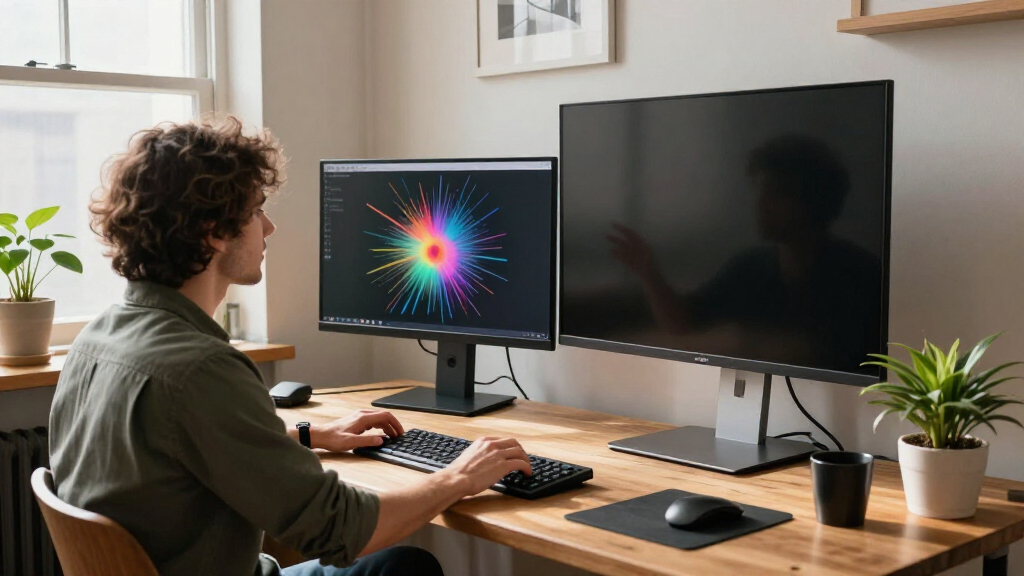
Liu’s “nom nom” draws on research into artificial life and emergent computation, including work by Google researchers Blaise Agüera y Arcas and Alexander Mordvintsev. The project uses the concept of Neural Cellular Automata, models in which many small units interact with their surroundings and can form, compete and dissolve. Google describes Liu’s work as an exploration of how collective intelligence might arise from those interactions.
Lee’s “In Your Eyes, Before My Own” combines hand-drawn sketches converted into 3D assets with motion-captured choreography. Google says Lee used its Nano Banana and Veo tools in the process and mapped Korean Hangul phonetics onto the digital environment, linking language to the geometry of the landscape. The work draws on ancient philosophy and modern psychology, according to the announcement.
The residency paired the two artists with digital tools and research themes rather than presenting the projects as scientific findings. Google says the artists were selected for technical skill and artistic imagination. Its report does not give the residency’s dates, duration, budget or selection process, and the supplied material does not specify whether the works are available to view online or in an exhibition.
AI as an Artistic Medium
The projects offer two distinct ways to bring AI research into art: Liu focuses on patterns emerging from many interacting units, while Lee connects digital imagery, movement and language to ideas of interdependence. For readers, the announcement illustrates how artists can use computational tools to frame questions about intelligence and perception without claiming to resolve them.
The works also place Google’s AI tools within a cultural collaboration, giving the company and the foundation a public example of creative uses for the technology. The announcement describes artistic processes and concepts, not independent evaluations of the tools. It does not establish that the works demonstrate scientific advances or that AI alone produced them.
Inside the Online Residency
The online residency was organized by LAS Art Foundation in collaboration with Google Arts & Culture Lab. Google says its aim was to support artists working with digital world building and simulated living systems. The September 29 report introduces the resulting works and describes some of the methods used to make them.
Liu’s project takes inspiration from Neural Cellular Automata, a class of models in which local interactions can produce larger patterns. Lee’s project combines hand-drawn source material, 3D conversion, choreography and Korean phonetics. The foundation’s commission credits, as reproduced by Google, identify both works as commissioned by LAS Art Foundation in collaboration with Google Arts & Culture.
““I want to explore an image of intelligence distributed across millions of tiny neural networks that react only to their surroundings — not as a singular mind above the world, but as a living ecology of fragments.””
— Xin Liu, on “nom nom”
Questions Beyond the Announcement
Google’s report does not state where or when audiences can see the works, whether they will be shown in a physical exhibition, or whether the residency will continue with further artists. It also gives no technical details about the models or settings used in the projects, beyond naming Nano Banana and Veo for Lee’s 3D asset process.
The artists’ descriptions are creative interpretations. The announcement does not present evidence that the artworks test or validate claims about intelligence, consciousness or the scientific behavior of living systems. Further information about how the tools shaped each work, and what material was created by the artists, is not included in the report.
Where the Projects Go
The immediate next step for audiences is to look for viewing details from LAS Art Foundation and Google Arts & Culture. Google’s report refers to a video guiding viewers through Liu’s “nom nom,” but the supplied announcement does not specify its access details or provide an exhibition schedule.
No further residency dates or public events are listed. Any additional presentation plans, artist talks or projects will need confirmation from the foundation or its collaborators.
Key Questions
What are the two artworks?
They are “nom nom” by Xin Liu and “In Your Eyes, Before My Own” by Eunjo Lee, created during an online residency with LAS Art Foundation and Google Arts & Culture Lab.
What does “nom nom” explore?
Liu’s project explores the idea that collective intelligence can emerge from interactions among many small units. It draws on artificial life research and Neural Cellular Automata.
How did Eunjo Lee make her work?
Google says Lee converted hand-drawn sketches into 3D assets using Nano Banana and Veo, added motion-captured choreography, and mapped Korean Hangul phonetics over the digital environment.
Where can the artworks be seen?
The announcement mentions a video guiding viewers through Liu’s work, but it does not provide specific access or exhibition details for either project.
Source: rss
Fall Picks
fall essentials
As an affiliate, we earn on qualifying purchases.