
🔍 Read the full analysis: Can Technology And AI Help Restore Tasmania’s Giant Kelp? on ThorstenMeyerAI.com

Get the latest gadgets delivered free with Prime
- Fast, free delivery on millions of items
- Prime Video, Amazon Music and more included
- Member-only deals all year
TL;DR
CSIRO and Google say AI-assisted DNA analysis is helping researchers identify genetic variation in wild Tasmanian giant kelp for selective breeding. Two Australian reference genomes are peer-reviewed and public; details about analysis of 600 wild specimens have so far been presented by Google, and the bred kelp’s ability to survive warmer seas has not been tested.
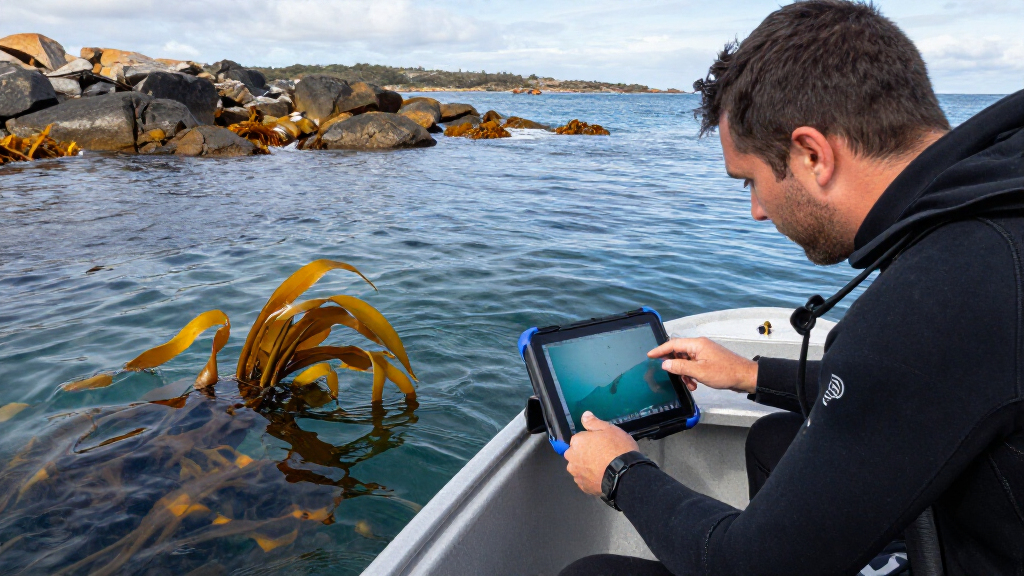
Google said on November 12 that its AI tools and genomics work with Australia’s CSIRO are helping researchers identify surviving giant kelp for selective breeding, as forests off Tasmania have fallen to about 5% of historic levels, according to the companies and research partners. The work is intended to help restore the endangered marine community, but it has not yet shown that bred kelp can withstand warmer conditions in the wild.
The project uses DNA data to compare wild kelp and help researchers choose which native plants to cross in the laboratory. AI does not test heat tolerance by itself: researchers conduct laboratory tests, then can relate those results to genetic variation. The proposed approach is selective breeding, not genetic modification, and does not involve AI planting kelp in the ocean.
Google says its tools helped produce two Australian giant kelp reference genomes and that a version of its DeepVariant model was trained to analyze DNA from 600 wild specimens collected at 40 sites along the Tasmanian coast. A reference genome provides a sequence against which researchers can compare individual samples. Google’s account says the analysis found that remaining Tasmanian patches are genetically isolated.
The genome work is documented in a peer-reviewed study published in BMC Genomics in June 2026, with CSIRO scientists and a Google researcher among its authors; the data is public. The study reports that the two Australian genomes differ from each other by 0.2%, while each differs from the Californian reference by 1.5%. The results about the 600 specimens and genetic isolation, however, are described in Google’s November announcement and video; the supplied material identifies no corresponding paper or dataset.
Giant kelp · Tasmania · CSIRO with Google AI
From the reef to the lab and back: where the AI fits
Five steps, as described by CSIRO and Google. The AI works in steps 2 and 3; people do the diving, the lab work and the planting.
1Reef
Collect wild kelp
600 wild specimens from 40 sites along the Tasmanian coast, according to Google.
2Lab + AI
Build a local reference
Long-read DNA plus Google’s DeepConsensus and DeepPolisher: two Australian reference genomes, published in BMC Genomics.
AI step3AI
Read each plant
A version of DeepVariant trained for kelp finds where each specimen’s DNA differs.
AI step4Lab
Choose and cross
Distinct survivors with genetic variation and heat-tolerant traits are crossed. Selective breeding, not genetic modification.
5Reef
Replant and watch
Young kelp is attached to rocky reef in pilot tests. Warm summers show which plants survive.
Sources: Google blog post, Nov 12, 2026, and Google Research video; Scharfenstein et al., BMC Genomics, 2026; CSIRO, 2024, and CSIRO on Google Arts & Culture. The scene is a schematic, not a map or real data.
Graphic: Powered by Thorsten Meyer AI
Breeding for Tasmania’s Changing Seas
Giant kelp forests are habitat for marine life, including fish, octopuses, sea stars and sea lions. Their decline therefore affects more than the seaweed itself: it threatens an underwater ecosystem and the species that use it. CSIRO says the forests have declined by 95% in recent decades, and the kelp forest is listed as an endangered marine community type.
The project’s possible contribution is practical rather than immediate restoration. If researchers can identify native kelp with useful genetic differences and breed suitable offspring, that could support attempts to re-establish forests. But genomic tools are one part of a longer process. Whether selected kelp survives warmer summers at sea remains untested, and the announcement does not report successful reef restoration or a measured recovery.
Products Worth Considering

Logitech MX Keys S Combo Wireless Keyboard and Mouse, Graphite

Bose TV Speaker Compact Soundbar with Bluetooth and HDMI-ARC, Black

DJI Mini 5 Pro Fly More Combo Plus with DJI RC 2
As an affiliate, we earn on qualifying purchases.
From Genome Maps to Wild Samples
Giant kelp, Macrocystis pyrifera, grows in cold, shallow seas. Around Tasmania, individuals can reach about 30 metres, according to CSIRO. The agency attributes the decline to warming and nutrient-poor water associated with the East Australian Current moving farther south, along with invading sea urchins. It says the Tasman Sea is warming at twice the global average.
The partnership, announced by Google Australia in February 2024, also includes the University of Tasmania’s Institute for Marine and Antarctic Studies, The Nature Conservancy, the Great Southern Reef Foundation and the Kelp Forest Alliance. Its work has included a mapping strand using satellite imagery and a genomics strand. Google’s November update concerns the latter.
Before the Australian genomes were available, the only giant kelp reference genome came from a Californian specimen. The 2026 study says the Australian kelp differs from that reference by 1.5%, compared with 0.2% between the two Australian genomes. That difference matters because a reference from a distant population may not represent local genetic variation as well. The study’s authors assembled 98–99% of each Australian genome into 35 pseudo-chromosomes.
“Without Giant Kelp to form the forests, the entire ecosystem disappears.”
— CSIRO
The Field Test Has Not Happened
The evidence is at different stages. The two Australian reference genomes are peer-reviewed and their data is public. By contrast, the account of sequencing and analyzing 600 wild specimens, and the reported genetic isolation of surviving patches, comes from Google’s blog post and video in the supplied material. It does not identify a publication or dataset documenting those findings.
It is also not yet clear which plants will be crossed, what traits will guide the selection, when young kelp will be planted on reefs, or how the trials will measure success. Most important, the survival of selectively bred kelp through warmer summers has not been established. No restoration outcome is reported in the announcement.
From Lab Crosses to Reef Trials
Researchers plan to cross genetically distinct native survivors in the laboratory and grow young kelp for planting on reefs, according to the source material. The next meaningful evidence would include published details of the wild-sample analysis, the breeding and selection process, and results from any field plantings.
Those trials will need to show whether the kelp can persist through warm conditions and contribute to forest recovery. Until then, the work is a research pathway supported by genome sequencing and AI-assisted analysis—not evidence that Tasmania’s giant kelp forests have begun to return.
Key Questions
What is AI being used for in the kelp project?
Google says a version of its DeepVariant model was trained to analyze DNA from wild giant kelp. The analysis is intended to help researchers compare plants and select candidates for breeding; it does not plant kelp or independently measure heat tolerance.
How much have Tasmania’s giant kelp forests declined?
CSIRO says giant kelp populations have fallen by 95% in recent decades. The source material also cites earlier research estimating a 95–98% loss of giant kelp cover in East Tasmania since 1940; that figure has a different stated time period and should not be treated as identical to the recent-decline estimate.
Has the AI analysis of 600 kelp specimens been peer-reviewed?
The supplied material says Google reported the 600-specimen analysis in a November 2026 blog post and video, but identifies no paper or dataset for those findings. The two Australian reference genomes are separately documented in a peer-reviewed June 2026 study.
Are researchers genetically modifying the kelp?
No. The planned approach described in the source is selective breeding: crossing native kelp in the laboratory and planting young kelp on reefs. It is not described as genetic modification.
Do researchers know whether the bred kelp will survive warmer seas?
No. The source says survival through warmer summers in the sea remains an open question. The planned reef plantings would provide a test of whether selected kelp can persist under those conditions.
Source: ThorstenMeyerAI.com