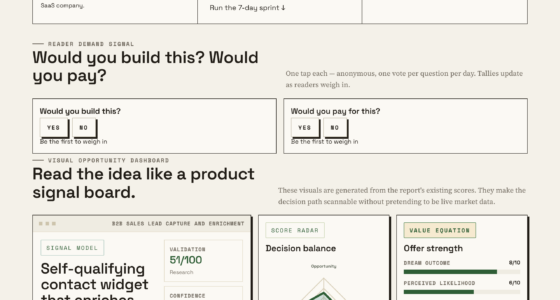
📊 Full opportunity report: Faceless Short-Form Videos: A Product Catalog Workflow on IdeaNavigator AI — validation score, market gap, and execution plan.

Get the latest gadgets delivered free — and shop member deals
- Fast, free delivery on millions of items
- Access to Prime Big Deal Days deals on October 6–7
- Prime Video, Amazon Music and more included
TL;DR
IdeaNavigator AI has outlined a proposed workflow that turns ecommerce product catalogs into faceless short-form videos for TikTok and Instagram Reels. The concept is aimed at sellers who lack on-camera talent or a video budget, but its performance and commercial viability remain untested; a suggested pilot would compare videos across 20 stores with existing creative.
IdeaNavigator AI has proposed a product-catalog workflow for generating faceless short-form videos for TikTok and Instagram Reels, targeting ecommerce sellers without on-camera talent or a video budget. The idea is presented as a testable business opportunity, not as a launched product: its suggested first validation step is to create videos for 20 stores and compare their performance with each store’s existing creative.
The proposed tool would connect to a seller’s product catalog and make several video versions for each item. Suggested formats include unboxing-style clips, lifestyle settings and feature callouts, with templates using trending audio. The workflow would also schedule videos directly to TikTok and Instagram Reels, reducing the manual work between product information and social publishing.
IdeaNavigator AI frames the intended customer as an online seller who cannot appear in videos or pay creators to produce them. Its proposal assumes that video-generation models can create product footage from still images and specifications, including scenes with hands, environments and motion. That is the premise behind the concept, not evidence that generated clips will meet a particular quality standard or perform well with viewers.
The proposed business model is a subscription tiered by monthly video volume. To test demand and results, the outline recommends generating videos for 20 stores, running both paid and organic tests, and measuring changes in engagement and conversion against the stores’ current creative. It does not report that those tests have taken place.
A Lower-Cost Route to Product Video
If the workflow can produce usable videos at low cost, it could give smaller sellers a way to test short-form product promotion without filming themselves or hiring creators. The possible benefit is not simply a larger number of clips: catalog data could support multiple creative treatments for many products, helping sellers test what attracts attention and prompts purchases.
But lower production effort does not establish business impact. A generated video may attract views without producing sales, and performance can vary by product, audience, platform and creative treatment. The proposed comparison with existing ads and organic posts is meant to address that gap by tracking both engagement and conversion, rather than treating output volume as proof of value.
The idea also sits between content generation and publishing. Catalog connections, platform scheduling and recurring subscriptions would make it a workflow product, not just a video generator. Whether sellers would pay for it depends on the reliability of the clips, the time saved, and measurable results compared with their current approach.
faceless product video maker for TikTok
As an affiliate, we earn on qualifying purchases.
As an affiliate, we earn on qualifying purchases.
The proposal responds to a specific constraint: some ecommerce sellers want product content on short-form feeds but lack the people, budget or production process to make it. It narrows the prospective customer to sellers without on-camera talent or a video budget, rather than claiming to serve all brands or marketing teams.
Its suggested workflow has three linked stages: connect product information, generate creative variations, then schedule publication. The proposed formats draw on common product-promotion approaches, such as showing an item in use or highlighting features. The plan places this within ecommerce creative automation and identifies monthly rendered-video limits as the basis for subscription tiers.
The validation plan is the only specific test described. Comparing generated clips with each store’s existing creative could offer a practical early read, but the outline does not specify a test duration, sample sizes per product, measurement definitions or how results would be separated between paid and organic distribution. Those details would affect how confidently any performance difference could be interpreted.
Instagram Reels product video templates
As an affiliate, we earn on qualifying purchases.
As an affiliate, we earn on qualifying purchases.
Performance and Product Status
No launched tool, completed pilot or measured results are reported. The proposal does not name a developer, give a release date, or state whether any catalog integrations or direct publishing features have been built. It also does not provide pricing, beyond suggesting monthly subscription tiers based on video volume.
Several practical questions remain open: how accurately a system could represent each real product, what level of editing sellers would need, and whether platform audio and scheduling features would be available in the proposed form. The outline does not define how it would handle product variations, brand requirements or content that might misrepresent an item. It also provides no evidence yet that generated videos outperform existing creative on engagement or conversion.
automated short-form product videos
As an affiliate, we earn on qualifying purchases.
As an affiliate, we earn on qualifying purchases.
The Proposed 20-Store Test
The next step described is a pilot involving 20 ecommerce stores. The concept calls for generating catalog-based video variants, testing them through both paid and organic distribution, and comparing engagement and conversion with existing content. No participating stores, schedule or test results have been announced in the available proposal.
For that test to show whether the workflow is useful, the team behind it would need to define the comparison period, metrics and treatment of differences among stores and products. Until those details and results are available, the catalog-to-video workflow remains an unvalidated product concept, rather than a demonstrated way to increase sales or reduce marketing costs.
Source: IdeaNavigator AI
product catalog video creation tool
As an affiliate, we earn on qualifying purchases.
As an affiliate, we earn on qualifying purchases.
Key Questions
What is the proposed faceless video workflow?
It would connect an ecommerce product catalog, generate short-form video variations from product images and specifications, and schedule clips for TikTok and Instagram Reels.
Who is the idea intended for?
The proposal targets ecommerce sellers who lack on-camera talent or the budget to hire video creators.
Has the tool launched or shown sales results?
No launch, completed pilot or sales results are reported. The workflow is presented as a concept to test.
How would the proposal be tested?
It recommends generating videos for 20 stores, testing them in paid and organic posts, and comparing engagement and conversion with each store’s existing creative.
Source: IdeaNavigator AI
Fall Picks
fall essentials
As an affiliate, we earn on qualifying purchases.