📊 Full opportunity report: How To Support Parent Permissions Across Youth Services on IdeaNavigator AI — validation score, market gap, and execution plan.

Get the latest gadgets delivered free — and shop member deals
- Fast, free delivery on millions of items
- Access to Prime Big Deal Days deals on October 6–7
- Prime Video, Amazon Music and more included
TL;DR
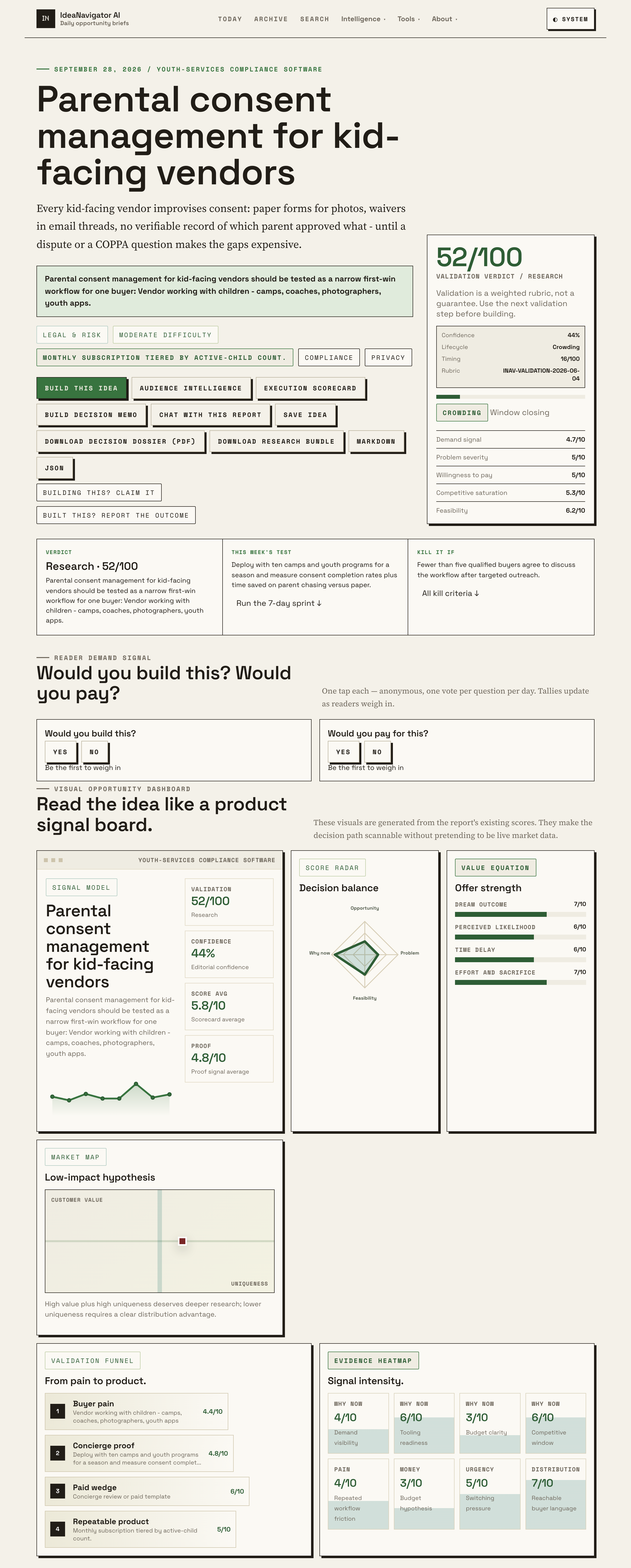
A proposal for parental consent software aimed at camps, coaches, photographers and youth apps calls for a one-season pilot with 10 youth programs. The suggested tool would collect and track permissions, but no product launch, pilot results or customer commitments are reported.
The proposed minimum viable product would offer vendor-branded forms that parents can complete on phones. Permission categories could cover photography, data collection, medical matters and liability. The suggested administrative features include identity checks matched to risk, a record for each child, expiration tracking and downloadable audit records. These are proposed features, not confirmed capabilities of an available service.
The suggested business model is a monthly subscription priced in tiers according to the number of active children. To assess demand, the proposal recommends working with 10 camps or youth programs for a season and measuring completion rates and staff time spent following up with parents. No pricing, participating organizations, schedule or results are given.
Permission Records at Small Providers
For providers serving children, a searchable record could make it easier to check whether a particular parent approved a specific use and whether that permission remains valid. That may matter when a family questions a photo, data practice or other activity, or when a provider needs to show how it handled consent. The proposal presents these as potential benefits; it supplies no evidence yet that the suggested workflow reduces disputes or improves compliance.The idea also raises a practical test for small organizations: whether a dedicated service saves enough staff time to justify another subscription. A seasonal pilot could compare digital completion and follow-up with the providers’ existing process. Without measured results, the effect on administrative work and parent participation remains unknown.
From Paper Forms to Digital Ledgers
The proposal frames the opportunity against changing expectations around children’s privacy, including updates to the U.S. Children’s Online Privacy Protection Act (COPPA) and state laws. It also points to parents questioning how images and data about their children are used. It does not identify particular legal provisions, enforcement actions or state requirements, so these references do not establish that every listed vendor faces the same obligations.The proposed product combines several permission types in one vendor-facing workflow. Its central record would connect a child, a parent’s approval, the approved purpose and any expiration date. The proposal does not specify how the service would confirm a parent’s identity, protect stored records, handle shared custody or respond to a permission being withdrawn.
Pilot, Safeguards and Demand
There is no reported product launch, pilot, named customer, funding, price or measured outcome. The proposed 10-program test is a validation plan, not evidence that providers have agreed to participate or that parents would use the forms.Key implementation details are also unspecified. These include the identity verification method for different permission types, data retention and security practices, access controls, withdrawal procedures, and how the service would address differing legal requirements. The proposal does not establish whether a single workflow could suit camps, photographers and youth apps, whose activities and risks may differ.
A Season-Long Provider Trial
The next step outlined in the proposal is a seasonal trial with 10 camps or youth programs. Organizers would track how often families complete consent forms and compare staff time spent pursuing responses with the existing paper-based process. No start date, recruitment plan or measurement method has been announced.Any assessment would also need to show how providers verify permission, keep records current and handle changes in a family’s choices. Until a pilot produces results, the concept’s demand, operational fit and value to vendors remain open questions.
Source: IdeaNavigator AI
Key Questions
Has a parental consent platform launched?
The proposal describes a product concept and suggested features. It does not report a launch or an available service.
Who is the proposed service for?
It targets vendors working with children, including camps, coaches, photographers and youth apps.
What would the proposed software do?
It would let parents complete vendor-branded consent forms by phone and give providers per-child records, expiration tracking and audit exports. These are proposed features, not verified product capabilities.
How would the idea be tested?
The proposal recommends a one-season pilot with 10 camps and youth programs, measuring form completion and staff time spent following up with parents. No trial results are reported.
What remains unknown?
The proposal does not name participating providers or give a launch date, price, security design, identity-checking process or evidence of customer demand.
Source: IdeaNavigator AI
Fall Picks
fall essentials
As an affiliate, we earn on qualifying purchases.