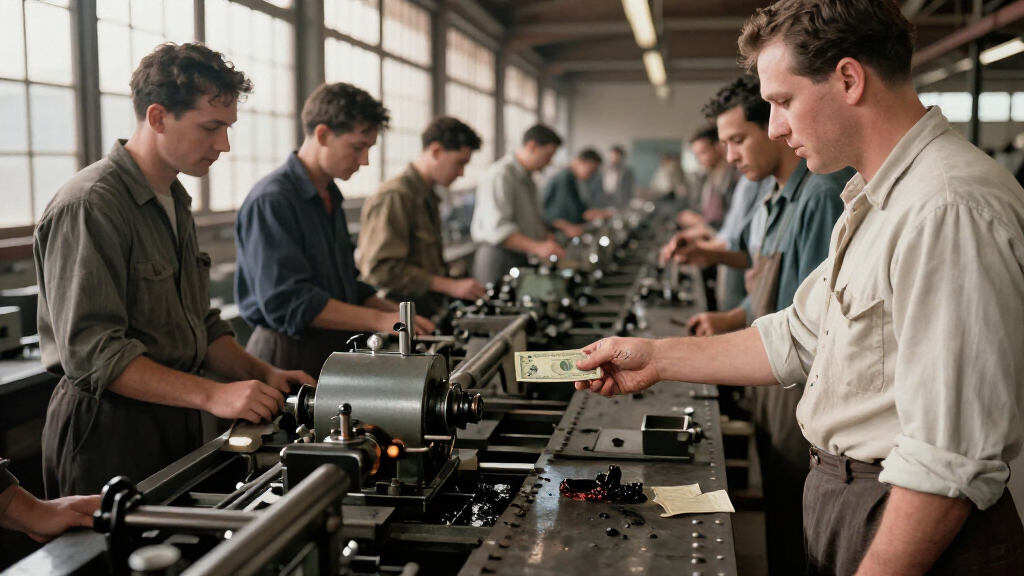
🔍 Read the full analysis: Why Five Dollars A Day Stood Out In Factory History on ThorstenMeyerAI.com

Get the latest gadgets delivered free with Prime
- Fast, free delivery on millions of items
- Prime Video, Amazon Music and more included
- Member-only deals all year
TL;DR
On Jan. 5, 1914, Ford Motor Co. raised minimum daily pay to $5 and cut the workday from nine hours to eight, as it struggled to keep workers at its Detroit plant. The account says the change followed severe turnover as the moving assembly line sped up production; whether workers could buy Ford cars was not the company’s immediate problem.
Ford Motor Co. raised its minimum daily pay to $5 and shortened the workday from nine hours to eight on Jan. 5, 1914, as it struggled to retain workers amid rapid changes to factory production. A historical account published by ThorstenMeyerAI.com on Nov. 6 says the policy followed annual turnover of about 370% in 1913, making the famous pay increase a response to a staffing crisis—not, according to the account, a plan chiefly to turn workers into buyers of Ford cars.
The account describes the scale of Ford’s staffing problem using figures cited from economists Daniel Raff and Lawrence Summers’ 1987 study, which drew on earlier labor research and company surveys. Ford hired 50,448 people in 1913 to maintain an average workforce of 13,623. The account also reports that about one in ten workers was absent on an average day. Those measures point to a plant repeatedly replacing workers even as it expanded production methods.
The pressure coincided with the introduction of the moving assembly line at Ford’s Highland Park plant in Detroit. In figures from Henry Ford’s 1922 book, cited by the account, labor time to assemble a Model T chassis fell from 12 hours and 28 minutes when it was built in place to one hour and 33 minutes on the line by early 1914. That is a reduction of roughly 88% in labor time per chassis, not a claim that the whole production process or workforce shrank by that amount.
Ford introduced the new pay arrangement as “profit sharing,” with conditions, according to the account. Turnover fell to 54% in 1914, though that remained substantial. The account says Ford later described the wage change as “one of the finest cost-cutting moves we ever made.” The quoted assessment is Ford’s retrospective explanation, not independent proof that the pay increase alone caused the decline in turnover.
How the Pay Deal Tackled Turnover
The episode matters because it connects a landmark wage decision to a practical factory problem: keeping enough people at work to run a faster, more specialized production system. The assembly line reduced the time needed for each chassis, but it also split tasks into repetitive steps and increased the pace of work. In the account’s telling, productivity gains did not automatically make the jobs easy to fill or keep.
Ford’s pay policy became a prominent example in debates over wages, productivity and labor retention. It also complicates a popular explanation that Ford raised pay mainly so employees could afford the cars they made. The source argues that the company’s immediate difficulty was workers leaving, while annual output was already about 250,000 cars with a workforce of roughly 14,000. The distinction matters: a celebrated wage decision can have several effects, but the stated business problem and the later popular story are not the same thing.
The source also places the change in a broader industrial pattern: U.S. factory employment rose by about a third between 1910 and 1920, even as assembly-line methods increased output per worker. That comparison suggests mechanized production did not immediately mean fewer factory jobs across the economy. It does not, by itself, establish how much of employment growth was caused by assembly lines.
Products Worth Considering

Jackery HomePower 3600 Plus Portable Power Station, 3584Wh, 3600W

Apple MacBook Air 15-inch with M5 chip, 16GB memory, 512GB SSD, and Liquid Retina display (Midnight)

Sonos Era 100 SL Compact Microphone-Free Speaker, White
As an affiliate, we earn on qualifying purchases.
From a Moving Chassis to $5
Before the line, workers assembled a car around a stationary chassis, bringing parts to it. Ford’s account says the company first tested line assembly on the flywheel magneto, a small generator used in ignition, in April 1913. The task was divided into 29 operations, with the part moving from worker to worker. Ford reported that assembly time fell from about 20 minutes to 13 minutes and 10 seconds, and then fell further after adjustments to the line.
The company then applied the method to the chassis. An early experiment pulled it along a 250-foot route with a rope and windlass; workers moved beside it and added parts. Ford reported that this reduced labor time to five hours and 50 minutes. Later adjustments raised the line and divided the work into smaller tasks, bringing the figure to one hour and 33 minutes by early 1914. These production figures come from Ford’s own account, published in 1922 with journalist Samuel Crowther, so they represent the company’s account of its achievements.
Workers’ departures were not all formally recorded as resignations. A March 1913 company survey, as described in the source, found that many people classified as leaving had missed five consecutive days without explanation. This complicates any simple reading of the turnover statistic: it includes workers who quit, people fired and employees recorded as having quit after extended absence.
What the Turnover Figures Capture
The historical figures do not settle exactly why each worker left or how much of the subsequent turnover decline was caused by higher pay, shorter hours, or other changes at Ford. The source says the five-dollar arrangement had strict eligibility conditions, but does not detail those requirements in the material provided. It also notes that the company’s own production figures come from Ford’s 1922 account; they should be read as company-reported figures rather than an independent audit.
The turnover rate is not a direct count of workers who voluntarily resigned. The account says it included formal quits, firings and “five-day men” recorded as having quit after missing work for five days. The source also cites different estimates—about 370% from the economists’ study and about 380% from the Henry Ford museum—without resolving the discrepancy. The relationship between the wage change and the later expansion of factory employment is also not established by the figures presented.
How Historians Read the Pay Change
There is no new policy announcement or forthcoming corporate milestone in this historical report. The next step for readers seeking a fuller account is to compare Ford’s memoir with the underlying labor records and later scholarship, particularly on the eligibility rules for the profit-sharing plan and the different methods used to calculate turnover.
The account’s central historical question remains relevant to studies of industrial work: whether higher pay can offset the strain and instability created by faster production. Ford’s reported experience offers evidence of a sharp change in turnover after the pay policy, but the available material does not isolate a single cause or establish that the same result would follow in other factories.
Key Questions
When did Ford introduce the five-dollar day?
Ford introduced it on Jan. 5, 1914, while also cutting the standard workday from nine hours to eight, according to the source account.
Why did Ford raise wages?
The account says Ford’s immediate problem was extreme worker turnover. The company hired 50,448 people in 1913 to maintain an average workforce of 13,623.
Did the moving assembly line reduce production time?
Ford’s 1922 account reported that labor time to assemble a Model T chassis fell from 12 hours and 28 minutes to one hour and 33 minutes by early 1914. Those are company-reported figures cited in the historical account.
Did the five-dollar day end turnover?
No. The account says turnover fell to 54% in 1914, down from about 370% in 1913, but the rate remained high. The source material does not establish how much of the decline resulted from the pay plan alone.
Was the wage increase mainly intended to help workers buy Ford cars?
The source account describes that explanation as a popular legend and says Ford’s immediate problem was workers leaving, not a lack of customers. The figures provided do not establish every motive behind the policy.
Source: ThorstenMeyerAI.com