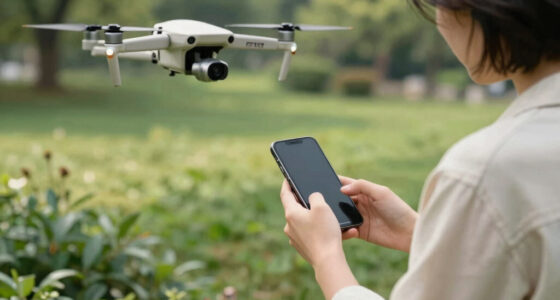
To practice aerial storytelling without a client project, focus on creating your own personal projects where you can experiment freely with visual techniques and narrative structures. Use diverse shot types, angles, and movements to evoke emotions and guide the viewer’s eye. Craft stories with clear beginnings, middles, and ends, then analyze your work to see what works best. Keep practicing regularly, and you’ll build a versatile style and strong storytelling skills that prepare you for real-world projects.

Get the latest gadgets delivered free with Prime
- Fast, free delivery on millions of items
- Prime Video, Amazon Music and more included
- Member-only deals all year
Key Takeaways
- Create personal aerial projects to experiment with visual techniques and narrative structures freely.
- Focus on developing clear story arcs with distinct beginnings, middles, and ends through shot sequencing.
- Analyze and critique your footage objectively to refine how visual techniques support storytelling.
- Practice varying shot angles, heights, and movements to evoke different emotions and narrative effects.
- Regularly reflect on your work to build a versatile style and deepen your understanding of visual storytelling principles.

Practicing aerial storytelling without a client project might seem challenging, but it’s entirely possible—and essential for mastering the craft. When you work on personal projects, you have the freedom to experiment with different visual techniques and refine your narrative structure without the pressure of client expectations. This flexibility allows you to develop a strong foundation in storytelling, which you can later adapt to real-world projects. Start by creating a variety of short, self-directed stories that challenge you to think creatively about how you use aerial shots to evoke emotion, guide the viewer’s eye, and build suspense. Focus on experimenting with different angles, heights, and movements to see how each influences the story you’re telling.
Your goal is to sharpen your visual techniques—like framing, composition, and camera movement—and learn how these can enhance your narrative structure. Think of visual techniques as your toolkit for constructing compelling stories. For example, using high-altitude shots to establish a vast setting can evoke feelings of loneliness or freedom, while tight, low-angle shots might intensify a sense of urgency or intimacy. Play with slow, sweeping motions to create a sense of grandeur or rapid, jittery movements to build tension. By practicing these techniques in a controlled environment, you gain a deeper understanding of how each contributes to storytelling. This process also allows you to explore visual storytelling principles that are fundamental to engaging aerial cinematography.
Equally important is developing your narrative structure. Without a client’s brief, you have the chance to craft stories that are purely driven by your creative instincts. Construct short narratives with clear beginnings, middles, and ends, using aerial footage to support each phase. For instance, you might start with a wide shot establishing the scene, then zoom in or change angles to reveal details, and finally pull back to conclude. This process helps you see how the sequencing of shots influences the story’s flow and emotional impact. Over time, you’ll learn how to craft a cohesive visual story that guides viewers seamlessly from start to finish.
Practicing with personal projects also allows you to analyze and critique your work objectively. Watch your footage and ask yourself how well your visual techniques serve your narrative goals. Are your shots conveying the intended mood? Does your narrative structure support the story’s progression? This reflection deepens your understanding and sharpens your skills. Additionally, exploring a variety of content can help you see how different storytelling styles are employed in aerial cinematography. By regularly engaging in self-directed aerial storytelling, you’ll build a versatile skill set that can be adapted to any client project in the future, all while honing your unique voice and style.
aerial drone camera for storytelling
As an affiliate, we earn on qualifying purchases.
As an affiliate, we earn on qualifying purchases.
Frequently Asked Questions
How Can I Measure Progress in Aerial Storytelling Practice?
You can measure progress in aerial storytelling practice by regularly reviewing your work using specific storytelling frameworks to evaluate clarity and engagement. Focus on improving your aerial techniques, such as camera angles, movement, and composition, while tracking how well your stories connect emotionally. Keep a journal of your projects, noting improvements over time, and seek feedback from peers or mentors to see how your storytelling skills evolve.
What Tools Are Essential for Practicing Aerial Storytelling Independently?
To hone your aerial storytelling skills independently, essential tools include a good drone with stable flight capabilities and a camera suited for creative visualization. Use storytelling apps to develop your narrative development and plan shots creatively. A sturdy tripod and editing software help refine your footage, while a notebook keeps your ideas flowing. These tools nurture your craft, turning your solo practice into enthralling visual stories.
How Often Should I Practice to Improve My Skills?
You should practice regularly, ideally 2-3 times a week, to improve your drone safety and storytelling techniques. Consistent practice helps you become more comfortable with your equipment and enhances your ability to craft compelling narratives from aerial footage. Focus on different storytelling styles and safety protocols to build confidence. Over time, this dedication will sharpen your skills and help you develop a unique aerial storytelling voice.
Can I Use Personal Projects as Practice Opportunities?
Absolutely, personal projects are your secret weapon for growth and creative exploration. They offer a safe space to experiment, fail, and refine your aerial storytelling skills without pressure. As you immerse yourself in these projects, you’ll uncover new techniques and perspectives that elevate your craft. Embrace the uncertainty—it’s where real innovation happens. Your personal projects become the catalyst for mastery, pushing you beyond limits and revealing your true potential.
How Do I Stay Motivated Without Client Feedback?
You stay motivated by regularly practicing self-assessment methods, like reviewing your work critically and setting personal goals. Peer collaboration also helps; sharing your progress with friends or fellow storytellers keeps you accountable and provides fresh perspectives. Celebrate small wins to boost your confidence, and remember that consistent effort, combined with honest self-review and feedback from others, sustains your motivation even without direct client input.
handheld gimbal stabilizer for aerial shots
As an affiliate, we earn on qualifying purchases.
As an affiliate, we earn on qualifying purchases.
Conclusion
Now that you know how to practice aerial storytelling on your own, there’s no limit to what you can create. Think of it as your personal playground where ideas soar higher than ever before. Keep experimenting, push your boundaries, and embrace mistakes as part of the journey. Before long, your skills will be so incredible, they’ll make even the most seasoned pros look like amateurs. So go ahead—ignite your imagination and let your stories take flight!
professional drone accessories kit
As an affiliate, we earn on qualifying purchases.
As an affiliate, we earn on qualifying purchases.
As an affiliate, we earn on qualifying purchases.
Halloween Picks
halloween
As an affiliate, we earn on qualifying purchases.