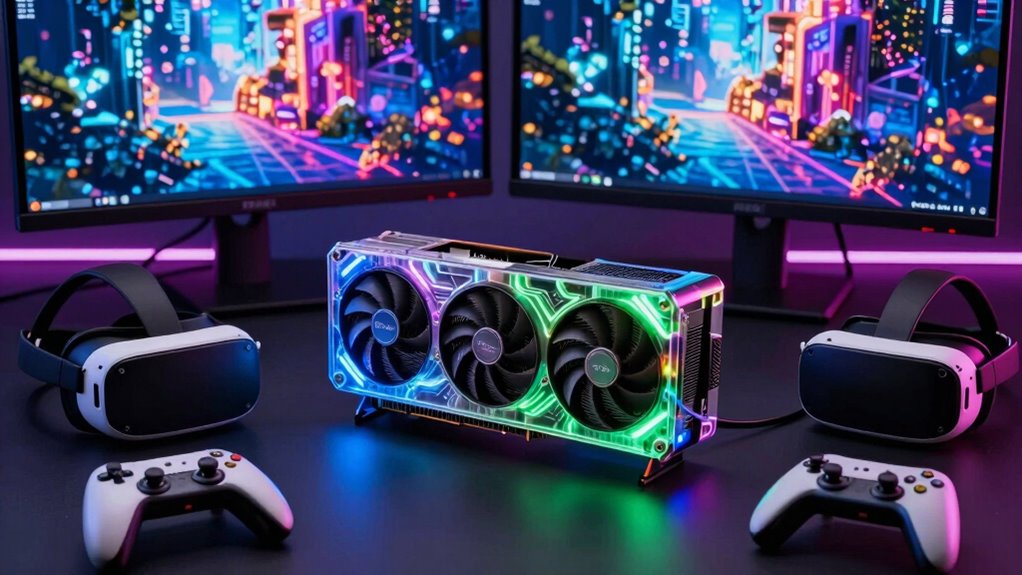

If you’re seeking an RTX graphics card optimized for virtual reality, you’re likely looking for a balance of high frame rates and smooth visuals. The ASUS Dual GeForce RTX 3050 stands out as a solid overall pick thanks to its affordability and decent VR performance. The ZOTAC Gaming GeForce RTX 5080 offers cutting-edge power for demanding VR experiences, but at a premium price. Meanwhile, the MSI Gaming GeForce RTX 3060 provides a reliable middle ground for those who want strong VR performance without overspending. In this guide, I’ll break down the key tradeoffs, from raw power to value, to help you find the best fit for your VR setup. Keep reading for the full breakdown of these top options.

Get the latest gadgets delivered free — and shop member deals
- Fast, free delivery on millions of items
- Access to Prime Big Deal Days deals on October 6–7
- Prime Video, Amazon Music and more included
Complete the kit



Key Takeaways
- The latest RTX 5080 offers the best future-proofing but comes at a high cost, making it ideal for enthusiasts.
- The GTX 2060 and RTX 3050 cards deliver solid entry-level VR performance but may struggle with more demanding titles.
- VR-specific features like HDMI 2.1 and DisplayPort 1.4a are common in newer models and improve compatibility.
- Price-to-performance ratios vary significantly; mid-range cards often hit the sweet spot for most users.
- Power consumption and size are often overlooked but critical for fitting into compact or pre-built PC cases.
| ASUS Dual GeForce RTX 3050 6GB GDDR6 OC Edition Gaming Graphics Card |  | Best for Budget VR Setups | GPU: GeForce RTX 3050 | Memory: 6GB GDDR6 | Boost Clock: 1500 MHz (OC Mode), 1470 MHz (Default) | VIEW ON AMAZON | See Our Full Breakdown |
| GPVHOSO RTX 2060 8GB Super Graphics Card 256Bit GDDR6 |  | Best for Mid-Range VR and Versatile Gaming | Memory: 8GB GDDR6 | Memory Interface: 256-bit | Boost Clock: up to 1650 MHz | VIEW ON AMAZON | See Our Full Breakdown |
| MSI Gaming GeForce RTX 2080 8GB GDDR6 VR Ready Graphics Card (RTX 2080 Gaming X Trio) (Renewed) |  | Best for Power Users and Heavy VR Gaming | Chipset: NVIDIA GeForce RTX 2080 | Video Memory: 8GB GDDR6 | Memory Interface: 256-bit | VIEW ON AMAZON | See Our Full Breakdown |
| MSI Gaming GeForce RTX 3060 Ventus 2X 12G OC V1 Graphics Card |  | Best for High-Resolution and Creative VR | Chipset: NVIDIA GeForce RTX 3060 | Video Memory: 12GB GDDR6 | Memory Interface: 192-bit | VIEW ON AMAZON | See Our Full Breakdown |
| ASUS Dual GeForce RTX 5060 Ti 16GB GDDR7 OC Edition Gaming Graphics Card |  | Best for Cutting-Edge VR and Quiet Operation | VIEW ON AMAZON | See Our Full Breakdown | |||
| GIGABYTE GeForce RTX 3050 WINDFORCE OC V2 6G Graphics Card |  | Best for Budget VR Gaming | GPU Architecture: NVIDIA Ampere | RT Cores: 2nd Generation | Tensor Cores: 3rd Generation | VIEW ON AMAZON | See Our Full Breakdown |
| MSI Gaming RTX 3050 LP 6G OC Graphics Card |  | Best Compact VR Card for Small Builds | Chipset: GeForce RTX 3050 | Memory: 6GB GDDR6 | Memory Interface: 96-bit | VIEW ON AMAZON | See Our Full Breakdown |
| GIGABYTE GeForce RTX 3060 Gaming OC 12G (REV2.0) |  | Best for High-Resolution VR and Ray Tracing | Memory: 12GB GDDR6 | Memory Interface: 192-bit | Fans: 3X WINDFORCE | VIEW ON AMAZON | See Our Full Breakdown |
| MSI Gaming RTX 3050 Ventus 2X 6G OC Graphics Card |  | Best for Entry-Level VR Gaming | Chipset: GeForce RTX 3050 | Boost Clock: 1492 MHz | Memory: 6GB GDDR6 | VIEW ON AMAZON | See Our Full Breakdown |
| MSI Gaming GeForce RTX 3060 12GB |  | Best for High-Resolution VR and Creative Work | GPU Memory: 12GB GDDR6 | GPU Clock Speed: 1710 MHz | Memory Clock Speed: 1807 MHz | VIEW ON AMAZON | See Our Full Breakdown |
| Maxsun GeForce RTX 3050 6GB Graphics Card – GDDR6, PCIe 4.0, HDMI 2.1, DisplayPort 1.4a, Low Profile Design |  | Best Compact for Entry-Level VR Setup | Graphics Coprocessor: NVIDIA GeForce RTX 3050 | Memory: 6 GB GDDR6 | Memory Clock Speed: 1750 MHz | VIEW ON AMAZON | See Our Full Breakdown |
| ZOTAC GAMING GeForce RTX 3060 Ti Twin Edge OC LHR 8GB GDDR6 Graphics Card |  | Best Mid-Range for High-Performance VR | Graphics Coprocessor: NVIDIA GeForce RTX 3060 Ti | RAM: 8 GB | Video Output Interface: DisplayPort, HDMI | VIEW ON AMAZON | See Our Full Breakdown |
| ZOTAC Gaming GeForce RTX 5080 Solid CORE OC DLSS 4 16GB GDDR7 Graphics Card |  | Best Premium for Ultimate VR and Future-Proofing | Architecture: NVIDIA Blackwell | Memory: 16GB GDDR7 | Memory Interface: 256-bit | VIEW ON AMAZON | See Our Full Breakdown |
| rtx graphics card for vr | Memory | Memory Interface |
|---|---|---|
| ASUS Dual GeForce RTX 3050 6GB | 6GB GDDR6 | — |
| GPVHOSO RTX 2060 8GB Super Gra | 8GB GDDR6 | 256-bit |
| MSI Gaming GeForce RTX 2080 8G | — | 256-bit |
| MSI Gaming GeForce RTX 3060 Ve | — | 192-bit |
| ASUS Dual GeForce RTX 5060 Ti | — | — |
| GIGABYTE GeForce RTX 3050 WIND | 6GB GDDR6 | 96-bit |
| MSI Gaming RTX 3050 LP 6G OC G | 6GB GDDR6 | 96-bit |
| GIGABYTE GeForce RTX 3060 Gami | 12GB GDDR6 | 192-bit |
| MSI Gaming RTX 3050 Ventus 2X | 6GB GDDR6 | 96-bit |
| MSI Gaming GeForce RTX 3060 12 | — | — |
| Maxsun GeForce RTX 3050 6GB Gr | 6 GB GDDR6 | — |
| ZOTAC GAMING GeForce RTX 3060 | — | — |
| ZOTAC Gaming GeForce RTX 5080 | 16GB GDDR7 | 256-bit |
More Details on Our Top Picks
ASUS Dual GeForce RTX 3050 6GB GDDR6 OC Edition Gaming Graphics Card
The ASUS Dual GeForce RTX 3050 OC Edition stands out for offering solid ray-tracing and AI capabilities within a compact and durable design, making it a good choice for entry-level VR gaming. Compared with the RTX 2060 Super, it provides similar VR support but with a lower 6GB VRAM limit, which may hinder performance in more demanding applications. Its axial-tech fans and dust resistance enhance longevity, though the limited VRAM could restrict high-resolution VR experiences. This card is ideal for gamers needing a budget-friendly option without sacrificing essential VR features, but it’s less suitable for those pursuing ultra-high-resolution or future-proof setups.Pros:- Enhanced ray-tracing and AI performance with Ampere architecture
- Effective cooling with axial-tech fan design
- Durable stainless steel bracket and dust resistance
Cons:- Limited to 6GB VRAM, which may restrict high-end VR experiences
- Performance might be limited at very high resolutions or with demanding VR titles
Best for: Budget-conscious gamers starting with VR who want decent ray-tracing performance
Not ideal for: Power users or enthusiasts aiming for ultra-high-resolution VR or future-proofing, due to VRAM limitations
- GPU:GeForce RTX 3050
- Memory:6GB GDDR6
- Boost Clock:1500 MHz (OC Mode), 1470 MHz (Default)
- Fan Design:Axial-tech
- Design:2-slot
- Dust Resistance:IP5X
Our verdict“This card suits entry-level VR gamers who prioritize affordability and durability over high VRAM capacity.”
GPVHOSO RTX 2060 8GB Super Graphics Card 256Bit GDDR6
The RTX 2060 Super with 8GB GDDR6 memory offers a significant step up in VR capability compared to the RTX 3050, supporting real-time ray tracing and DLSS for improved visual fidelity. It’s better suited for immersive VR experiences and multi-monitor setups, making it a good choice for gamers looking for balanced performance. However, it may demand higher power and cooling solutions, especially in extended gaming sessions. Compared to the RTX 3050, this card supports more demanding VR titles and higher resolutions, but it also comes at a potentially higher cost and power draw. It makes sense for users seeking reliable VR performance without stepping into high-end pricing.Pros:- High-performance gaming with 8GB GDDR6 memory
- Supports real-time ray tracing and DLSS for improved visuals
- VR ready with multi-display support
Cons:- Potentially high power consumption requiring a robust PSU
- May need enhanced cooling for sustained performance
Best for: Mid-range VR gamers who want good performance with multiple displays and enhanced visuals
Not ideal for: Budget users or those with limited power supply capacity, since it can be more demanding
- Memory:8GB GDDR6
- Memory Interface:256-bit
- Boost Clock:up to 1650 MHz
- Architecture:Turing
- Outputs:DisplayPort 1.4, HDMI 2.0b
- VR Ready:Yes
Our verdict“This card is ideal for VR enthusiasts who seek a balance between performance and affordability in mid-tier setups.”
MSI Gaming GeForce RTX 2080 8GB GDDR6 VR Ready Graphics Card (RTX 2080 Gaming X Trio) (Renewed)
The RTX 2080 Gaming X Trio, even as a renewed product, packs robust VR capabilities with 8GB GDDR6 and support for multiple monitors up to four. It offers higher performance than lower-tier options like the RTX 3050 or 2060 Super, especially in demanding VR titles. The need for two 8-pin power connectors indicates a requirement for a high-capacity power supply, which may limit some builds. While its renewed status offers cost savings, the condition and warranty are less predictable than new cards. Compared to the RTX 3060 or newer models with larger VRAM, it might be slightly less future-proof but provides excellent performance for high-end VR gaming.Pros:- Supports VR and up to 4 monitors for multitasking
- High-performance GPU suitable for demanding VR titles
- Cost savings with renewed condition
Cons:- Requires two 8-pin PCIe power connectors, demanding more power
- Renewed product may have limited warranty or unknown condition
Best for: Advanced gamers and professionals requiring powerful VR performance with multi-monitor support
Not ideal for: Casual gamers or users with limited PSU capacity, due to high power needs and potential warranty concerns
- Chipset:NVIDIA GeForce RTX 2080
- Video Memory:8GB GDDR6
- Memory Interface:256-bit
- Max Resolution:Supports 4x Display Monitors
- Input:2x 8pin PCI-E Power Connectors
Our verdict“This pick is best for power users seeking high VR performance and multi-monitor versatility on a budget through renewal options.”
MSI Gaming GeForce RTX 3060 Ventus 2X 12G OC V1 Graphics Card
The MSI RTX 3060 Ventus 2X with 12GB of GDDR6 stands out for supporting ultra-high resolutions up to 8K, making it a strong choice for high-end VR and creative workflows. Its dual Torx Twin Fans provide effective cooling, essential for sustained performance during demanding VR sessions. Compared with the RTX 2060 Super, the added VRAM and 8K support offer a clear advantage for future-proofing or immersive high-res VR. However, it requires a PCIe 4.0 slot and may draw significant power, which could limit compatibility with older systems. For users focused on high-fidelity VR or creative tasks, this card delivers impressive specs, but it’s less suited for budget builds or older motherboards.Pros:- 12GB GDDR6 supports high-resolution VR and creative applications
- Supports up to 8K resolution for immersive visuals
- Dual fan cooling for thermal stability
Cons:- Requires PCIe 4.0 slot, limiting older system compatibility
- Potentially high power consumption without included overclocking tools
Best for: VR users pushing resolution boundaries and creative professionals needing high VRAM
Not ideal for: Budget or older system builders lacking PCIe 4.0 support or high-capacity power supplies
- Chipset:NVIDIA GeForce RTX 3060
- Video Memory:12GB GDDR6
- Memory Interface:192-bit
- Maximum Resolution:7680 x 4320
- Outputs:DisplayPort x 3 (v1.4a), HDMI 2.1
Our verdict“This card is ideal for high-resolution VR enthusiasts and creative professionals seeking maximum VR fidelity and future-proofing.”
ASUS Dual GeForce RTX 5060 Ti 16GB GDDR7 OC Edition Gaming Graphics Card
The ASUS Dual RTX 5060 Ti OC Edition, with 16GB of GDDR7 memory, offers an impressive leap forward in VR and gaming performance thanks to the latest Blackwell architecture. Its dual BIOS and axial-tech fans with 0dB technology combine performance with quiet operation, appealing to those who want high-end VR without excessive noise. Compared to the RTX 3060 models, the larger VRAM and new architecture promise better future-proofing and handling of intensive VR applications. However, limited detailed reviews and higher power consumption are considerations, especially for systems with tighter PSU constraints. This card is suitable for gamers seeking top-tier VR performance with a focus on quiet, efficient operation.Pros:- High-performance 16GB GDDR7 memory for demanding VR and gaming
- Efficient cooling with axial-tech fans and 0dB technology
- Dual BIOS for customizable performance and noise levels
Cons:- Limited detailed reviews available, potential uncertainty in real-world performance
- Potentially higher power consumption due to high VRAM and architecture
Best for: Enthusiasts aiming for the latest VR tech combined with quiet, efficient cooling
Not ideal for: Budget-conscious buyers or those with limited power capacity, due to high performance and power needs
Our verdict“This card targets high-end VR users seeking the latest architecture with quiet operation and future-proofing capabilities.”
GIGABYTE GeForce RTX 3050 WINDFORCE OC V2 6G Graphics Card
The GIGABYTE RTX 3050 stands out for delivering NVIDIA Ampere architecture at an accessible price point, making it a solid choice for VR gamers on a budget. Compared with the MSI Ventus 2X 6G OC, it offers similar core specs but benefits from a more robust cooling system with dual WINDFORCE fans, which can help sustain performance during longer VR sessions. However, the 6GB VRAM may limit performance in more demanding VR environments, especially with future titles or higher resolutions. Its cooling setup and architecture make it suitable for entry-level to mid-tier VR setups, though it’s less equipped for ultra-high-end experiences requiring larger VRAM pools.
Pros:- NVIDIA Ampere architecture provides efficient performance and ray tracing
- Effective cooling with dual WINDFORCE fans ensures stable VR sessions
- 6GB GDDR6 memory supports current VR games and creative tasks
Cons:- Limited VRAM may hinder performance in future or high-resolution VR titles
- No advanced cooling features like vapor chamber or triple fans
Best for: Budget-conscious gamers seeking reliable VR performance without breaking the bank
Not ideal for: High-end VR enthusiasts or users planning to run the latest demanding titles at maximum settings
- GPU Architecture:NVIDIA Ampere
- RT Cores:2nd Generation
- Tensor Cores:3rd Generation
- Memory:6GB GDDR6
- Memory Interface:96-bit
- Cooling:2X WINDFORCE Fans
Our verdict“This card offers good value for entry-level VR gamers who prioritize affordability over maximum VRAM capacity.”
MSI Gaming RTX 3050 LP 6G OC Graphics Card
The MSI Gaming RTX 3050 LP excels for users who need a smaller, space-efficient GPU without sacrificing too much VR performance. Its compact size (6.9 inches long) compared to the GIGABYTE RTX 3050 makes it ideal for small form factor builds, yet it maintains a boost clock of 1492 MHz, close to higher-tier models like the MSI RTX 3060. Compared to the GIGABYTE model, it lacks some cooling features, which could impact thermal performance during extended VR sessions. Its multiple output options, including HDMI 2.1a and DisplayPort 1.4a, support high resolutions vital for VR headsets. This makes it best suited for users with limited space who want a capable VR card that fits in tight cases, though it’s not ideal for those seeking maximum VRAM or overclocking headroom.
Pros:- Compact size fits in small form factor cases
- High-speed GDDR6 memory with 14 Gbps bandwidth
- Multiple high-resolution outputs including HDMI 2.1a and DisplayPort 1.4a
Cons:- Limited to 6GB VRAM, potentially restricting future VR titles
- Lack of advanced cooling features may impact thermal performance
Best for: Small build enthusiasts and VR users with limited case space
Not ideal for: Power users or those running demanding VR applications that require extensive VRAM or cooling capacity
- Chipset:GeForce RTX 3050
- Memory:6GB GDDR6
- Memory Interface:96-bit
- Boost Clock:1492 MHz
- Video Memory Speed:14 Gbps
- Dimensions:6.9″ L x 2.7″ W
Our verdict“This pick makes the most sense for VR users with tight space constraints who want solid performance in a compact form.”
GIGABYTE GeForce RTX 3060 Gaming OC 12G (REV2.0)
The GIGABYTE RTX 3060 Gaming OC 12G offers a significant upgrade over the RTX 3050 models, with 12GB of VRAM making it better suited for demanding VR environments and ray tracing capabilities. Its triple-fan cooling system enhances thermal stability during long VR sessions, surpassing the cooling efficiency of the MSI Ventus 2X 6G OC. While it consumes more power, this extra capacity translates into smoother performance at higher resolutions and more complex scenes. Compared to the RTX 3050 cards, it provides a more future-proof experience, especially for VR titles that leverage larger VRAM buffers. This card is ideal for serious VR gamers who want high fidelity and extended longevity from their GPU investment.
Pros:- 12GB GDDR6 memory supports demanding VR and ray tracing
- Effective cooling with three fans maintains performance during intensive VR use
- Based on NVIDIA’s latest Ampere architecture for efficiency and AI features
Cons:- Higher power consumption requiring a robust power supply
- More expensive than lower-tier RTX 3050 options
Best for: VR enthusiasts seeking high-resolution, ray-traced experiences with future-proofing
Not ideal for: Casual VR users or those with limited power supplies, due to higher power demands
- Memory:12GB GDDR6
- Memory Interface:192-bit
- Fans:3X WINDFORCE
- Architecture:Ampere
- Model:GV-N3060
Our verdict“This card is best for VR users who prioritize high-resolution, ray-traced visuals and have a compatible system to handle its power needs.”
MSI Gaming RTX 3050 Ventus 2X 6G OC Graphics Card
The MSI Ventus 2X RTX 3050 provides a straightforward, cost-effective approach to VR gaming, featuring a boost clock of 1492 MHz and 6GB GDDR6 memory. It’s a practical choice for those new to VR or with budget constraints, offering decent performance supported by NVIDIA’s Ampere architecture. Compared with the MSI RTX 3060, it’s less powerful but still capable of running many VR titles at moderate settings. Its dual-fan cooling system is adequate for standard use, though it might struggle during extended or demanding VR sessions. If you’re starting with VR or don’t need the extra VRAM for future titles, this model offers a balanced mix of performance and affordability.
Pros:- High-performance RTX 3050 GPU for VR and gaming
- Supports HDMI 2.1a for high-resolution VR headsets
- Dual-fan cooling maintains stable operation
Cons:- Limited VRAM may bottleneck future VR titles
- No advanced cooling or overclocking features
Best for: Beginners or budget-conscious users interested in entry-level VR experiences
Not ideal for: High-end VR users or those aiming for maximum fidelity with ray tracing
- Chipset:GeForce RTX 3050
- Boost Clock:1492 MHz
- Memory:6GB GDDR6
- Memory Interface:96-bit
- Outputs:DisplayPort 1.4a, HDMI 2.1a
Our verdict“This card is ideal for newcomers to VR or those seeking a budget-friendly option for casual virtual reality gaming.”
MSI Gaming GeForce RTX 3060 12GB
The MSI RTX 3060 12GB delivers substantial VR performance with 12GB of VRAM, making it well-suited for immersive, high-resolution VR experiences and demanding creative tasks. Its 1710 MHz GPU clock and multiple output options—including three DisplayPorts and HDMI 2.1—support resolutions up to 7680 x 4320, ideal for both gaming and professional use. Compared to the RTX 3050 models, it offers more VRAM and higher clock speeds, translating into more stable performance in complex VR scenes. The main tradeoff involves higher power consumption and a requirement for a PCIe 4.0 slot, which may limit compatibility with older systems. This model makes sense for serious VR setups that need extra headroom for future growth and higher fidelity.
Pros:- 12GB GDDR6 VRAM supports demanding VR titles and multitasking
- High GPU clock speed ensures smooth performance
- Multiple high-res outputs support immersive VR headsets
Cons:- Requires PCIe 4.0 compatible motherboard
- Higher power consumption necessitates a robust PSU
Best for: VR enthusiasts and creative professionals demanding high-resolution, demanding VR and multimedia workflows
Not ideal for: Casual VR users with older systems or limited power capacity
- GPU Memory:12GB GDDR6
- GPU Clock Speed:1710 MHz
- Memory Clock Speed:1807 MHz
- Display Outputs:3 x DisplayPort, HDMI 2.1
- Maximum Resolution:7680 x 4320
Our verdict“This card is perfect for users looking for substantial VR performance and future-proofing at a premium price point.”
Maxsun GeForce RTX 3050 6GB Graphics Card – GDDR6, PCIe 4.0, HDMI 2.1, DisplayPort 1.4a, Low Profile Design
The Maxsun RTX 3050 stands out for its compact low-profile design, making it an excellent choice for small form factor PCs that need to deliver VR performance without taking up too much space. While it supports 8K output and modern connectivity like PCIe 4.0 and HDMI 2.1, its 6GB GDDR6 memory limits its ability to handle demanding VR applications or future titles that require more VRAM. Compared to the RTX 3060 Ti, it’s less powerful, but its low-profile form factor makes installation easier in cramped cases. The single fan cooling may struggle under prolonged VR sessions, risking thermal throttling. This card makes sense for budget-conscious users with small cases who prioritize basic VR compatibility over high-end performance.
Pros:- Compact low-profile design fits small form factor PCs
- Supports 8K resolution for future-proof visuals
- Modern PCIe 4.0 and HDMI 2.1 support for high bandwidth connections
Cons:- Limited to 6GB VRAM, possibly insufficient for intensive VR titles
- Single fan cooling could lead to higher temperatures under load
- Lacks professional features for content creation or overclocking
Best for: VR newcomers or users with small cases needing a budget-friendly, space-efficient upgrade
Not ideal for: Enthusiasts seeking high-fidelity VR experiences with demanding titles or professional VR work
- Graphics Coprocessor:NVIDIA GeForce RTX 3050
- Memory:6 GB GDDR6
- Memory Clock Speed:1750 MHz
- GPU Core Clock:1042 MHz
- Boost Clock:1470 MHz
- Maximum Resolution:7680 x 4320
Our verdict“This is a solid choice for small, budget-conscious VR setups where space and cost are primary concerns.”
ZOTAC GAMING GeForce RTX 3060 Ti Twin Edge OC LHR 8GB GDDR6 Graphics Card
The ZOTAC RTX 3060 Ti Twin Edge OC offers a significant performance leap over the RTX 3050, with 8GB of GDDR6 memory that better supports demanding VR titles and multi-tasking. Its dual-fan IceStorm 2.0 cooling system ensures better thermal management during extended VR sessions compared to the Maxsun’s single fan, making it more reliable for intensive use. It provides multiple display outputs, including HDMI and DisplayPort, and is VR ready, matching the capabilities of the RTX 5080 in a more affordable form. However, it’s larger and requires a dual-slot space, which might limit compatibility in smaller cases. This card strikes a balance between price and performance, ideal for gamers who want a noticeable upgrade from entry-level options.
Pros:- 8GB VRAM supports more demanding VR content
- Effective dual-fan cooling system ensures thermal stability
- Multiple output options including HDMI and DisplayPort
Cons:- Requires a dual-slot case space, limiting compatibility in compact builds
- Lacks the advanced features of higher-tier cards like DLSS 4 or 16GB VRAM
- No bundled overclocking software
Best for: Mid-range gamers looking for reliable VR performance in standard-sized cases
Not ideal for: Small case users or those seeking the absolute highest VR performance without regard to size
- Graphics Coprocessor:NVIDIA GeForce RTX 3060 Ti
- RAM:8 GB
- Video Output Interface:DisplayPort, HDMI
- Graphics RAM Type:GDDR6
- Memory Clock Speed:14000 MHz
- Item Dimensions:8.74″L x 4.55″W
Our verdict“This card delivers a considerable upgrade for VR enthusiasts who need more VRAM and reliable cooling without venturing into premium pricing.”
ZOTAC Gaming GeForce RTX 5080 Solid CORE OC DLSS 4 16GB GDDR7 Graphics Card
The ZOTAC RTX 5080, based on NVIDIA’s Blackwell architecture, elevates VR performance with 16GB of GDDR7 memory and DLSS 4 support. Its advanced cooling system with Vapor Chamber and triple fans handles heat efficiently, even under demanding VR workloads or extended gaming sessions. The card’s PCIe 5.0 interface and multiple high-resolution outputs make it a versatile choice for multiple displays and ultra-high-quality VR. Its aesthetic features like RGB lighting add a customizable flair, appealing to enthusiasts. The main tradeoff is its high power consumption and cost, putting it out of reach for many casual users. This makes it best suited for those who want the latest tech, high performance, and are prepared for the premium investment.
Pros:- 16GB GDDR7 memory supports future VR titles and multitasking
- DLSS 4 provides improved AI-based rendering for smoother VR experiences
- Robust cooling system with Vapor Chamber and triple fans
Cons:- High power consumption and heat output require strong power supply and cooling
- Premium price point may be prohibitive for casual users
- Large size may require extensive case space and compatibility checks
Best for: High-end VR users, content creators, and gamers demanding top-tier performance
Not ideal for: Budget buyers or users with limited power supply capacity due to high power needs
- Architecture:NVIDIA Blackwell
- Memory:16GB GDDR7
- Memory Interface:256-bit
- Memory Speed:30 Gbps
- Cooling:IceStorm 3.0, 3x 90mm BladeLink fans, Vapor Chamber
- Display Outputs:3 x DisplayPort 2.1b, 1 x HDMI 2.1b
Our verdict“This card is designed for users seeking the highest VR performance, future-proofing, and customizable aesthetics, at a premium cost.”

How We Picked
To determine the best RTX graphics cards for VR, I evaluated each model based on gaming performance in VR environments, compatibility with VR headsets, build quality, and value for the price. I also considered their features such as HDMI 2.1 support, VR-specific optimizations, and power efficiency. The ranking reflects a balance between raw performance, future-proofing, and affordability, ensuring that both budget-conscious users and high-end enthusiasts find suitable options. Products were chosen for their relevance to VR, ensuring they can handle demanding VR titles smoothly while maintaining reliability over time.Factors to Consider When Choosing Rtx Graphics Card For Vr
Choosing the right RTX graphics card for VR involves more than just raw power. Important factors include compatibility, features, and future-proofing that can significantly influence your VR experience. Understanding these considerations helps avoid common pitfalls like overspending on unnecessary specs or buying a card that can’t support your headset’s requirements. Let’s explore the key factors to keep in mind when selecting an RTX card for immersive VR gameplay.Performance and VR Optimization
VR gaming demands high frame rates and low latency. When selecting an RTX card, prioritize models with strong performance benchmarks in VR environments. Cards like the RTX 5080 excel here, but mid-range options like the RTX 3060 can suffice for less demanding titles. Keep in mind that VR-specific optimizations, such as higher refresh rate support and reduced latency features, can make a noticeable difference in experience quality and comfort.
Compatibility with VR Headsets
Not all graphics cards support every VR headset equally. Check that your chosen RTX card offers compatible outputs such as HDMI 2.1 or DisplayPort 1.4a, which are essential for high-resolution VR displays. Some cards also include features like VR Ready certification, indicating optimized drivers and hardware support. Failing to verify these can result in connection issues or subpar visual quality, especially with newer headsets demanding high bandwidth.
Future-Proofing and Longevity
VR technology continues to evolve rapidly, and investing in a more powerful or recent RTX model can extend the lifespan of your setup. The latest cards, like the RTX 5080, support DLSS 4 and higher VR resolutions, making them more adaptable to future VR titles. However, these premium options come with a higher price tag. Balancing your current needs with potential future demands ensures you don’t need to upgrade too soon.
Power Consumption and Size
Power draw varies among RTX models, impacting your system’s energy efficiency and cooling requirements. Compact cases especially benefit from shorter or lower-power cards like the RTX 3050 LP variants. Overlooking size and wattage can lead to installation difficulties or increased noise levels. Always check your case’s clearance and power supply capabilities before choosing a model to avoid compatibility issues.
Price-to-Performance Balance
While high-end cards like the RTX 5080 offer top-tier performance, they may be overkill for casual VR users. Conversely, budget models such as the RTX 2060 or GTX 2060 provide decent entry-level performance but might struggle with newer titles or higher resolutions. Finding a card that offers a good balance between cost and performance is key. Often, mid-range models like the RTX 3060 deliver the best value for most VR gamers.
Frequently Asked Questions
Do I need a high-end RTX card for VR?
Not necessarily. While high-end RTX cards like the RTX 5080 provide excellent future-proofing and can handle demanding VR titles at high settings, many users find that mid-range options like the RTX 3060 or even the RTX 3050 deliver smooth experiences for most current VR games. Your choice should depend on the resolution of your VR headset, the games you play, and your budget. Over-investing in a top-tier card may not be justified if your use case is casual or limited to less demanding titles.
How important are VR-specific features like HDMI 2.1?
VR-specific features such as HDMI 2.1 and DisplayPort 1.4a are quite important because they support higher bandwidths necessary for smooth high-resolution VR output. These features reduce latency and help prevent visual artifacts like tearing or stuttering. If your VR headset supports HDMI 2.1, choosing a card with that port will ensure better compatibility and performance, especially with the latest headsets that demand higher data transfer rates.
Is DLSS worth considering for VR?
DLSS (Deep Learning Super Sampling) can significantly improve VR performance by rendering at lower resolutions and then upscaling images with AI, reducing the load on your GPU. This results in higher frame rates and smoother visuals, which are critical for comfortable VR experiences. If you plan to run demanding VR titles or use higher resolutions, a card with DLSS support, like those from the RTX 30 and 40 series, can offer noticeable benefits.
Should I prioritize VR performance or general gaming performance?
For most users focused primarily on VR, prioritizing VR performance features and high frame rates is essential. However, since many RTX cards also excel in traditional gaming, choosing a versatile model can serve dual purposes. If your main goal is immersive VR, look for cards with higher VR benchmarks and features optimized for low latency. For mixed-use, a balanced choice like the RTX 3060 or RTX 4070 may provide the best overall value.
How much should I spend on an RTX card for VR?
The budget for an RTX card suitable for VR varies based on your needs. Entry-level cards like the RTX 3050 or GTX 2060 can handle basic VR setups at a lower cost, but they might struggle with newer or more demanding titles. Mid-range options such as the RTX 3060 or RTX 3070 strike a good balance for most users, providing reliable performance without breaking the bank. High-end models like the RTX 5080 are best for enthusiasts or those planning to future-proof for years to come.
Conclusion
For casual VR users or those on a tight budget, the ASUS Dual GeForce RTX 3050 offers reliable performance at an accessible price. Gamers seeking a balance of power and affordability should consider the MSI Gaming GeForce RTX 3060, which handles most titles smoothly. VR enthusiasts and high-end builders will find the ZOTAC GAMING GeForce RTX 5080 the best choice for future-proofing and demanding experiences. Beginners should prioritize compatibility and ease of setup, while advanced users might focus on raw performance and features like DLSS and high refresh rate support.
As an affiliate, we earn on qualifying purchases.Fall Picks
fall essentials