TL;DR

Get the latest gadgets delivered free with Prime
- Fast, free delivery on millions of items
- Prime Video, Amazon Music and more included
- Member-only deals all year
Ring announced Ring Robotics on November 10, 2026, with an indoor flying camera for homes and a wheeled patrol robot for businesses. The products use Ring’s AI Pilot system; the drone’s U.S. sale is subject to FCC authorization, and privacy questions remain around cloud processing and Ring’s encryption model.
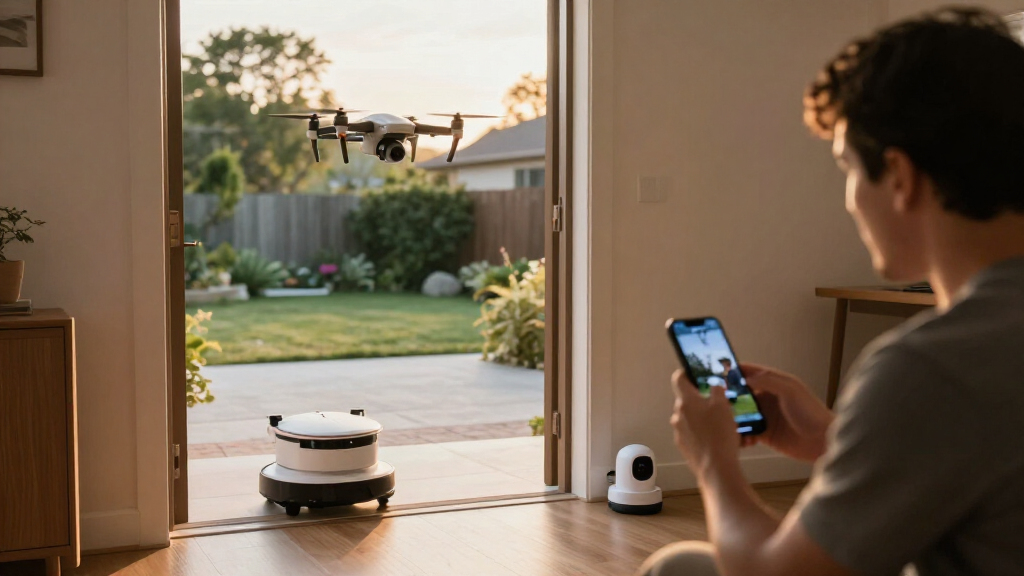
Amazon’s Ring announced Ring Robotics on November 10, introducing two mobile security cameras: a flying device for homes and a wheeled patrol robot for businesses. The products are designed to move toward activity detected by other Ring devices, but the home drone has not received required FCC authorization and cannot be sold until it does.
Ring calls the system that guides both products AI Pilot. According to the company, it maps a space, suggests patrol points and steers around obstacles using cameras, vision models, sensors and cloud processing. A triggered Ring camera, sensor or alarm can prompt a device to investigate. Scheduled patrols require a compatible Ring Protect plan.
The Ring Drone Cam is listed at $249.99, with U.S. shipping planned for January 27, 2027, subject to authorization. Ring says it offers 2K video, a 148-degree field of view, 360-degree rotation and LED lights. The Verge reported that the 165-gram drone has a claimed flight time of five to eight minutes per charge and depends on an internet connection; without Wi-Fi, it can only land.
The Ring Rover Cam, aimed at shops and offices, is listed at $999.99 and scheduled to ship in the U.S. on December 16, 2026. Ring says it patrols scheduled points, scans 360 degrees when it arrives, and records in up to 4K while moving or patrolling. Its features include a mast-mounted camera, siren, light tower and two-way audio. The Verge reported an estimated 5,000-square-foot coverage area, single-floor operation and about 30 minutes of battery life.

Mobile Cameras Follow Alerts
These devices extend Ring’s security system beyond cameras fixed to walls or doorways. A mobile unit could check a location where a separate camera or sensor has detected activity, potentially giving owners or staff a view of more than one area with a single device. Ring’s design also makes connectivity and subscriptions part of the service: the drone relies on an internet connection, and scheduled patrols require a compatible plan.
The products also put recording devices in motion through homes and workplaces. That raises practical questions about who can see the footage, when recording begins, and how cloud features handle video and encryption keys. Ring’s privacy controls address some of those concerns, but the company’s assurances will be judged alongside its past handling of customer footage.
Products Worth Considering

DJI Mini 4K Drone with 4K UHD Camera

Sonos Arc Ultra Soundbar with Dolby Atmos, Black

Bose QuietComfort True Wireless Earbuds with Active Noise Cancellation, Bluetooth 5.3, USB-C Charging, IPX4, Black
As an affiliate, we earn on qualifying purchases.
From Astro to Ring Robotics
Ring’s announcement builds on a concept the company has explored for years. Ring previewed an indoor drone called Always Home Cam in 2020. The Verge reported that founder Jamie Siminoff said development began in 2016. The new announcement presents the drone alongside a separate wheeled robot for business security.
Ring says Rover draws on work from Amazon Astro, a home robot. But the business version has a short history: The Verge reported that Amazon launched Astro for Business in 2023 and discontinued it about a year later. Ring has not said whether Rover shares the same commercial approach or how its service will differ.
Ring announced its Throw Away the Key, or TAKE, encryption in August 2026. The company says its servers temporarily access encryption keys to run cloud features such as smart alerts, then delete them; customers can separately enable end-to-end encryption. The Electronic Frontier Foundation said in September 2026 that TAKE remains short of the privacy protections offered by end-to-end encryption.
“For years, customers told us they wanted eyes in the places a fixed camera couldn’t reach, and peace of mind in the spots they’d never want one.”
— Jamie Siminoff, Ring founder and chief inventor, in Ring’s announcement
Approval and Privacy Questions
The Drone Cam’s FCC authorization status is a direct condition on its sale: Ring’s announcement says it has not been authorized as required by FCC rules. The company’s planned January shipping date may depend on that authorization. The announcement does not specify when a decision is expected.
Some performance details come from launch coverage rather than Ring’s product release, including the drone’s reported flight time and the Rover’s estimated coverage and battery life. Ring has not provided independent test results in the supplied material. The full scope of cloud processing, how long footage is retained, and how access is managed for these mobile devices are also not detailed there.
Ring says the drone’s camera is off while docked and that Rover’s Sleep Mode retracts its periscope and turns off its microphone. It also says recording indicators are visible. Those are company descriptions of the products’ controls; independent assessments of how they work in practice are not yet available.
Launch Dates Depend on Readiness
Ring plans to begin U.S. Rover Cam shipments on December 16, 2026. Drone Cam shipments are listed for January 27, 2027, but the sale cannot proceed before the required FCC authorization. Ring has not announced an authorization date in the supplied material.
Further details to watch include whether either launch date changes, what the compatible Ring Protect plan will cost, and how the devices’ cloud and recording controls work in practice. Buyers and businesses will also be able to assess whether the stated patrol features, battery life and coverage fit their spaces once devices are available.
Key Questions
What are Ring’s two new mobile security devices?
Drone Cam is an indoor flying camera for homes. Rover Cam is a wheeled patrol robot Ring is marketing to businesses.
When will the devices ship in the United States?
Ring lists Rover Cam for December 16, 2026, and Drone Cam for January 27, 2027. The drone’s sale is contingent on required FCC authorization.
How much will Ring Robotics devices cost?
Ring lists the Drone Cam at $249.99 and the Rover Cam at $999.99. Scheduled patrols require a compatible Ring Protect plan; the supplied announcement does not state that plan’s price.
What privacy controls does Ring describe?
Ring says the drone’s camera is off in its dock, Rover has a Sleep Mode that retracts its periscope and turns off its microphone, and recording indicators show when the devices are recording. The company says footage uses its TAKE encryption, while end-to-end encryption remains an optional setting.
Can Ring sell the Drone Cam now?
Ring says the Drone Cam has not received authorization required under FCC rules and may not be sold until it does. The supplied material does not give a date for that authorization.
Source: Thorsten Meyer AI