

📊 Full opportunity report: Using RegTech To Achieve Pesticide-Residue Compliance In Food Importing on IdeaNavigator AI — validation score, market gap, and execution plan.
TL;DR
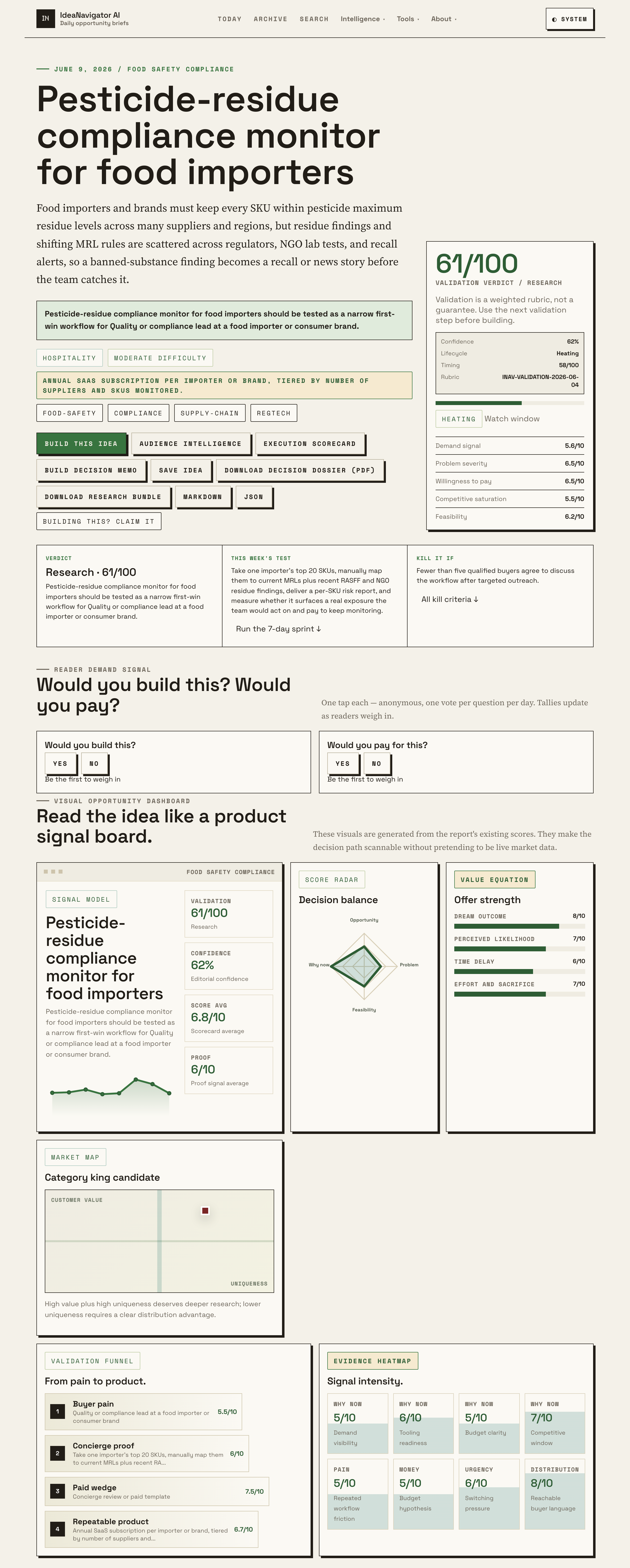
A RegTech startup has introduced a pesticide-residue compliance monitor designed for food importers. It maps suppliers and SKUs to current MRLs and recent residue alerts, aiding compliance efforts. The tool aims to prevent recalls and enhance transparency in food safety.
A new RegTech-based pesticide-residue compliance monitor has been introduced to assist food importers in managing pesticide residue risks across their supply chains. The tool maps a brand’s SKUs to current EU and regional maximum residue levels (MRLs) and recent public residue findings, providing an audit-ready compliance brief. This development responds to increasing regulatory and retailer demands for documented pesticide safety and aims to prevent costly recalls.
The compliance monitor is designed for quality and compliance leads at food importers and consumer brands. It integrates data on regional MRLs, NGO lab tests, and regulatory alerts such as RASFF to identify products at risk of exceeding legal limits. The initial MVP involves manually mapping a sample of top SKUs to current MRLs and recent residue alerts, then generating risk reports that highlight potential violations. The goal is to automate this process and provide ongoing monitoring through a SaaS subscription model, tiered by the number of SKUs and suppliers tracked.
According to an anonymous researcher involved in the project, the tool aims to surface real risk exposures before products reach consumers or trigger recalls. The approach leverages publicly available data sources and aims to streamline compliance workflows, reducing the manual effort typically required to stay current with evolving residue rules and findings.
Implications for Food Safety and Supply Chain Transparency
This development is significant because it addresses a critical gap in food safety compliance management. As NGOs and regulators increasingly detect EU-banned pesticides in staples like rice, tea, and spices, importers face mounting pressure to demonstrate residue compliance. The monitor could help prevent recalls, regulatory penalties, and damage to brand reputation by providing timely, actionable insights. It also offers a scalable solution for brands seeking to meet retailer demands for documented pesticide safety across multiple markets, potentially transforming how compliance is managed in the global food supply chain.
As an affiliate, we earn on qualifying purchases.
Growing Regulatory and Market Pressures on Pesticide Residues
Over recent years, NGO testing and regulatory reports have repeatedly surfaced EU-banned pesticides in common food staples, prompting stricter residue limits and increased scrutiny. Retailers and brands are now under pressure to provide documented evidence of pesticide safety, especially as consumer awareness and demand for transparency grow. Current compliance efforts often rely on manual data collection and fragmented sources, making it difficult to proactively identify and address risks. The launch of this RegTech tool responds to these challenges by offering an integrated, data-driven approach to residue monitoring.
“The goal is to automate the mapping of SKUs to current MRLs and residue alerts, enabling brands to act proactively before violations occur.”
— an anonymous researcher
As an affiliate, we earn on qualifying purchases.
Uncertainties About Implementation and Data Accuracy
It is not yet clear how effectively the tool will scale across diverse supply chains or how accurately it will reflect real-time residue findings. The initial MVP involves manual mapping, and automation will depend on data integrations and updates. Additionally, the extent to which this solution will reduce false positives or missed violations remains to be validated through broader testing and user feedback.
regulatory residue testing software
As an affiliate, we earn on qualifying purchases.
As an affiliate, we earn on qualifying purchases.
Next Steps for Validation and Broader Deployment
The team plans to pilot the monitor with select importers, starting with their top 20 SKUs, to evaluate its ability to identify actual exposure risks. Feedback from these pilots will inform further development, including automation and integration with existing compliance systems. Broader deployment is expected once the tool demonstrates reliable accuracy and user value, with potential expansion to additional regions and residue types.
As an affiliate, we earn on qualifying purchases.
Key Questions
How does the pesticide-residue compliance monitor work?
The monitor maps a brand’s SKUs to current EU and regional maximum residue levels and recent public residue findings, generating risk reports to flag products at potential risk of non-compliance.
Who can benefit from this compliance tool?
Food importers, consumer brands, and compliance teams seeking to proactively manage pesticide residue risks across their supply chains will benefit most from this solution.
Is this tool ready for full deployment?
The current version is in pilot testing. Effectiveness and scalability will be confirmed through ongoing trials with select importers before broader rollout.
What data sources does the tool use?
It integrates publicly available data, including EU and regional MRLs, NGO lab tests, and regulatory alerts like RASFF, to provide comprehensive residue risk assessments.
Will this solution eliminate all pesticide residue risks?
While it aims to significantly reduce risks by providing early warnings, no monitoring system can guarantee complete prevention of residue violations. Continuous updates and manual review remain important.
Source: IdeaNavigator AI