
📊 Full opportunity report: The Real Cost of a Local-Inference Rig in 2026 on ThorstenMeyerAI.com — validation score, market gap, and execution plan.

Get the latest gadgets delivered free with Prime
- Fast, free delivery on millions of items
- Prime Video, Amazon Music and more included
- Member-only deals all year
TL;DR
In 2026, owning a local inference rig for large language models involves significant hardware costs, with VRAM capacity being the key factor. Used GPUs like the RTX 3090 offer better value than newer, more expensive cards, especially for high-memory needs. The choice of hardware depends on model size and budget, impacting AI deployment strategies.
In 2026, the cost of building a local inference rig for large language models varies widely based on hardware choices, with the most critical factor being VRAM capacity. A single high-end GPU like the RTX 5090 can run a 70-billion-parameter model entirely in VRAM, but the overall expenses often favor older, used hardware such as the RTX 3090. This shift impacts how individuals and organizations approach AI deployment, balancing cost and performance.
The core challenge in local inference is the VRAM cliff: models must fit entirely within GPU memory to run efficiently. For example, a 70B model requires approximately 43GB of VRAM at FP16 precision, making high-memory GPUs essential. The inference process is memory-bandwidth-bound, so raw compute power is less relevant than VRAM size. Consequently, the most cost-effective solution often involves used GPUs like the RTX 3090, which offers 24GB of VRAM at a fraction of the cost of newer cards.
Buying older, used hardware provides better VRAM-per-dollar value, especially since multiple 3090s can be combined via NVLink to pool VRAM, enabling the running of larger models at a lower total cost. The RTX 5090 remains the only single consumer card capable of fitting a 70B model entirely in VRAM, but it is significantly more expensive and consumes more power. Hardware choices depend heavily on the model size targeted and budget constraints.
The real cost of a local-inference rig
Owning beats renting for steady AI work — so what does a local rig cost in 2026? The unintuitive, good news: the most expensive build is almost never the smartest one. It all comes down to one rule.
The difference is only whether the weights fit. LLM inference is memory-bandwidth-bound — VRAM capacity is the hard limit you build around. Compute specs are mostly noise.
The squeeze reframes the rig like everything else in this series: discipline beats maximalism. VRAM is exactly the memory under most pressure, so over-buying it is the 128GB-“to-be-safe” trap, only worse per gigabyte. Take the cheap, high-value step to 24GB (the gateway to the 30B class), reach for used 3090s and MoE models, and use quantization to climb a tier without buying silicon. Sized right, the rig pays for itself against the cloud’s ever-rising hidden bill. Next: Apple Silicon’s quiet memory advantage.
Implications for Cost-Effective AI Deployment in 2026
Understanding the real costs of local inference rigs is essential for organizations seeking to reduce reliance on cloud API calls, which are increasingly expensive. The hardware decisions made now will influence AI deployment strategies, with cost-per-GB of VRAM being a key metric. For many, investing in used GPUs provides a practical, budget-friendly way to run large models locally, impacting the AI ecosystem’s accessibility and scalability.
As an affiliate, we earn on qualifying purchases.
Hardware Trends and Model Size Milestones in 2026
As of 2026, the landscape of AI hardware is shaped by the VRAM cliff, which determines whether models can run locally. Smaller models (7–14B) are accessible on modest hardware like the RTX 5070 Ti or used 3090s, while mid-range models (26–32B) require a single 24GB GPU. Larger models (70B and above) necessitate multi-GPU setups or large-unified-memory systems. The trend toward using older, used GPUs like the RTX 3090 for inference is driven by their superior VRAM-per-dollar ratio, despite being generation-old. Additionally, Apple Silicon’s unified memory offers a different pathway for large models, blurring traditional hardware boundaries.
“The VRAM cliff forces buyers to prioritize memory capacity, making older, used GPUs the most cost-effective choice for local inference.”
— Industry Expert
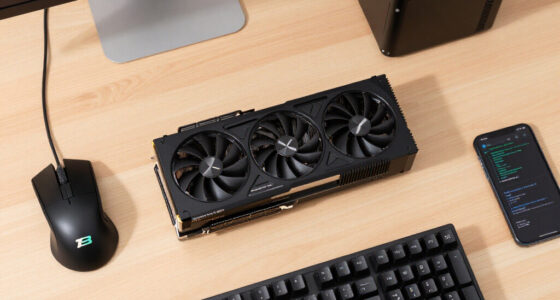
high VRAM graphics card for AI inference
As an affiliate, we earn on qualifying purchases.
As an affiliate, we earn on qualifying purchases.
Unresolved Questions About Hardware Longevity and Performance
It is still unclear how long used GPUs like the RTX 3090 will remain reliable for intensive inference tasks, and how future model developments might alter hardware requirements. The impact of emerging memory technologies and AI-specific accelerators on cost and performance also remains uncertain.
As an affiliate, we earn on qualifying purchases.
Future Hardware Developments and Market Trends in 2026
Expect continued growth in multi-GPU setups and the emergence of specialized inference hardware that could shift cost dynamics. The market for used GPUs is likely to evolve as supply and demand fluctuate, and new memory technologies may further reduce the importance of high-end flagship cards for inference tasks. Monitoring these trends will be critical for anyone planning to build or upgrade local inference rigs.
As an affiliate, we earn on qualifying purchases.
Key Questions
Is building a local inference rig cheaper than cloud services in 2026?
For high-utilization workloads and models fitting within VRAM, building a local rig using used GPUs like the RTX 3090 can be more cost-effective over time than ongoing cloud API costs.
What hardware should I prioritize for running large language models?
Prioritize GPUs with at least 24GB of VRAM, such as used RTX 3090s or newer models like the RTX 5090, depending on your budget and model size requirements.
Will newer GPUs always be the best choice for inference?
Not necessarily. For inference, VRAM capacity and cost-per-GB are more important than raw compute power, making older, used GPUs often the smarter choice financially.
Can Apple Silicon Macs run large models effectively?
Yes, due to their unified memory architecture, Macs with large RAM can run models that would otherwise require multiple GPUs, offering an alternative path for local inference.
Source: ThorstenMeyerAI.com
Halloween Picks
halloween
As an affiliate, we earn on qualifying purchases.