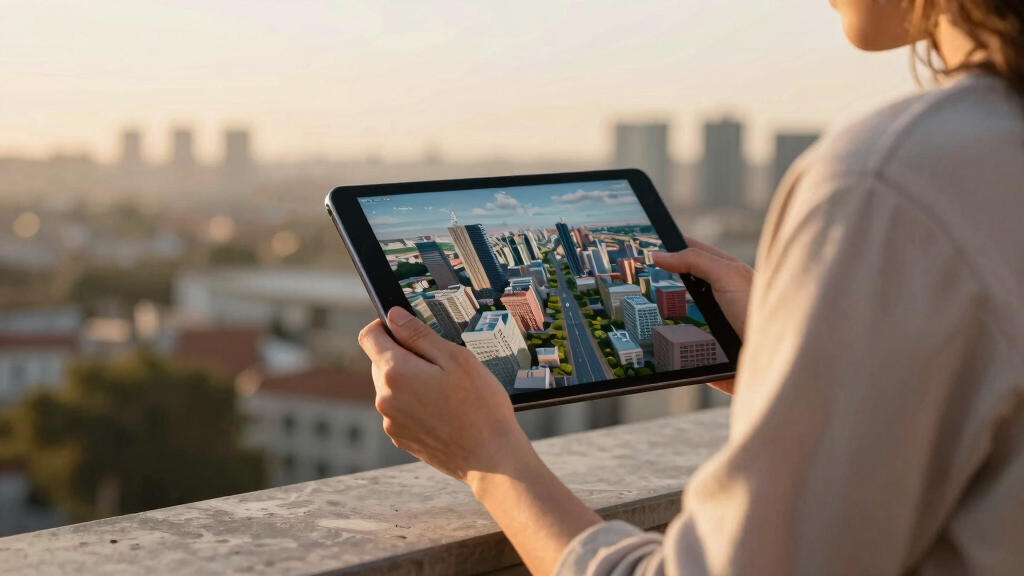

📊 Full opportunity report: The City That Watches Itself: The Living Digital Twin, And The God’s-Eye View We’re Building on ThorstenMeyerAI.com — validation score, market gap, and execution plan.

Get the latest gadgets delivered free with Prime
- Fast, free delivery on millions of items
- Prime Video, Amazon Music and more included
- Member-only deals all year
TL;DR
Urban digital twins are evolving into real-time, self-monitoring systems using sensors, radar, and AI. While they promise improved planning, they also pose significant surveillance risks.
Modern cities are increasingly adopting dynamic digital twins that mirror their real-time operations through live data feeds and advanced AI analysis. These systems, powered by a convergence of sensors, radar, and artificial intelligence, allow cities to monitor, simulate, and manage urban environments with enhanced detail — but also raise considerations related to surveillance and privacy concerns.
The core of this development is the creation of living digital twins: virtual replicas of cities that update second-by-second, integrating data from IoT sensors, satellite imagery, GIS, and utility networks. Notable examples include Singapore’s Virtual Singapore, Helsinki, and Las Vegas, which use these models for urban planning, traffic management, and infrastructure optimization.
Recent technological advancements, such as Wide-Area Motion Imagery (WAMI) and all-weather radar, enable continuous, detailed tracking of vehicles and pedestrians, creating comprehensive datasets of city activity. When combined with advanced AI models capable of understanding complex data, these systems can answer natural language queries, simulate scenarios, and provide predictive insights — supporting various aspects of city management.
While these innovations offer potential benefits like shorter planning cycles, cost efficiencies, and improved environmental monitoring, they also introduce considerations related to mass surveillance and data sovereignty, especially when models are hosted outside national control, which could impact infrastructure security and data privacy.
The city that watches itself: the living digital twin, and the god’s-eye view we’re building
Soon most cities will exist twice — once in concrete, once as a live data model you can rewind, simulate, and question in plain language. Persistent sensing + frontier AI turn the planner’s digital twin into an oracle. The most useful thing we’ve built — and the most powerful surveillance instrument. Both at once.
- Plan better — cities & rural: traffic, zoning, energy, land use
- Emergency response — route crews, one live picture, ~50% faster
- Disaster resilience — simulate, track live, assess damage in hours
- Mass surveillance — track everyone, retroactively, forever
- Pattern-of-life — AI links movements, infers associations
- Social control — no warrant, no suspicion (cf. Baltimore, 2021 ruling)
We’re building a city that watches itself, remembers everything, and can be asked anything. The technology won’t choose between saving lives and ending privacy — we will, through the rules we write now, while the twin is still under construction and the defaults haven’t yet hardened into permanence. WAMI and the living twin open our lives to a view from the heavens that, from the dawn of civilization until a heartbeat ago, was reserved for gods and stars. The question is no longer whether we can see everything — it’s who gets to look, and who watches the watchers.
Implications of Self-Monitoring Urban Systems
The development of self-watching city systems represents a significant shift in urban management, offering opportunities for more data-informed planning and operational responsiveness. However, it also raises questions regarding privacy and security, as these systems can track individual movements and behaviors at scale. Balancing technological benefits with privacy protections will be important as these systems expand.
IoT sensors for smart city monitoring
As an affiliate, we earn on qualifying purchases.
As an affiliate, we earn on qualifying purchases.
Technological Foundations of Digital Twin Evolution
The concept of a digital twin has traditionally been a static planning tool, but recent advances in sensor technology, satellite imaging, and AI have enabled the development of live, dynamic replicas. Countries like Singapore have pioneered this approach with Virtual Singapore, integrating underground infrastructure data and expanding into rural areas for applications such as agriculture and environmental monitoring. The integration of WAMI sensors and advanced AI models has been instrumental in creating continuous, detailed, and interpretable data streams.
This technological convergence has been driven by improvements in data processing capacity and AI capabilities, resulting in a comprehensive, real-time urban observatory that can be queried in natural language, simulate scenarios, and support proactive governance.
“The city’s digital twin is becoming a shared operational brain, shifting governance from reactive to anticipatory.”
— Thorsten Meyer, AI researcher
AI-powered city digital twin software
As an affiliate, we earn on qualifying purchases.
As an affiliate, we earn on qualifying purchases.
Unresolved Risks and Privacy Challenges
Although technological capabilities are advancing, questions remain regarding how widespread adoption will affect privacy rights and data sovereignty. The potential for misuse or external control of these systems raises security and ethical considerations. Additionally, the level of public awareness and consent regarding pervasive monitoring remains uncertain.
wide-area motion imagery (WAMI) systems
As an affiliate, we earn on qualifying purchases.
As an affiliate, we earn on qualifying purchases.
Future Developments and Policy Considerations
As cities expand their digital twin capabilities, focus is expected to increase on establishing regulatory frameworks that balance public safety with privacy. Advances in AI interpretability and cybersecurity will be important, along with international discussions on data sovereignty. Deployment in rural areas and critical infrastructure is likely to grow, with ongoing assessments of ethical and security implications.
As an affiliate, we earn on qualifying purchases.
Key Questions
What is a city digital twin?
A digital twin is a virtual, real-time replica of a city that integrates data from sensors, satellite imagery, and other sources to monitor and simulate urban environments.
How do sensors and AI make these systems more powerful?
Sensors like WAMI and radar provide continuous, detailed tracking of movement, while AI models interpret complex data, enabling natural language queries and scenario simulations, enhancing the system’s analytical capabilities.
What are the main risks associated with digital twins?
The primary concerns involve privacy violations, mass surveillance, and security vulnerabilities, especially if systems are hosted outside national control or are susceptible to hacking or censorship.
Will these systems replace human city planners?
They are designed to support planning and operational decision-making, providing data-driven insights and simulations, but human oversight remains essential for ethical and contextual considerations.
How soon will most cities have such digital twins?
Implementation varies; some cities like Singapore, Helsinki, and Las Vegas are already using operational digital twins. Broader adoption will depend on technological, political, and privacy factors, likely over the next decade.
Source: ThorstenMeyerAI.com
Halloween Picks
halloween
As an affiliate, we earn on qualifying purchases.