
TL;DR
Mistral focuses on sovereignty, open weights, and full-stack control rather than chasing the largest models. Its strategy appeals to European enterprises and regulated industries seeking independence, but questions remain about its technical edge and market share.
When you think about AI giants like OpenAI or Google, you picture vast, sprawling models that gobble up data and compute. But what if the real game isn’t size, but control? Mistral’s recent shift from just building models to offering a full-stack, self-hosted AI platform is a bold move.
This isn’t just about tech. It’s about sovereignty—Europe’s push for independence from US giants, especially in regulated industries like finance and defense. In this article, you’ll see what makes Mistral different, whether its strategy is a clever play or already a sign of falling behind, and what it means for the future of enterprise AI.
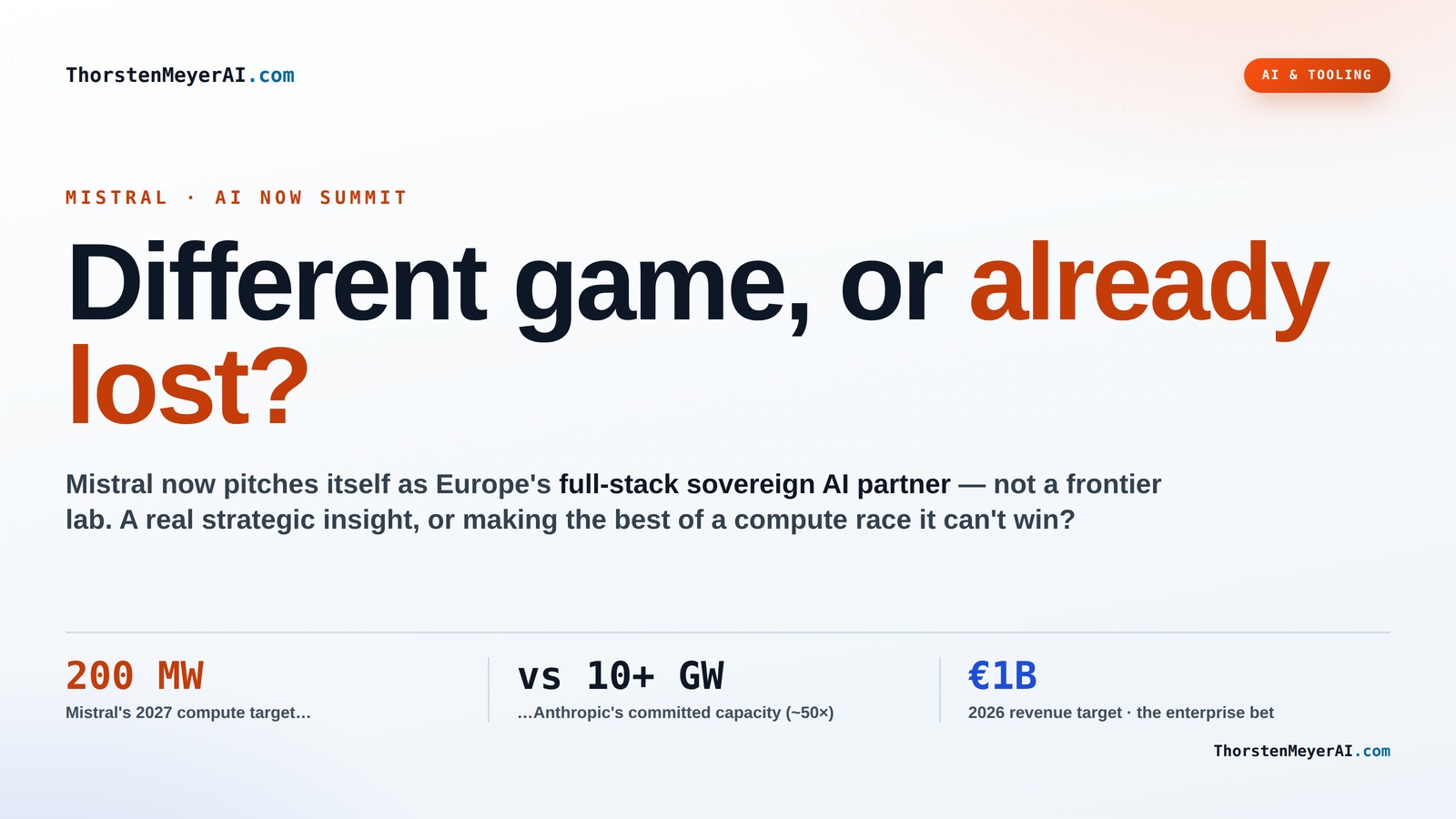
Different game, or already lost?
Mistral now pitches itself as Europe’s full-stack AI provider — compute, models, platform, consultancy — not a frontier-model lab. Is that a real strategic insight, or making the best of a race it can’t win? Both readings fit the same facts.
From model lab to full-stack provider
The clearest signal from the summit wasn’t a model — it was a posture. Heavy on enterprise logos and partnerships (ASML, BNP Paribas, Alexa+), light on new-model announcements. That absence is exactly what skeptics seized on.
Compute
40MW Paris DC + Sweden build · 200MW target by 2027
Models
Open & custom · efficient · you own and run them
Platform
Forge for custom models · Vibe for Work agent
Consultancy
Sales teams, integrators, EU provenance & support

Enterprise AI Governance: Data Sovereignty Compliance and Audit Frameworks for Self-Hosted Intelligence Platforms Using Local Models in 2026 (Autonomous Intelligence Systems Series)
As an affiliate, we earn on qualifying purchases.
As an affiliate, we earn on qualifying purchases.
Small & focused, or large & general?
Mistral bets on specialized small models. The claim isn’t that they win a reasoning leaderboard — they don’t. It’s that on the metrics that matter in production agent systems, a purpose-built small model wins. Flip the metric to see the case reverse.
Small specialized vs large general — by what you measure
In token-heavy agentic apps making hundreds of calls, speed/energy/cost compound. Toggle the metric.

GenAI on Google Cloud: Enterprise Generative AI Systems and Agents
As an affiliate, we earn on qualifying purchases.
As an affiliate, we earn on qualifying purchases.
Narrow models doing real work
Each is one model doing one thing efficiently — the tangible version of the strategy. Strong on their own terms; the open question is whether the bundle beats a free Chinese open-weight download.
On-prem KYC compliance
Mistral models run inside the bank’s walls for know-your-customer checks. Sensitive financial data never leaves. (BNP was Mistral’s first customer, 2023.)
Voxtral multilingual voice
A focused voice model powering Alexa+ across Europe — speed and efficiency over raw size.
Robostral industrial robotics
Plus a “physics AI” push (via the Emmi acquisition) into aerospace, automotive & semiconductor design and simulation.
Document AI / OCR at scale
Large-scale text extraction — the unglamorous, high-volume enterprise work small models excel at.

The AI Data Center Race: No-Constraints Thinking for the Age of Compute
As an affiliate, we earn on qualifying purchases.
As an affiliate, we earn on qualifying purchases.
The strategy is downstream of the compute gap
Once you see the raw numbers, “why is Mistral behind?” answers itself — and the specialized-small-model strategy starts looking partly like a smart adaptation to a binding constraint, not a pure philosophical choice.
Compute & capital · Mistral vs a frontier leader, this same week
Not a knock — it’s the constraint that forces the efficiency-first, sovereignty-wedge strategy. Adapting intelligently to your position is what good strategy is.
Agentic AI Full-Stack Development: A Practical Guide to Building Autonomous AI Agents, LLM-Powered Applications, Tool-Using Systems, and End-to-End Intelligent Products Across the Modern Tech
As an affiliate, we earn on qualifying purchases.
As an affiliate, we earn on qualifying purchases.
“I want them to win, but I’m worried”
That ambivalence is the most accurate read of where Mistral sits. The enterprise pivot gets read two opposite ways — and both deserve airing.
On-prem, real sales teams, the Koyeb deployment acquisition, EU provenance — exactly what regulated enterprises want, and stickier than consumer mindshare. Targeting €1B revenue in 2026 with 1,000 staff, up from 15 people and one customer in 2023. US closed-API labs structurally can’t match the sovereignty axis.
“Software consultancy with a data center,” not a foundation-model moat. Enterprise B2B is where European startups go when they can’t win consumer or world-scale SaaS. Why pay Mistral on-prem when you could run Qwen free? One paying Le Chat Pro user said the quality gap with frontier labs is now hard to ignore.
Key Takeaways
- Mistral’s focus on sovereignty and full-stack control attracts enterprises in regulated industries seeking data independence.
- Open weights and self-hosting are core features—appealing for European customers who want customization, security, and compliance.
- Small, purpose-built models deliver speed and efficiency, often outperforming larger models in real-world, cost-sensitive applications.
- Despite concerns over reasoning performance, Mistral’s strategy targets a different market—those prioritizing control over size.
- The future depends on whether regional trust and sovereignty can sustain Mistral’s growth amid evolving AI benchmarks.
What Does Sovereign AI Really Mean? It’s More Than Just a Buzzword
Sovereign AI is about control—control over data, models, and infrastructure. It means hosting models locally, keeping sensitive info inside regional borders, and avoiding reliance on US or Chinese cloud giants.
Imagine a European bank running Mistral’s models on-prem, ensuring customer data stays within EU laws. That’s sovereignty in action. It’s not just political; it’s a practical shield against regulatory headaches and geopolitical risks.
For example, BNP Paribas uses Mistral models on-site for compliance, processing sensitive financial data without sending it off to a US cloud. That’s sovereignty translating into business advantage.

How Mistral’s Open-Weight Strategy Sets It Apart
Mistral’s open weights are a core pillar. Unlike OpenAI’s closed API, Mistral offers models like 7B and Mixtral 8x8B that customers can download, fine-tune, and run themselves.
This approach appeals to enterprises that want full control—especially in Europe—who prefer hosting their models internally for security and compliance. It’s a clear shift from the 'black box' model of US providers.
For instance, a European defense contractor can customize Mistral’s models for sensitive projects, knowing they own the weights and can upgrade or audit them anytime.

The Enterprise Wedge: Why On-Prem AI Matters for Europe
Mistral’s biggest strength is its focus on on-prem, private deployment. Companies like BNP Paribas and Abanca run Mistral models locally, complying with strict regulations and data residency rules. Learn more about innovative tech solutions for secure deployments.
Why pay for Mistral instead of free open weights? Because Mistral offers support, regional trust, and a platform for customization—features US labs can’t easily replicate.
Yet, skeptics ask: if a company can run models like Qwen for free, why pay Mistral? The answer lies in trust, support, and the European angle—supporting regional sovereignty and compliance.

Small Models, Big Impact: Why Focus on Efficiency and Speed?
Mistral champions small, purpose-built models over giant general-purpose ones. These tiny models—like Voxtral or Robostral—are designed for specific tasks, running faster and cheaper.
For example, Voxtral powers Amazon’s Alexa+ in Europe, handling multilingual voice commands with minimal latency. Such models might only be 8B parameters, but they excel in their narrow niche.
In production, speed and cost matter. Hundreds of calls per workflow make smaller, efficient models a win—especially when energy and hardware costs are rising.

Are Smaller Models Really Better? The Truth About Performance
The debate over small vs. big models is heated. Mistral admits its models don’t top reasoning benchmarks like GPT-4. But in real-world applications, small models often outperform giant, expensive ones on speed and cost. Read more about the different game in AI development.
Take the European Patent Office: it uses Mistral’s small models for large-scale text extraction. The models process millions of documents quickly, with a fraction of the energy and hardware needed for a giant model.
So, in practice, the game isn’t just about raw reasoning power but about delivering reliable, fast results at scale.

Is Mistral Falling Behind or Playing a Different Game?
Recent reports suggest Mistral’s reasoning and medium-context performance are lagging behind some US and Chinese rivals. But that might be missing the point. Mistral isn’t chasing the largest models; it’s building a sustainable, controllable ecosystem.
Its focus on sovereignty, compliance, and efficiency caters to a different set of customers—those who value control over size. The question remains: can this niche grow fast enough to sustain Mistral’s ambitions?
It’s a strategic gamble—playing a different game, not just losing one.

What’s Next for Mistral? The Real Test of Sovereignty
In the next 12–24 months, Mistral faces a tough choice. Will it lead Europe’s sovereign AI push, or get squeezed as competitors improve their open weights and reasoning skills?
Its success hinges on whether regional trust and control can outweigh raw model performance. If European enterprises and governments prioritize independence, Mistral’s model of sovereignty could thrive.
Otherwise, it risks being a regional alternative, no different from other small players in a race dominated by larger labs.
Frequently Asked Questions
What exactly does 'sovereign AI' mean in practice?
Sovereign AI means hosting models locally, keeping data within regional borders, and avoiding reliance on US or Chinese cloud giants. It’s about control, security, and independence—especially in regulated sectors.
Why would an enterprise choose open weights over a closed API?
Open weights give organizations full control—self-host, fine-tune, audit, and upgrade models at will. This is vital for companies with strict compliance needs or those wanting to reduce dependency on external providers.
Is Mistral really falling behind in reasoning performance?
Some benchmarks suggest Mistral’s models are weaker in complex reasoning compared to US and Chinese labs. But for many enterprise applications, speed, cost, and control matter more than top-notch reasoning benchmarks.
Can Mistral’s sovereignty strategy succeed in the long run?
It depends. If regional trust, compliance, and control continue to matter for European enterprises and governments, Mistral’s approach could dominate that niche. Otherwise, it risks being overshadowed by larger, more powerful models.
Conclusion
Playing a different game isn’t just a gamble for Mistral—it’s a necessity. If sovereignty, control, and regional trust matter more than chasing the biggest models, Mistral could carve out a lasting niche.
But if the race for reasoning prowess accelerates beyond its reach, it might remain a regional player rather than a global competitor. For now, the real question is: does control outweigh raw power? That’s the game Mistral is betting on.